Nonprofit Thank You Pages: Donor Acknowledgement That Builds Retention
Four out of five first-time donors never give again. The thank-you page is the first moment in that relationship — and most organisations treat it as a transaction confirmation rather than a retention tool.

Summary
The thank-you page is the most visited page on a nonprofit website that receives the least strategic attention. Every donor who completes a gift sees it. It is the first communication the organisation sends after a donor has made a commitment. And in the sector research on donor retention, the thank-you experience is consistently identified as one of the factors that determines whether a first-time donor becomes a committed supporter or a one-time transaction.
Most nonprofit thank-you pages are built as confirmation screens: the payment has been processed, here is the reference number, here is what happens next in terms of the receipt. This is technically adequate and relationally inadequate. The donor has just made an emotional and financial commitment to the organisation. The first thing they see after making it should confirm that commitment was worthwhile, not confirm that a payment was accepted.
This post covers the governance and content dimensions of a nonprofit thank-you page that serves donor retention rather than just transaction confirmation: what content should appear immediately after a gift is made, how to personalise the experience for different gift levels and donor types without requiring CRM integration that many nonprofits do not have, how to make the thank-you page accessible across devices and connection speeds, how to connect it to the email acknowledgement sequence that continues the relationship beyond the website interaction, and how to measure whether the thank-you page is performing its retention function through the metric that actually matters: whether donors who see it give again.
Thank You Pages and Donor Acknowledgement: The First Touchpoint of the Relationship
The donation was not the end of the transaction. It was the beginning of the relationship.
The default state for a nonprofit thank-you page is a generic confirmation: “Thank you for your donation. A receipt has been sent to your email.” This is the last thing a first-time donor sees before they close the tab. In most cases, it is also the last time the organisation speaks to them in a way that matters.
First-time donor retention is the most consequential unsolved problem in nonprofit fundraising. The Fundraising Effectiveness Project's Q4 2024 data shows that overall donor retention dropped to 42.9 per cent, with first-time donor retention falling to just 19.4 per cent. That means four out of five first-time donors never give again. The sector has been aware of this figure for years and has produced no systematic improvement in response to it.
The thank-you page is not the solution to donor retention. But it is the first touchpoint of the donor relationship, and treating it as a transaction confirmation rather than a relationship moment is a structural choice with measurable consequences.
What the thank-you page currently does
Most nonprofit thank-you pages do one or more of the following: confirm the donation amount, provide a receipt reference, thank the donor generically, and include a link back to the homepage. Some include a social sharing prompt. A small number redirect to a separate confirmation page with more content.
None of these things are wrong. They are just insufficient. The donor has just taken a significant action. They have given money, often to an organisation they may have discovered recently, based on a combination of institutional credibility, emotional resonance, and trust. The response to that action shapes their perception of the organisation and their likelihood of giving again.
The thank-you page is also frequently neglected because it requires no ongoing content management. It is set up once, at the time the donation platform is integrated, and then left. No one reviews it as programmes change, as leadership changes, or as the organisation's priorities shift. It becomes the most static page on the site, which is particularly ironic given that it is the page shown to the people who have just demonstrated the highest level of engagement.
What a thank-you page should do
The purpose of the thank-you page is not to confirm a transaction. It is to deepen the donor's sense that giving to this organisation was the right decision, and to create a natural next step that extends the relationship beyond the single gift.
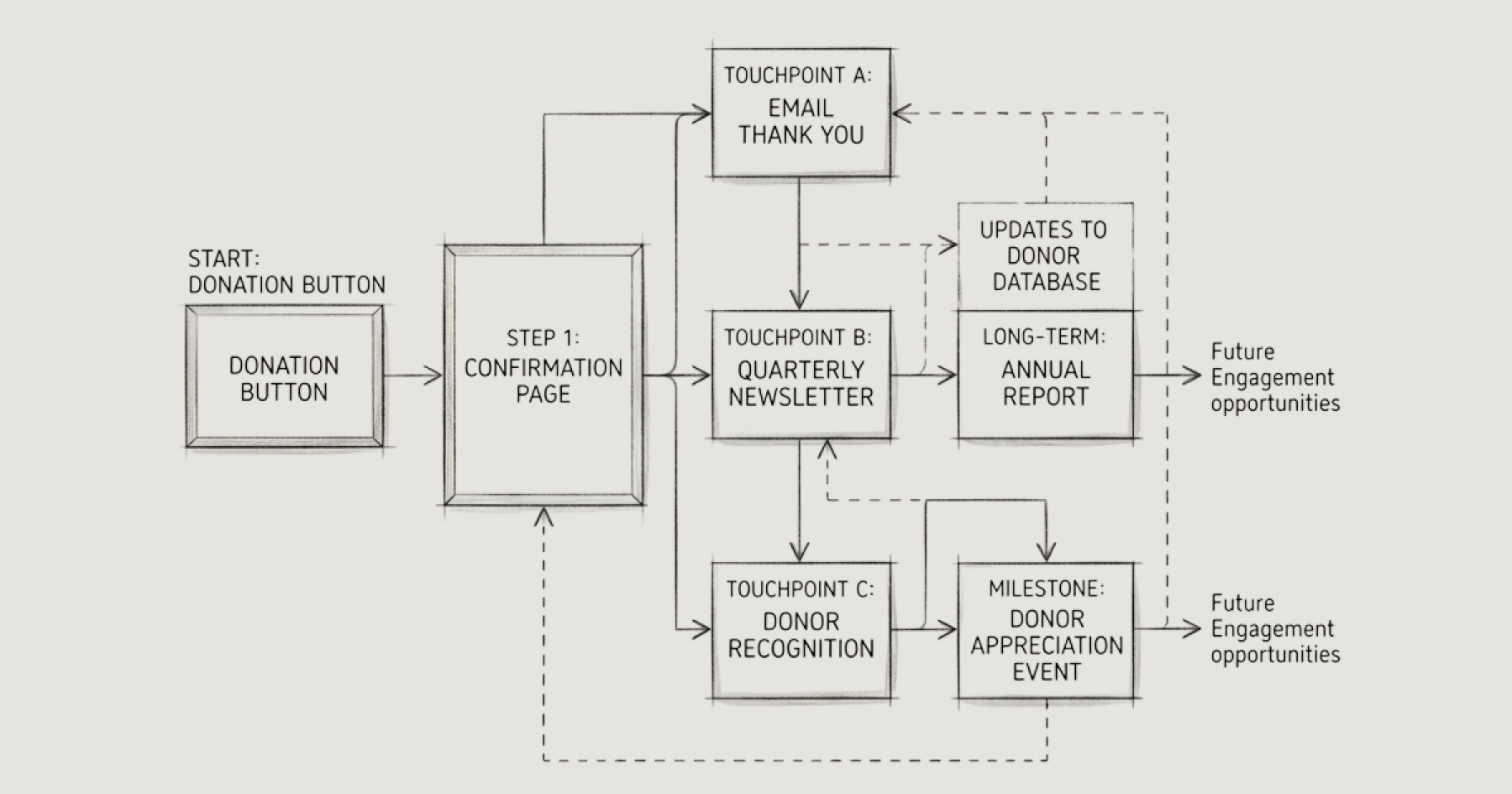
That requires four things: a genuine, specific acknowledgement of the gift; a reinforcement of impact; a low-friction invitation to deepen the relationship; and a clear next action.
Genuine, specific acknowledgement
Generic gratitude signals automation. Specific acknowledgement signals that the organisation sees the donor as an individual rather than a transaction. This does not require personalisation at the technical level, though that is valuable where it is available. It requires specificity at the programme or impact level: “Your gift goes directly to [specific programme] this month” is more meaningful than “Your support makes our work possible.”
If the donation was made to a specific campaign or in response to a specific appeal, the thank-you page should reflect that campaign. A page that congratulates the donor on their gift to the emergency response appeal and then describes general organisational work is a missed connection.
Reinforcement of impact
The donor gave because they believe the organisation can make a difference. The thank-you page should immediately reinforce that belief with a specific impact statement: not aspirational language about what the organisation hopes to achieve, but a concrete statement of what previous gifts have made possible. One or two sentences is sufficient. A short video message from the Executive Director or a programme lead, if possible, performs significantly better than static text at this stage.
An invitation to deepen the relationship
The research on donor retention is clear: the cost of retaining a donor is a fraction of the cost of acquiring a new one. The Fundraising Effectiveness Project data shows donors who gave consistently for five years contributed 1,519 per cent more than one-time donors, and those five-year repeat donors made up nearly half of total revenue. The economics of donor retention are unambiguous.
The thank-you page is the natural moment to make the first move toward a second gift. This should not be another donation ask: a second solicitation immediately after a gift is one of the fastest ways to create a negative donor experience. The invitation should be to deepen engagement without financial commitment: follow the organisation on social media, sign up for the newsletter, read an impact report, watch a short film about the programme. These actions build familiarity and emotional connection, which are the precursors to a second gift.
For organisations with a monthly giving programme, the thank-you page is also an appropriate place to introduce it, briefly and without pressure. The framing should not be “make your gift go further by upgrading to monthly” but rather “some supporters choose to give monthly because it helps us plan our work year-round.” The difference is between a sales pitch and an informed invitation.
A clear next action
The thank-you page should have one primary call to action, not five. The common mistake is to offer everything: share this, follow us, read this, sign up for this, here is another thing we do. A page that offers everything asks for nothing. The decision about what the next action should be requires the organisation to think clearly about what it most needs from a first-time donor at this stage of the relationship, and to design the thank-you page around that answer.
Gift Aid and the thank-you moment
For UK-registered charities, the thank-you page is an important moment in the Gift Aid conversion pathway. If the donor did not complete a Gift Aid declaration during the donation flow (which is common when the donation is made quickly or via a mobile device), the thank-you page is the next opportunity to prompt it.
Gift Aid declarations require explicit, informed consent: the donor must confirm they are a UK taxpayer and understand the tax implications. This cannot be a buried checkbox. It should be a short, clear prompt with a direct link to the declaration form, or an inline form if the donation platform supports it. The potential revenue uplift of 25 pence per pound donated is significant enough to warrant treating the Gift Aid prompt as a key element of the thank-you page design, not an afterthought.
The email confirmation: not a substitute for the page
The receipt email is not the same as the thank-you page. The email is typically automated by the donation platform and arrives minutes after the gift. It serves a transactional function: it provides the receipt, the reference number, and the confirmation for tax purposes. It is rarely personalised beyond the donor's name and gift amount.
The thank-you page is different. It is the immediate response to the gift, shown at the moment of highest emotional engagement. The email arrives later, when the donor has moved on to something else. These two communications serve different purposes and should be designed accordingly.
That said, the confirmation email does offer a secondary opportunity to reinforce impact and extend the relationship. A confirmation email that includes a single impact statement and a link to the impact report performs better than one that includes only the receipt details. Most donation platforms allow some degree of customisation of the confirmation email; this customisation is worth investing in.
How this connects to the website architecture
For organisations whose donation process redirects to an external platform and returns to the main website on completion, the thank-you page is part of the main site architecture and can be fully designed and managed. For organisations whose donation process is embedded on the site and handled within the page, the thank-you state may be controlled by the donation platform's embed and offer less design flexibility.
Understanding which situation applies to your organisation is the first step in assessing what is and is not possible with the current setup. The nonprofit website funder credibility post addresses the broader donor journey and institutional credibility questions. The form design post covers the conversion architecture of the donation flow itself. And the embedding donation forms in Webflow resource provides the technical setup guidance.
FAQ
Question 1: Should the thank-you page ask for another donation?
No. Soliciting a second gift immediately after the first is one of the most common mistakes in post-donation experience design, and one of the most damaging to long-term retention. The thank-you page should acknowledge the gift, reinforce the donor's decision, and invite them to deepen the relationship in a non-financial way. A monthly giving prompt can be included if framed as an option rather than an ask, but the primary purpose of the page is relationship-building, not conversion.
Question 2: How often should the thank-you page be reviewed?
At minimum, the thank-you page should be reviewed when the donation campaign changes, when a new programme is launched, and as part of the annual content review cycle. It should also be reviewed whenever the donation platform setup is modified, to ensure that the redirect still works correctly and that the page content still reflects the current state of the organisation's work. A thank-you page that references a programme that has ended, or a campaign that concluded six months ago, signals to the donor that their gift has not been noticed.
Question 3: What impact does the thank-you page have on second gift timing?
The thank-you page itself does not determine second gift timing, but it sets the conditions for it. A donor who leaves the thank-you page feeling seen, informed, and connected to the mission is more receptive to subsequent communications than one who received a generic confirmation. The practical implication is that the thank-you page should introduce the mechanism through which the organisation plans to maintain contact: the newsletter, the impact report, the social media channel. The second gift follows from sustained engagement, and the thank-you page is where that engagement begins.
The Blueprint Audit includes an assessment of the full donor journey, including the post-donation experience, as part of the stakeholder journey analysis. If your current thank-you page has never been reviewed or redesigned, that is worth knowing before any other fundraising infrastructure work begins. Learn more about the Blueprint Audit.
Is this familiar?
Most nonprofit websites don't fail at launch. They fail quietly, over time.
The governance gaps, the stakeholder confusion, the Board that's stopped referring people to the site — these don't announce themselves. See what the difference looks like when it's built correctly from the start.
Eric Phung has 7 years of Webflow development experience, having built 100+ websites across industries including SaaS, e-commerce, professional services, and nonprofits. He specialises in nonprofit website migrations using the Lumos accessibility framework (v2.2.0+) with a focus on editorial independence and WCAG AA compliance. Current clients include WHO Foundation, Do Good Daniels Family Foundation, and Territorio de Zaguates. Based in Manchester, UK, Eric focuses exclusively on helping established nonprofits migrate from WordPress and Wix to maintainable Webflow infrastructure.
Ready to understand your current situation clearly?
The Blueprint Audit is where we start.
A two-to-three week diagnostic that maps your stakeholder needs, audits your current site, and gives you a clear strategic brief before any implementation commitment is made. £2,500. No obligations beyond the audit itself.
In case you missed it
Explore more
FAQ Pages for Nonprofits: What to Include and What to Remove
Thank You Pages and Donor Acknowledgement: The First Touchpoint of the Relationship
How to Conduct User Testing on a Nonprofit Website
Join our newsletter
Subscribe to my newsletter to receive latest news & updates