Why Your Nonprofit Website Fails Under Funder Scrutiny — and the Credibility Gaps That Cost Funding
What institutional funders actually look for when they review your nonprofit website during due diligence — and the governance gaps, credibility failures, and missing content that cost organisations funding.
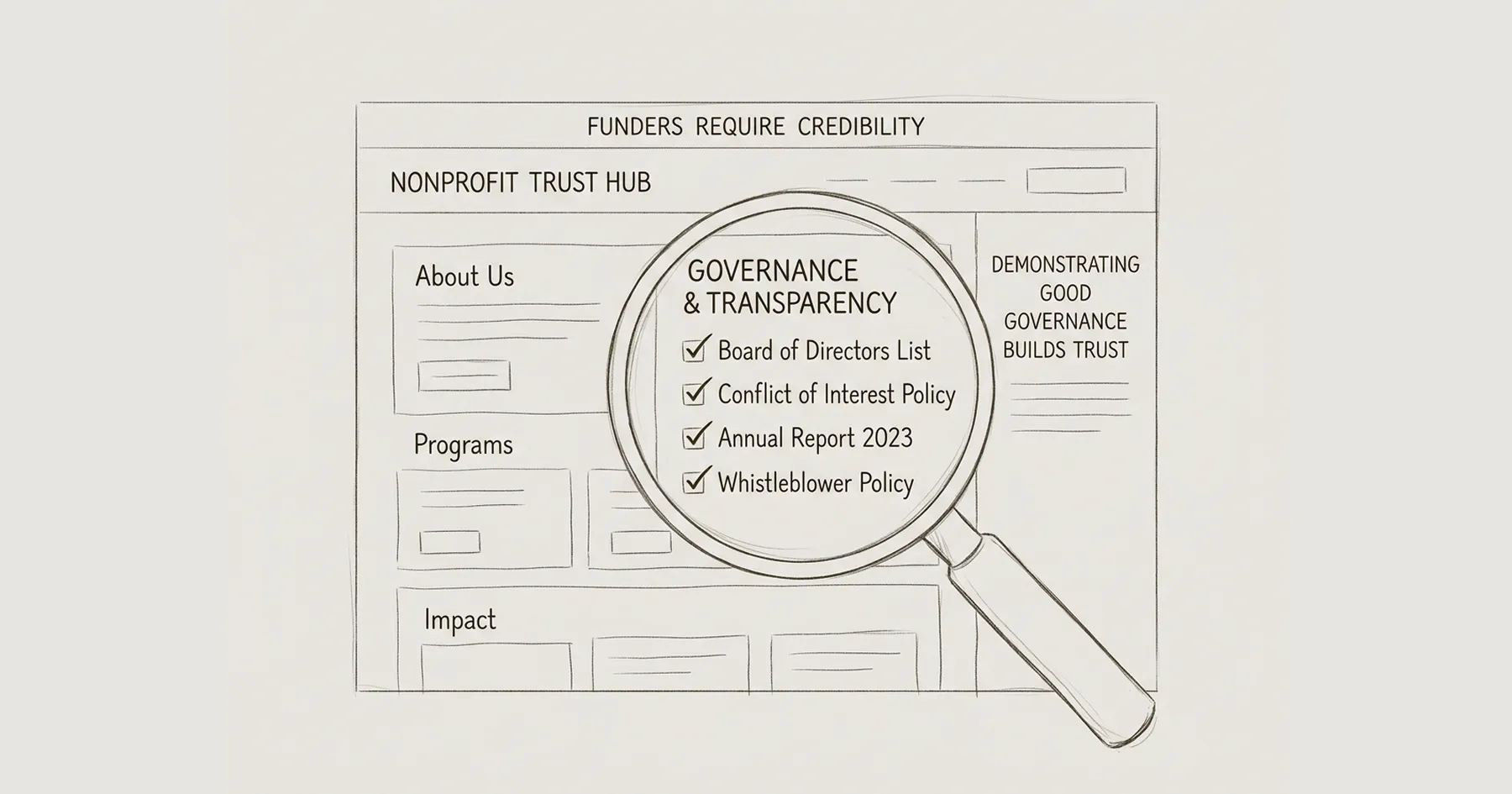

Summary
Institutional funders conduct due diligence on organisations they are considering supporting. The due diligence process has evolved significantly as the tools available to programme officers have improved: in addition to reviewing application materials, they search for the organisation online, review the website in detail, and use AI tools to research the organisation's work, leadership, and governance history. An application that is strong on paper can be undermined by a website that does not hold up to the scrutiny that accompanies it.
The specific elements of a nonprofit website that institutional funders examine during due diligence are well-documented in funder feedback and programme officer guidance. They include: current and accessible governance documents, impact evidence that is dated and sourced, named leadership whose credentials can be verified, a clear description of the programme for which funding is sought that is consistent with the application, and an overall quality standard that is consistent with the organisational scale and ambition the application projects.
This post covers each of these elements in detail: what institutional funders specifically look for, how to assess whether the current website presents each element convincingly, what the most common failures are, and how to address each failure efficiently. It also covers the newer dimension of funder due diligence that most nonprofits have not yet adapted to: the AI-powered research that programme officers use before any human contact begins, and what the website needs to contain for that research to produce a favourable impression of governance quality and institutional credibility.
Nonprofit Website Funder Scrutiny
Institutional funders review your website before they review your proposal. This is not a theory — it is standard due diligence practice for trusts, foundations, and government funders. The website is the first place a programme officer goes to validate whether an organisation is what it claims to be.
And most nonprofit websites fail this test quietly. Not because they look bad, but because they are missing the specific content and credibility signals that funders are trained to look for.
What Funders Actually Look For
The due diligence review of a nonprofit website is not a design assessment. Funders are not evaluating whether the site is attractive or modern. They are evaluating whether the organisation is credible, transparent, and accountable. Specifically, they are looking for evidence across five areas.
Governance and leadership visibility. Funders want to see who runs the organisation. Named trustees or board members. Named senior leadership. Not just a team page with first names and cheerful photographs, but institutional information — roles, responsibilities, and a clear governance structure. The absence of trustee information on a charity website is a red flag that experienced funders notice immediately.
Financial transparency. The most recent annual report and accounts should be findable within two clicks from the homepage. Not buried in a downloads section or hidden behind an outdated page structure. Funders check whether the accounts are current, whether they have been independently examined or audited, and whether the financial position matches the scale of the organisation’s claims. If the most recent annual report on your website is from 2022, that signals either negligence or something the organisation does not want to make visible.
Impact evidence. Funders distinguish between activity reporting and impact evidence. Stating that you delivered 500 workshops is activity. Stating that 73% of participants reported improved outcomes against a specific measure, with methodology cited, is impact. The website does not need to contain full evaluation reports, but it should present impact data that is specific, dated, sourced, and proportionate to the claims being made.
Programme accuracy. Are the programmes described on the website the same programmes the organisation is currently delivering? Funders who are considering a grant for a specific programme will check whether the website reflects that programme accurately. Outdated programme descriptions, discontinued initiatives still listed, or vague language that does not match the specificity of a funding application all undermine credibility.
Regulatory compliance signals. Charity registration number. Registered address. Privacy policy. Accessibility statement. Safeguarding policy (where applicable). These are not optional governance decorations — they are the minimum compliance signals that institutional funders expect to verify. The Charity Commission requires specific information to be publicly available. If your website does not display it, funders will either find it on the Charity Commission register (raising the question of why it is not on your own site) or flag it as a governance concern.
The Credibility Gap You Cannot See
The most damaging aspect of website credibility failures is that you never hear about them. A funder who visits your site, cannot find what they need, and decides not to shortlist your application does not send you a rejection letter explaining that your website was the problem. They simply move on to an organisation whose digital presence matches their expectations.
This means the cost of a website that fails under funder scrutiny is invisible. You do not know which funding relationships never started because the website undermined your credibility before the conversation began.
I have seen this pattern repeatedly in Blueprint Audits. An organisation with strong programmes, committed leadership, and genuine impact — whose website tells a different story. Outdated content. Missing governance documents. Accessibility failures that signal a lack of institutional seriousness. A donation flow that does not work properly on mobile. These are not design problems. They are governance failures that have a direct financial cost.
The Specific Failures That Cost Funding
Based on what I have found consistently across audits of established nonprofit websites, these are the failures that matter most to institutional funders.
Annual report not current or not findable. This is the single most common failure. The annual report exists but is buried in a PDF archive page, or the most recent version is two years old. Funders check this first because it tells them whether the organisation takes transparency seriously.
No named trustees or board members. For UK-registered charities, trustee information is publicly available on the Charity Commission register. But funders expect to find it on your website as well. The absence of named governance leadership signals either that the organisation does not understand disclosure expectations or that there is a reason the information is not being made prominent.
Impact claims without evidence. Broad statements like ‘we transform lives’ or ‘we reach thousands of people’ without specific data, methodology, or timeframes. Funders are trained to distinguish between organisations that can demonstrate impact and organisations that describe their activities in aspirational language. The website should contain specific, verifiable impact data — even if it is modest in scale.
Programme descriptions that do not match the funding application. If your website describes a programme differently from how you present it in a grant application, funders will notice. This creates a credibility problem that no amount of proposal quality can overcome. Programme content on the website should be accurate, current, and consistent with how the organisation represents itself in other channels.
Accessibility failures. Increasingly, institutional funders include accessibility as part of their due diligence criteria. An inaccessible website signals that the organisation does not take inclusion seriously — which is particularly damaging for organisations whose mission involves serving disabled people or promoting equality. With the European Accessibility Act now enforceable and UK regulatory expectations tightening, accessibility is no longer a best practice aspiration. It is a compliance obligation that funders are beginning to evaluate.
No safeguarding policy visible. For organisations working with children, vulnerable adults, or in contexts where safeguarding applies, the absence of a visible safeguarding policy or statement is a significant red flag. Funders in these sectors will specifically look for it.
What to Do About It
The response is not a redesign. It is a systematic review of what your website currently communicates to institutional funders, followed by targeted action to close the gaps.
Start by testing your own site against the five areas above. Can a programme officer find your annual report within two clicks? Are your trustees named? Is your impact data specific and dated? Are your programme descriptions current? Are your compliance documents visible?
If the answer to any of these is no, you have identified a credibility gap that is potentially costing you funding. The good news is that most of these gaps are content problems, not architectural ones — they can be addressed without rebuilding the site.
The Blueprint Audit includes a specific credibility signals assessment as part of the technical audit. It maps what institutional funders expect to find against what your site actually contains, and produces a prioritised list of gaps with specific recommendations. The audit costs £2,500 and stands alone.
For the stakeholder framework that determines which audiences your site should prioritise, see Nonprofit Website Stakeholder Mapping. For the governance context behind website credibility, see Why Your NGO Website Is a Governance Problem. For UK-specific disclosure obligations, see Charity Commission Website Requirements.
Frequently Asked Questions
Q1: What do institutional funders look for on a nonprofit website?
Institutional funders evaluate five areas during due diligence: governance and leadership visibility (named trustees and board members), financial transparency (current annual report and accounts), impact evidence (specific, dated, sourced data), programme accuracy (descriptions matching current delivery), and regulatory compliance signals (charity registration, privacy policy, accessibility statement).
Q2: Can a bad website cost a nonprofit funding?
Yes. Funders who find credibility gaps during website due diligence typically do not explain their decision. They simply do not shortlist the application. The cost is invisible because you never know which funding relationships failed to start because the website undermined credibility before the conversation began.
Q3: What is the most common website failure that affects nonprofit funding?
The most common failure is the annual report not being current or not being findable within two clicks from the homepage. Funders check this first because it signals whether the organisation takes financial transparency seriously.
Q4: Do funders check website accessibility during due diligence?
Increasingly, yes. Major trusts and foundations are including accessibility in their evaluation criteria, particularly for organisations working in disability, health, and social services. With the European Accessibility Act now enforceable and UK Equality Act obligations, accessibility is becoming a compliance expectation rather than a best practice aspiration.
Q5: Should nonprofit trustees be named on the website?
Yes. For UK-registered charities, trustee information is publicly available on the Charity Commission register. Institutional funders expect to find it on your website as well. The absence of named governance leadership is a red flag that signals either governance gaps or deliberate opacity.
Q6: What is the difference between impact evidence and activity reporting on a nonprofit website?
Activity reporting states what the organisation did, such as delivering 500 workshops. Impact evidence states what changed as a result, such as 73% of participants reporting improved outcomes against a specific measure with methodology cited. Funders look for impact evidence because it demonstrates accountability and effectiveness.
Q7: How can a nonprofit improve website credibility for funders without a full redesign?
Most credibility gaps are content problems, not architectural ones. Updating the annual report, adding named trustee profiles, publishing specific impact data, correcting programme descriptions, and ensuring compliance documents are visible can all be done on an existing site without rebuilding.
Q8: What compliance documents should be visible on a UK charity website?
At minimum: charity registration number, registered address, privacy policy, accessibility statement, and current annual report and accounts. For organisations working with children or vulnerable adults, a safeguarding policy or statement should also be visible. These are Charity Commission expectations, not optional extras.
Q9: How do I assess whether my nonprofit website passes funder due diligence?
Test your site against five criteria: can a programme officer find your annual report within two clicks? Are trustees named? Is impact data specific and dated? Are programme descriptions current and accurate? Are compliance documents (registration, privacy policy, accessibility statement) visible? If any answer is no, you have a credibility gap.
Q10: What is a website credibility audit for nonprofits?
A structured assessment that maps what institutional funders expect to find on your website against what your site actually contains. It identifies governance gaps, missing compliance documentation, outdated content, and accessibility failures, then produces a prioritised action plan. The Blueprint Audit includes this assessment as part of a broader technical and stakeholder review.
Is this familiar?
Most nonprofit websites don't fail at launch. They fail quietly, over time.
The governance gaps, the stakeholder confusion, the Board that's stopped referring people to the site — these don't announce themselves. See what the difference looks like when it's built correctly from the start.
Eric Phung has 7 years of Webflow development experience, having built 100+ websites across industries including SaaS, e-commerce, professional services, and nonprofits. He specialises in nonprofit website migrations using the Lumos accessibility framework (v2.2.0+) with a focus on editorial independence and WCAG AA compliance. Current clients include WHO Foundation, Do Good Daniels Family Foundation, and Territorio de Zaguates. Based in Manchester, UK, Eric focuses exclusively on helping established nonprofits migrate from WordPress and Wix to maintainable Webflow infrastructure.
Ready to understand your current situation clearly?
The Blueprint Audit is where we start.
A two-to-three week diagnostic that maps your stakeholder needs, audits your current site, and gives you a clear strategic brief before any implementation commitment is made. £2,500. No obligations beyond the audit itself.
In case you missed it
Explore more
FAQ Pages for Nonprofits: What to Include and What to Remove
Thank You Pages and Donor Acknowledgement: The First Touchpoint of the Relationship

How to Conduct User Testing on a Nonprofit Website
Join our newsletter
Subscribe to my newsletter to receive latest news & updates