







-
0:00
They land on the homepage.
What most sites give them
A hero about the mission, and no sense of scale.
The first question is not what you do. It is how big you are and whether you are the kind of organisation they fund. A £4m charity with a template website is a credibility gap before a design one.
- 10Brand consistency
- 08Credibility signals
-
0:20
They look for who runs it.
What most sites give them
A team page that stops at the founder, or lists someone who left.
Named trustees, a registered address, a registration number. If it is not on the site they assume there is a reason, and the reason they assume is never the real one.
- 08Credibility signals
- 04Content accuracy
-
0:45
They look for the accounts.
What most sites give them
Two years old, three clicks deep, or a PDF that no longer opens.
Funders check the accounts before they check the impact. Absence reads as concealment whatever the cause, and the annual report is the second thing they open.
- 05Governance documents
- 03Navigation and architecture
-
1:20
They check whether anything is recent.
What most sites give them
The last news post is from 2023.
Currency is the cheapest signal of a functioning organisation and the most commonly missed. A journalist checks the same thing, for a different reason.
- 04Content accuracy
-
1:50
They try to give, on their phone.
What most sites give them
A donate button that opens a form nobody has tested since the platform updated.
A donation flow that fails on mobile, or cannot be completed with a keyboard or a screen reader, is money not given and an Equality Act exposure in the same moment.
- 06Integrations
- 09Mobile experience
- 02Accessibility
-
2:30
They look for the policies.
What most sites give them
Safeguarding and complaints exist somewhere. Privacy is a template. Cookie consent blocks nothing.
A funder’s due-diligence checklist is mostly documents. The site either answers or deflects, and the checklist does not have a box for “probably in someone’s inbox”.
- 05Governance documents
- 07Technical infrastructure
-
3:00
They search your name.
What most sites give them
A stale Google snippet, no structured data, and an AI answer assembled from someone else’s description of you.
What search engines and answer engines can cite about you is now part of how you are read. If the site does not say it in a form machines can quote, something else will.
- 07Technical infrastructure
- 03Navigation and architecture
-
3:40
They go back to the homepage.
What most sites give them
The same hero. It loads slowly the second time too.
They are no longer reading. They are deciding whether what they found matches what you claim. Performance and consistency are the last impression, and the last impression is the one that gets written down.
- 01Performance
- 10Brand consistency
4:00
They have decided. You were not in the room.
The Blueprint Audit runs the same four minutes by hand, in the same order, against WCAG 2.2 AA and the disclosures your regulator expects, and hands you their report four weeks before they write it.
Ten areas scored red, amber or green, each with the consequence named and a priority attached. A roadmap your board can approve. And a fee that is payable whatever the conclusion, so the recommendation is not underwritten by what I would prefer to build.
- Fee · £2,500 fixed
- Duration · Four weeks
- Obligation · None
- Report · Yours
What you receive
Three documents, written to be put in front of trustees.
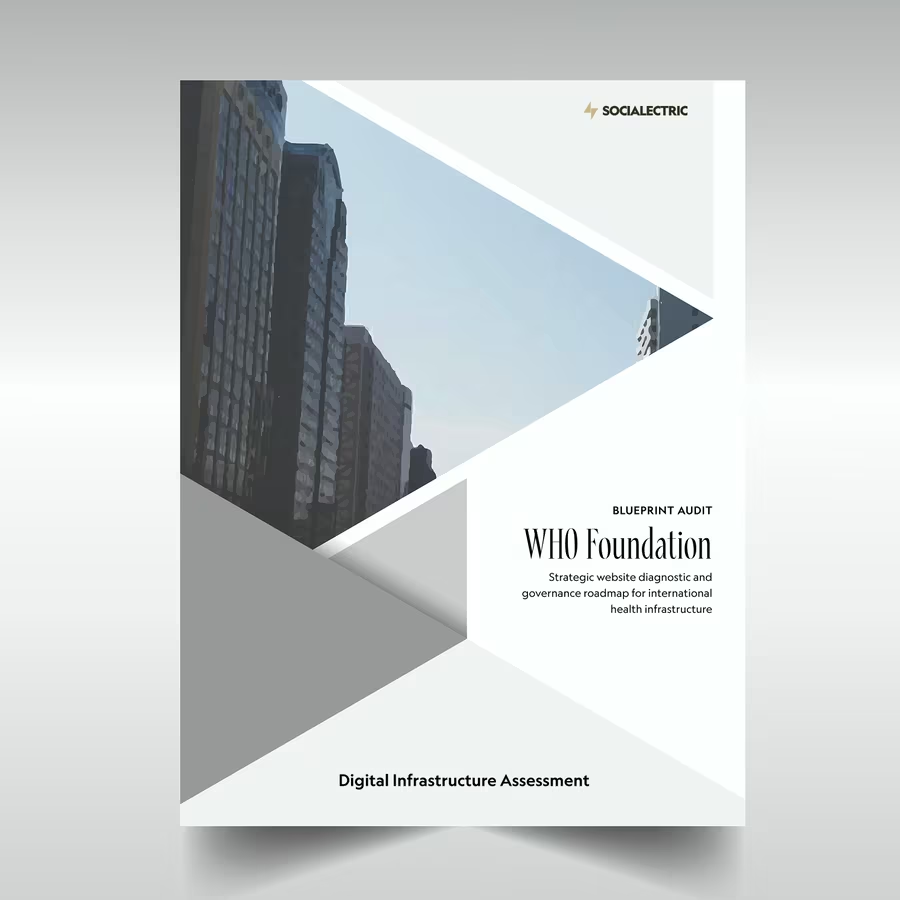
Scorecard · specimen
Roadmap · sequenced
Plus the recorded stakeholder call, a 90-minute findings presentation to your leadership, and all supporting documentation. Yours entirely: implement it internally, brief another provider with it, or continue with me.
The ten areas
Every finding states what it means for your organisation. A score on its own is not one.
“Accessibility score is 54 out of 100” is not a finding. “A screen reader user cannot complete your donation flow” is a finding your board can act on. Each area below is scored red, amber or green and given a priority: immediate, three months, or maintain.
Scored
Red · immediate
Amber · three months
Green · maintain
Open an area to see what is tested.
-
Lighthouse across representative templates; Core Web Vitals against LCP under 2.5s, CLS under 0.1, INP under 200ms.
-
Manual WCAG 2.2 AA across every unique template and key journey: keyboard, NVDA and VoiceOver, contrast, focus, reflow at 200% and 400%.
-
Whether the structure follows stakeholder need or the org chart, and whether three priority audiences reach what they need in two or three clicks.
-
Currency of programme, team and impact content, and anything that would concern an institutional funder or a journalist.
-
Annual report, accounts, safeguarding, complaints and privacy: present, current, and findable.
-
A live test donation, form submissions, email sign-up, and whether cookie consent blocks scripts before consent.
-
HTTPS, robots.txt, sitemap, JSON-LD schema, analytics configuration and goal tracking.
-
Registration number, registered address, named trustees, linked accounts, sourced impact data.
-
Layout integrity, navigation, tap targets, and whether the donation flow completes on a phone.
-
Whether the site is consistent with the scale and ambition the organisation claims.
Plus your jurisdiction
The compliance module depends on how you are constituted. Pick yours.
UK charity · 7 checks
- Charity Commission number displayed sitewide
- Registered address and named trustees
- Accounts linked, Fundraising Regulator registration
- Gift Aid information on donation pages
- ICO registration
- Safeguarding and complaints procedures accessible
- Modern slavery statement where turnover exceeds £36M
International NGO · 6 checks
- Registration in country of incorporation
- Governance structure and audited accounts
- Safeguarding, anti-fraud and corruption policy
- IATI reporting where applicable
- Multilingual coverage
- Accountability frameworks such as CHS Alliance or Sphere
US 501(c)(3) · 6 checks
- EIN and status statement
- Form 990 or Candid profile
- Board listing
- Non-discrimination statement
- Donor privacy
- State solicitation registration
How it runs
Four weeks. About four hours of your time.
Week 1 · your part
About two hours, spread across the week.
A 20-minute questionnaire so we do not spend the call on basics, then one recorded 90-minute call with the people who know the site best: who owns decisions, what your team can and cannot do today, and what success looks like for each audience.
Week 2 · your part
Nothing. I work; you carry on.
Thirteen pages fetched and analysed: homepage, about, trustees, contact, donate, programmes, impact, governance, privacy, accessibility statement, news, robots.txt and sitemap. Then manual testing across every unique template and every key journey. A page that does not exist is itself a finding.
Week 3 · your part
Nothing yet. Read it when it lands.
Ten areas scored with the consequence named; platform and architecture options with the trade-offs stated; who owns which pages; a sequenced roadmap with phasing options; and an investment breakdown showing what a build would cost and what drives that cost.
Week 4 · your part
90 minutes, when your leadership can attend.
The findings, presented to the people who will approve the next step, with questions. The fourth week exists so that session lands when your leadership can actually be in the room, rather than in whichever slot is left.
Your four hours, itemised
- 90 minStakeholder call, you and up to three colleagues
- 20 minIntake questionnaire
- AccessRead-only CMS, or a walkthrough
- AccessAnalytics and Search Console, if available
- £5A test donation, reimbursed
- 90 minFindings presentation to your leadership
If stakeholder access is limited, that does not prevent the audit. It clarifies where assumptions sit, and the report says so.
Why the audit is paid
You pay for the diagnosis so that the answer can be “no”.
A free discovery is usually offered by the agency that hopes to build your site, so the answer is usually a rebuild. Here the fee is the same whatever the report finds. If your site needs targeted fixes rather than a rebuild, it says so, and I have said so. The roadmap is yours to take to anyone.
Is it for you?
Six statements. Tick the ones that are true of your organisation.
0 / 6
Tick what applies.
If none of them are true and your organisation's income is under £1 million, a small charity website at a fixed price is probably the better answer, and I would rather say that than sell you this.
One constraint
One constraint is worth naming before the audit rather than after it. WCAG 2.2 AA conformance cannot be assured on a platform whose templates you cannot edit, and Squarespace and Wix are the common examples, because the fixes the audit identifies may sit in markup you have no access to. The audit still tells you where you stand. It cannot promise the platform will let you act on all of it.
Then, two routes
You set the budget. The audit tells you what it buys.
The audit stands alone, and most organisations continue anyway: the diagnostic creates context that is expensive to recreate with someone new. There is no obligation, the roadmap works without me, and the fee is not credited against either route.
After the audit, you tell me your budget. Implementation starts at £7,500. I will show you two or three ways to spend it, what each one fixes, and what each one leaves exposed.
My rate is the same whatever you spend. A larger budget buys more depth, not a bigger margin. If a smaller scope is the right answer, that is what I will recommend.
One question decides it
Does the spend have to be committed as a single figure?
Until you answer · both routes, side by side
Two routes out of the audit
Both begin with the audit, and the audit will make clear which fits. The comparison below shows both until you answer the question.
- Cost
- Monthly, rolling Fixed before work begins
- Commitment
- 30 days’ notice Fixed timeline and price
- Best when
- The site must keep changing after launch The cost must be committed as a single figure
- Typically chosen by
- Continuous programme and campaign activity A restricted grant, a tender or a capital budget
- A new build
- First phase of the Partnership, no separate fee The whole engagement
- After launch
- Continues Ends, or converts to a Partnership
If you are not sure, you do not need to decide before we talk.
Continuity
If I am not available
I work alone. You speak to the person doing the work. It is also a legitimate question in procurement, and your board is right to ask it.
Available on request
What your procurement process will need
- Professional indemnity, public liability and cyber liability certificates
- Named reference contacts from previous engagements
- Data processing agreement and full sub-processor list
- Accessibility conformance statement for the site and my own practice
- Standard contract and payment terms, for your legal team
- Supplier and security questionnaires, returned within five working days
- ICO registration reference and UK tax reference
- Evidence of the audit methodology, if your panel scores the approach
Need a written quote for your procurement file? Ask on the call and I’ll send one.
Questions
From NGO decision-makers, answered directly.

One person, the whole way through. Not answered here? Ask me directly.
£2,500, fixed. No obligation to proceed to anything else. The fee is payable whatever the audit concludes, including a conclusion against a rebuild. That is what makes the recommendation independent.
Four weeks from the stakeholder call to the findings presentation. About four hours of your organisation’s time in total.
Everything. Report, stakeholder map, accessibility findings, roadmap, recording and supporting documentation, yours to take to any provider.
Then it says so. If targeted remediation gets you what you need for a fraction of the cost, that is the recommendation. I have recommended against full rebuilds when the diagnostic did not support one.
Every account is registered to your organisation from day one, the build uses open, documented platforms, documentation is a contractual deliverable, and billing is against completed milestones. You would lose a contact, not an asset.
Yes. The written scope and fixed quote are designed to be submitted directly. Insurance certificates, references, a data processing agreement, a sub-processor list and completed supplier questionnaires are all available, with questionnaires returned within five working days.