How AI Search Is Changing How Funders Find Nonprofits — and What Your Organisation Can Do About It
How institutional funders use AI-powered search tools like ChatGPT and Perplexity to research nonprofits during due diligence, why traditional SEO is no longer sufficient, and what NGOs need to do to be visible in AI-generated answers.

Summary
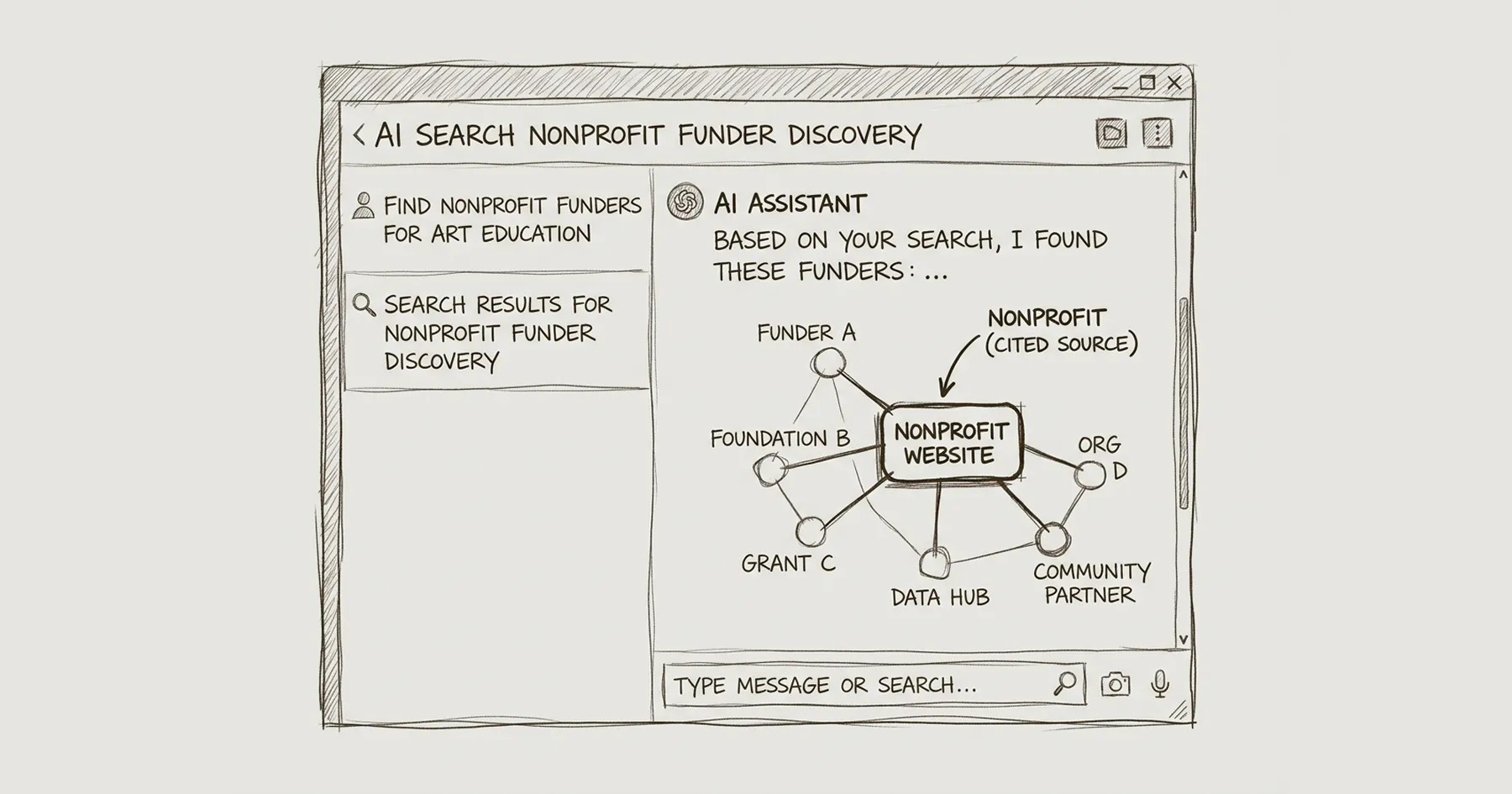
Institutional funders are changing how they research potential grantees. Before any conversation, before any application, before any relationship begins, grant officers and programme managers are using AI tools — ChatGPT, Perplexity, Google AI Overviews — to form an initial picture of an organisation. If that picture is incomplete, inaccurate, or absent, the funder's impression is shaped by whatever the AI can find, which may be nothing at all.
This post covers how institutional funders are actually using AI-powered search in due diligence, what they are looking for when they do, and why traditional SEO alone is no longer sufficient for nonprofits that depend on institutional funding. It draws on how AI systems assess credibility — structured content, cited evidence, current governance information, external authority signals — and maps these requirements to the specific things funders need to find during due diligence.
For nonprofits whose primary funding comes from institutional sources, AI search visibility is not a marketing question. It is a funding infrastructure question. The organisations that appear in AI-generated answers when funders search their cause area have a structural advantage that compounds with every application cycle.
AI Search and Nonprofit Funder Discovery
When a programme officer at a foundation types ‘organisations working on food insecurity in East Africa’ into ChatGPT or Perplexity, does your organisation appear in the answer? If not, you have an AI visibility problem that traditional SEO will not solve.
This is not a hypothetical scenario. Funders, journalists, and policy researchers are increasingly using AI-powered search tools for initial discovery and due diligence. The way organisations are found is shifting from ‘who ranks on page one of Google’ to ‘who gets cited in the AI-generated answer.’
For nonprofits that depend on institutional funding, this shift has direct financial implications. If your organisation is invisible to AI search, you are invisible to an increasing share of the people who decide where funding goes.
How Funders Use AI Search
Institutional funders do not use AI search the way consumers do. They are not asking for product recommendations. They are conducting structured research: identifying organisations working in a specific thematic area or geography, comparing approaches, assessing institutional credibility, and building shortlists for funding rounds.
The queries look like: ‘nonprofits working on youth employment in Sub-Saharan Africa’, ‘organisations providing legal aid to refugees in the UK’, ‘NGOs with strong governance frameworks in the climate space.’ AI tools synthesise information from multiple sources to produce a response that names specific organisations, summarises their work, and often links to their websites.
If your organisation is not in that synthesised answer, you are not on the shortlist. And unlike Google search results where you could rank on page two and still be found by a persistent researcher, AI answers present a curated set of organisations. There is no page two.
Why Traditional SEO Is Not Enough
Traditional SEO optimises for search engine rankings — getting your website to appear higher in Google’s list of blue links. This remains valuable, but it addresses a shrinking share of how people find information.
AI search systems work differently. They do not rank pages. They synthesise information from across the web and generate a new response. The sources they draw from are not necessarily the highest-ranking Google results. Research shows only 12% overlap between AI citations and Google’s top 10 results. AI systems prioritise content that is authoritative, well-structured, entity-rich, and directly answerable.
This means a nonprofit website can rank well on Google but be completely absent from AI-generated answers. And conversely, an organisation with strong, structured content about its work, impact, and governance may be cited by AI systems even without top Google rankings.
What Makes Content Visible to AI Systems
AI search tools pull from content they can parse, verify, and cite. The characteristics that make nonprofit content AI-visible are:
Entity clarity. AI systems need to understand what your organisation is, what it does, where it operates, and who it serves. This requires clear, specific language on your website — not mission statement abstractions but concrete descriptions: ‘We provide legal representation to asylum seekers in the UK, supporting approximately 400 cases per year across London, Birmingham, and Manchester.’
Structured information. Schema markup (Organisation, WebSite, Article schema types) helps AI systems parse your content accurately. If your site has JSON-LD schema implemented, AI tools can extract structured data about your organisation more reliably. See Schema Markup for Nonprofit Websites.
Authoritative content with specificity. AI systems weight content that includes specific data, cited sources, named methodologies, and evidence of expertise. Generic content — ‘we are passionate about making a difference’ — is not citable. Specific content — ‘our 2024 evaluation showed 73% of programme participants achieved sustained employment within 12 months’ — is.
Third-party citations. AI systems consider whether other authoritative sources reference your organisation. Being mentioned in Charity Commission records, academic research, media coverage, funder reports, and sector directories all contribute to AI visibility. This is the equivalent of backlinks in traditional SEO, but for AI systems it is about entity authority rather than link equity.
Freshness and maintenance. AI systems prefer current content. A website with a 2024 annual report, current programme descriptions, and recent governance documentation signals an active organisation. A website with 2021 content signals an organisation that may no longer be operational or relevant.
Practical Steps for Nonprofits
Audit your AI visibility. Search for your organisation’s thematic area in ChatGPT, Perplexity, and Google’s AI Overview. Do you appear? Are you described accurately? If not, you have a baseline to work from.
Strengthen entity descriptions on your website. Ensure your About page, programme pages, and governance section contain specific, parseable information about what you do, where you operate, who you serve, and what outcomes you achieve. Avoid abstract mission language in favour of concrete, factual descriptions.
Implement schema markup. Organisation schema, WebSite schema, and Article/BlogPosting schema on your content pages help AI systems parse your information accurately. This is a one-time technical implementation with ongoing benefit.
Publish original research and data. Impact reports, evaluation findings, sector analysis, and programme data are the content types most likely to be cited by AI systems. If your organisation generates original data, publish it prominently on your website in a structured, accessible format.
Build third-party references. Directory listings, media mentions, academic citations, and sector partnerships all contribute to AI visibility. The directory listings identified in your content plan — Catalyst Dovetail, Consultants for Good, NCVO Service Directory — are relevant here not just for traditional SEO but for building entity authority that AI systems recognise.
Maintain content currency. Keep your annual report current, programme descriptions accurate, and governance documents visible. AI systems deprioritise stale content. Regular maintenance is an AI visibility strategy, not just a governance obligation.
The Governance Dimension
AI search visibility is not a marketing initiative. It is a governance concern. If institutional funders cannot find your organisation through the channels they are increasingly using for discovery and due diligence, the website is failing in its institutional purpose — regardless of how well it ranks on Google.
This should be part of the Board’s awareness of how the website serves the organisation. The question is not ‘are we on page one of Google’ but ‘when someone asks an AI tool about organisations working in our space, do we appear in the answer?’
The Blueprint Audit includes an assessment of digital visibility across both traditional and AI search as part of the technical audit. For the broader AEO strategy, see Answer Engine Optimisation for Nonprofits. For the governance framework, see Why Your NGO Website Is a Governance Problem.
Frequently Asked Questions
Q1: Do funders use ChatGPT and AI tools to research nonprofits?
Increasingly, yes. Programme officers and grant-makers use AI-powered search tools for initial discovery, thematic research, and due diligence shortlisting. AI tools synthesise information to name specific organisations, making visibility in AI answers directly relevant to funding.
Q2: How do I check if my nonprofit appears in AI search results?
Search for your thematic area in ChatGPT, Perplexity, and Google AI Overview. Use queries a funder would use: organisations working on [your issue] in [your geography]. Note whether you appear, whether the description is accurate, and which competitors are mentioned instead.
Q3: What is the difference between SEO and AI search optimisation?
SEO optimises for ranking positions in traditional search results. AI search optimisation (AEO/GEO) optimises for being cited in AI-generated answers. Only 12% of AI citations overlap with Google top 10 results, meaning strong Google rankings do not guarantee AI visibility.
Q4: Does schema markup help with AI search visibility?
Yes. Organisation, WebSite, and Article schema types help AI systems parse and accurately represent your information. Schema markup is a one-time technical implementation that improves how AI tools understand and cite your content.
Q5: What type of content gets cited by AI search tools?
Content that is specific, authoritative, well-structured, and entity-rich. Impact data with methodology, programme descriptions with concrete outcomes, governance documentation, and original research are more likely to be cited than generic mission statements or aspirational language.
Q6: How does AI search affect nonprofit fundraising?
If funders use AI tools for initial discovery and your organisation does not appear in the answers, you are excluded from shortlists before any application is submitted. AI invisibility has a direct financial cost that is invisible because you never know which funding conversations did not start.
Q7: Can a small nonprofit compete in AI search?
Yes. AI systems prioritise content quality over domain authority. A smaller organisation with specific, well-structured content about its niche area can be cited ahead of larger organisations with generic content. Specificity and entity clarity matter more than size.
Q8: How often should we check our AI search visibility?
Quarterly is a reasonable cadence. AI systems update their knowledge regularly, so visibility can change. Include an AI visibility check in your quarterly website governance review alongside accessibility scanning and content currency checks.
Q9: What are the most important pages for AI search visibility?
About page (entity description), programme pages (specific descriptions of what you do and outcomes achieved), impact/annual report page (evidence and data), and governance section (institutional credibility signals). These are the pages AI systems draw from when constructing answers about your organisation.
Q10: Is AI search optimisation a marketing or governance concern?
Governance. If institutional funders cannot find your organisation through the channels they increasingly use for discovery and due diligence, the website is failing its institutional purpose. AI visibility should be part of the Board’s understanding of how the website serves the organisation.
Is this familiar?
Most nonprofit websites don't fail at launch. They fail quietly, over time.
The governance gaps, the stakeholder confusion, the Board that's stopped referring people to the site — these don't announce themselves. See what the difference looks like when it's built correctly from the start.
Eric Phung has 7 years of Webflow development experience, having built 100+ websites across industries including SaaS, e-commerce, professional services, and nonprofits. He specialises in nonprofit website migrations using the Lumos accessibility framework (v2.2.0+) with a focus on editorial independence and WCAG AA compliance. Current clients include WHO Foundation, Do Good Daniels Family Foundation, and Territorio de Zaguates. Based in Manchester, UK, Eric focuses exclusively on helping established nonprofits migrate from WordPress and Wix to maintainable Webflow infrastructure.
Ready to understand your current situation clearly?
The Blueprint Audit is where we start.
A two-to-three week diagnostic that maps your stakeholder needs, audits your current site, and gives you a clear strategic brief before any implementation commitment is made. £2,500. No obligations beyond the audit itself.
In case you missed it
Explore more

AI Website Building for Nonprofits: What the Hype Doesn't Tell You

Webflow vs WordPress for Charities: A Governance-First Comparison

Best Website Platforms for Nonprofits: A Governance-First Comparison
Join our newsletter
Subscribe to my newsletter to receive latest news & updates