What the European Accessibility Act Means for NGO Websites — Enforcement, Penalties, and What Your Board Needs to Know
How the European Accessibility Act applies to international nonprofits, what EN 301 549 requires, enforcement penalties across EU member states, and how to present accessibility compliance as a Board-level governance obligation.

Summary
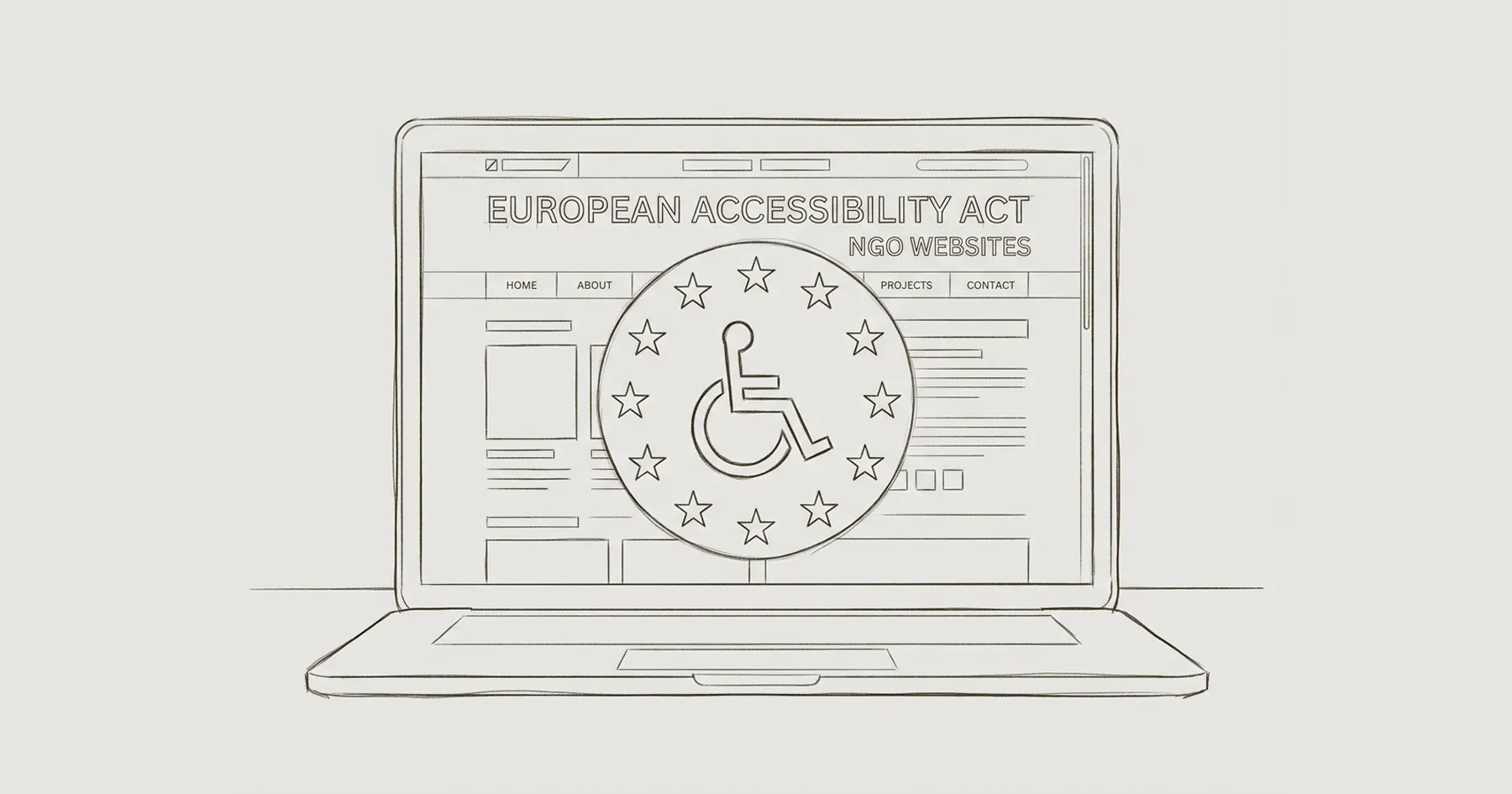
The European Accessibility Act came into force in June 2025, requiring digital services provided to consumers in EU member states to meet EN 301 549 — the European standard that maps closely to WCAG 2.1 AA. For international NGOs with programmes, beneficiaries, or donor audiences in EU countries, this is not a European regulatory matter that does not apply to them. It applies to any digital service accessible to and targeted at EU consumers, regardless of where the organisation is based.
The enforcement consequences vary significantly across EU member states — some have implemented fines and monitoring regimes, others are still developing their enforcement frameworks — but the compliance obligation is uniform. An international NGO that accepts EU-based donations, recruits EU-based volunteers, or communicates programme information to EU-based beneficiaries through its website is within scope.
This post explains what EN 301 549 requires in practice, how it differs from and overlaps with WCAG 2.1 AA, what the enforcement landscape looks like across key EU member states, and how international NGOs should frame accessibility compliance as a Board-level governance obligation rather than a technical project. It also covers how to document compliance for regulatory purposes and how to present the investment in accessibility as both a legal obligation and an institutional credibility signal.
European Accessibility Act for NGOs
If your NGO operates in Europe, accepts donations from EU residents, or has programme pages targeting European audiences, the European Accessibility Act applies to you. Enforcement is live. This is not a future obligation — it has been enforceable since June 2025.
Most nonprofit communications teams are unaware of this. The EAA was designed primarily for commercial digital services, but its scope captures any organisation delivering services to EU residents through digital channels. That includes NGOs with European programme delivery, fundraising operations targeting EU donors, and websites offering services or information to European audiences.
Here is what your Board needs to understand.
What the European Accessibility Act Is
The European Accessibility Act (Directive 2019/882) is EU-wide legislation requiring digital products and services to be accessible to people with disabilities. It was adopted in 2019 and became enforceable across all 27 EU member states on 28 June 2025.
The EAA is not a single regulation — it is a directive that each member state has transposed into its own national law. This means enforcement mechanisms, penalties, and complaint processes vary by country. What does not vary is the technical standard: EN 301 549, which maps directly to WCAG 2.1 Level AA.
For practical purposes, if your website meets WCAG 2.1 AA, you meet the core technical requirements of the EAA. But the EAA also requires an accessibility statement, a complaint mechanism, and evidence of ongoing compliance monitoring — elements that go beyond what most nonprofits currently have in place.
Does the EAA Apply to Nonprofits?
The EAA primarily targets commercial operators. Microenterprises — organisations with fewer than 10 employees and annual turnover below €2 million — are exempt from the directive’s core requirements.
However, there are important caveats for NGOs.
If your NGO has 10 or more employees and turnover above €2 million, and you provide digital services to EU residents, the EAA applies. Many established international NGOs fall above this threshold.
If you receive EU public funding, the EU Web Accessibility Directive (a separate, earlier directive) already requires accessibility compliance for publicly funded organisations. The EAA extends similar requirements to the private and third sector.
If you operate in multiple EU countries, each country where you serve audiences can independently enforce the EAA. A complaint filed in France does not prevent a separate complaint in Germany. Financial exposure multiplies with each market served.
Even if the EAA does not technically apply to your organisation, meeting its requirements is increasingly expected by institutional funders, EU-based partners, and regulators. The direction of travel is clear: accessibility compliance is becoming a baseline expectation for any organisation operating in or receiving funding from Europe.
What EN 301 549 Requires
EN 301 549 is the European standard for digital accessibility. It incorporates WCAG 2.1 Level AA and adds requirements specific to European regulation. The areas most relevant to nonprofit websites are:
Perceivable content. All images must have descriptive alt text. Videos must have captions and audio descriptions. Colour contrast must meet 4.5:1 for normal text. Content must be readable when text is resized to 200%.
Operable interfaces. Every interactive element must be accessible via keyboard. Focus indicators must be visible. Users must have enough time to read and interact with content. Nothing on the site should flash more than three times per second.
Understandable content. The language of the page must be declared in the HTML. Forms must have clear labels and descriptive error messages. Navigation must be consistent across the site.
Robust markup. The HTML must be valid and parseable by assistive technologies. ARIA attributes, where used, must be correctly implemented. The site must work with current screen readers and other assistive tools.
Enforcement and Penalties
Enforcement is complaint-driven in most member states. Regulators are not systematically auditing every website — but when complaints are filed, investigations follow.
France was among the first to issue formal notices to major organisations. Germany’s Bundesnetzagentur has been investigating complaints. The Netherlands has publicly stated it is prioritising e-commerce and service platforms for early enforcement.
Penalties vary by country but can reach up to €100,000 or 4% of annual revenue per member state. For an international NGO operating in multiple EU countries, the financial exposure is significant.
The practical risk for most nonprofits is not an immediate fine. It is a complaint from a user, a partner organisation, or an advocacy group that triggers an investigation, requires resources to respond to, and creates reputational exposure precisely when the organisation is seeking to demonstrate institutional credibility.
What Your Board Needs to Know
The EAA is not a technical issue for the web team to handle. It is a governance obligation that the Board should be aware of, particularly for organisations that operate internationally, receive EU funding, or serve European audiences.
Present it to Trustees in three parts. First, the regulatory landscape: the EAA is enforceable, the UK Equality Act already creates domestic accessibility obligations, and institutional funders are increasingly including accessibility in due diligence. Second, the current state: commission an accessibility audit (even a basic automated scan with axe DevTools) to establish where the organisation stands. Third, the recommended action: a structured remediation plan that addresses critical failures first and establishes ongoing compliance monitoring.
The cost of compliance is lower than most organisations expect — particularly for organisations already on accessible platforms like Webflow with the Lumos framework, where WCAG AA compliance is built into the foundation. The cost of non-compliance is unpredictable: regulatory penalties, complaint investigations, reputational damage, and lost funding opportunities.
Practical Steps for NGOs
Audit your current site. Run axe DevTools on your homepage, a programme page, and your donation page. Note the number and severity of violations. This gives you a baseline.
Publish an accessibility statement. The EAA requires one. See Accessibility Statement Template for Nonprofits.
Implement a complaint mechanism. This can be as simple as a dedicated email address for accessibility feedback, linked from your accessibility statement.
Address critical failures first. Missing alt text, broken keyboard navigation, insufficient colour contrast, and unlabelled form fields are the most common failures and the easiest to fix.
Establish a review cadence. Build a quarterly review into your website governance schedule. See How to Create a Website Governance Policy.
The Blueprint Audit includes a full WCAG AA accessibility assessment as part of the technical audit.
For how WCAG AA compliance works on Webflow, see WCAG AA Accessibility on Webflow. For the broader governance context, see WCAG Accessibility as a Nonprofit Governance Obligation.
Frequently Asked Questions
Q1: Does the European Accessibility Act apply to charities and nonprofits?
It depends on size and activity. Organisations with 10 or more employees and annual turnover above €2 million that provide digital services to EU residents are covered. Many established international NGOs meet this threshold. Even exempt organisations face growing accessibility expectations from funders and partners.
Q2: What is EN 301 549 and how does it relate to WCAG?
EN 301 549 is the European digital accessibility standard referenced by the EAA. It incorporates WCAG 2.1 Level AA as its core technical requirements. Meeting WCAG 2.1 AA gets you most of the way to EN 301 549 compliance, though the EAA also requires an accessibility statement and complaint mechanism.
Q3: What are the penalties for EAA non-compliance?
Penalties vary by EU member state but can reach €100,000 or 4% of annual revenue. Each country where you serve audiences can enforce independently, so financial exposure multiplies across markets.
Q4: Does the EAA apply to UK nonprofits after Brexit?
The EAA does not apply to UK domestic operations. However, if a UK-based NGO provides digital services to EU residents — accepting donations from EU donors, delivering programmes in EU countries, or serving European audiences — the EAA applies to those activities. The UK Equality Act creates separate domestic accessibility obligations.
Q5: Is WCAG 2.1 or WCAG 2.2 required by the EAA?
The EAA currently references WCAG 2.1 AA via EN 301 549. WCAG 2.2 is not yet formally required but is recommended. The EU is expected to update the standard in a future revision. Building to WCAG 2.2 now avoids a second round of remediation later.
Q6: Do we need an accessibility statement on our website?
Yes. The EAA requires a publicly available accessibility statement that describes your commitment, the standard you meet, any known limitations, and how users can report barriers.
Q7: How much does it cost to make a nonprofit website EAA compliant?
For websites built on accessible foundations like Webflow with the Lumos framework, remediation costs are modest. For websites built without accessibility consideration, remediation can be extensive enough that rebuilding on an accessible framework is more cost-effective.
Q8: Can we be fined if we are actively working on compliance?
Enforcement authorities in most member states allow remediation time for organisations demonstrating good-faith compliance efforts. Document your compliance roadmap, maintain records of audits and fixes, and publish your accessibility statement. Fines are typically reserved for organisations that ignore requirements entirely.
Q9: How does the EAA interact with the UK Equality Act?
They are separate legal frameworks. The Equality Act applies to all UK organisations and requires reasonable adjustments for disabled users. The EAA applies to services provided to EU residents. An international NGO may need to comply with both.
Q10: How often should we audit our website for EAA compliance?
At minimum, annually and after any significant site changes. A quarterly automated scan plus an annual manual audit is a sensible governance cadence.
Is this familiar?
Most nonprofit websites don't fail at launch. They fail quietly, over time.
The governance gaps, the stakeholder confusion, the Board that's stopped referring people to the site — these don't announce themselves. See what the difference looks like when it's built correctly from the start.
Eric Phung has 7 years of Webflow development experience, having built 100+ websites across industries including SaaS, e-commerce, professional services, and nonprofits. He specialises in nonprofit website migrations using the Lumos accessibility framework (v2.2.0+) with a focus on editorial independence and WCAG AA compliance. Current clients include WHO Foundation, Do Good Daniels Family Foundation, and Territorio de Zaguates. Based in Manchester, UK, Eric focuses exclusively on helping established nonprofits migrate from WordPress and Wix to maintainable Webflow infrastructure.
Ready to understand your current situation clearly?
The Blueprint Audit is where we start.
A two-to-three week diagnostic that maps your stakeholder needs, audits your current site, and gives you a clear strategic brief before any implementation commitment is made. £2,500. No obligations beyond the audit itself.
In case you missed it
Explore more

Nonprofit Website Audit Checklist: What to Review Before a Rebuild

What Is Website Governance for Nonprofits? A Complete Guide

How to Choose a Charity Web Design Agency
Join our newsletter
Subscribe to my newsletter to receive latest news & updates