






The NGO Website Section Checklist: 90 Sections, and Which the Law Requires


Key takeaways
- Seven of the 90 sections are required by law or a binding regulatory code: the legal identity line, the privacy notice, cookie choices, the fundraising complaints procedure, and privacy information on referral, volunteer and job application forms.
- Twenty are Conditional: required only above a threshold, such as £36m of turnover for a modern slavery statement or 250 employees for gender pay gap reporting, or because of a trigger such as FCDO funding or a standard you have signed up to.
- Section 39 of the Charities Act 2011 requires the fact that you are a registered charity on anything soliciting money, not your number in the footer; the number is funder expectation, and there is no reason to leave it out.
- The charity soft opt-in and the new cookie exceptions for analytics both took effect on 5 February 2026, and both still need an opt-out or a way to object.
- Most of what an NGO website carries is not required by anyone, and it is exactly what donors, funders, partners and journalists check before they trust you.
Summary
An established NGO's website answers seven audiences: donors, institutional funders, the people it serves, volunteers and candidates, partners, journalists, and the regulators and trustees who hold it to account. This checklist lists the 90 sections those audiences look for, each tagged Required, Conditional or Best practice and sourced to the law, code or evidence behind the tag. Seven are required by law or a binding code. Twenty depend on a threshold, a funder or a standard you have signed up to. The rest are what each audience checks before it trusts you.
The Short Answer
An established NGO's website serves seven audiences, and each one arrives with a different question. This checklist lists the 90 sections they look for and tags each one. Required means a statute, regulation or binding regulatory code requires it. Conditional means it becomes required above a threshold or because of a trigger you can check. Best practice means no one requires it, but the audience it serves checks for it.
Seven sections are Required, twenty are Conditional, and 63 are Best practice. So the law explains very little of what a good NGO website carries. What explains the rest is trust.
Why the Best Practice Rows Matter Anyway
In the Charity Commission's 2026 research on public trust, 57% of the public in England and Wales had high trust in charities. The most common reason given for trusting one was that most of the money goes directly to the cause (55%). "Makes a real difference" was chosen by 51%, up from 45% the year before. In the 2025 research, 69% said a charity being transparent about how much it raises and where it is spent would make them more likely to support it.
None of that is a legal duty. All of it is a page on a website, or the absence of one.
Other audiences are just as specific. In Cision's 2025 survey of journalists, 72% named press releases as the most useful thing a PR team provides. FCDO assesses the organisations it funds against five due-diligence pillars: governance and internal controls, ability to deliver, financial stability, downstream delivery, and safeguarding. A site that answers those before anyone asks shortens every due-diligence conversation that follows.
How to Read the Tags
Each section opens on four things: what it is for, what goes on it, why it carries its tag, and the source for that. Where a real organisation's page shows the section well, it is linked as an example. Every example was loaded and checked on 30 September 2026. Where this site has a checklist or article that goes further, it is linked too.
A Conditional row always names its trigger in one line: "250 or more employees", "FCDO-funded partners", "Dóchas signatories". If the trigger does not apply to you, read the row as best practice.
Several tags are narrower than they are usually described, and the row says so. Section 39 does not require your charity number in the footer. The Code of Fundraising Practice rule on fundraising pages binds the platforms that host them, not the charities that benefit from them. Nothing in FCDO's guidance requires a public due-diligence pack. Getting these right matters, because a checklist that overstates the law teaches trustees to distrust the parts that are real.
How to Use It
Filter to Required and check each row against your own site. Then filter to Conditional, read each trigger and mark the ones that apply to you. Those two lists are what you would be asked to fix after a complaint, a funder's review or a regulator's letter.
For the rest, choose the audience that matters most to your income this year and open its sections. Every section can be linked to directly: section 76 is #s-76. Put the links in a board paper, a brief to your web team, or a proposal you are about to sign.
What This Page Does Not Do
It does not tell you whether your own site meets any of this. It tells you what to look for. It is not legal advice, and every source was checked on 30 September 2026: laws change, and that date is how old each claim is. Northern Ireland's charity rules were not checked. An NGO with a US or EU entity has that entity's obligations as well as its own.
The 90 sections
- Required
- A statute, regulation or binding regulatory code requires it, for the organisations it names.
- Conditional
- Required only above a threshold, or because of a trigger: a funding agreement, a regulated service, a standard you have signed up to.
- Best practice
- No duty to publish it. The case for it is the evidence of what that audience checks.
Individual donors
- What it is for
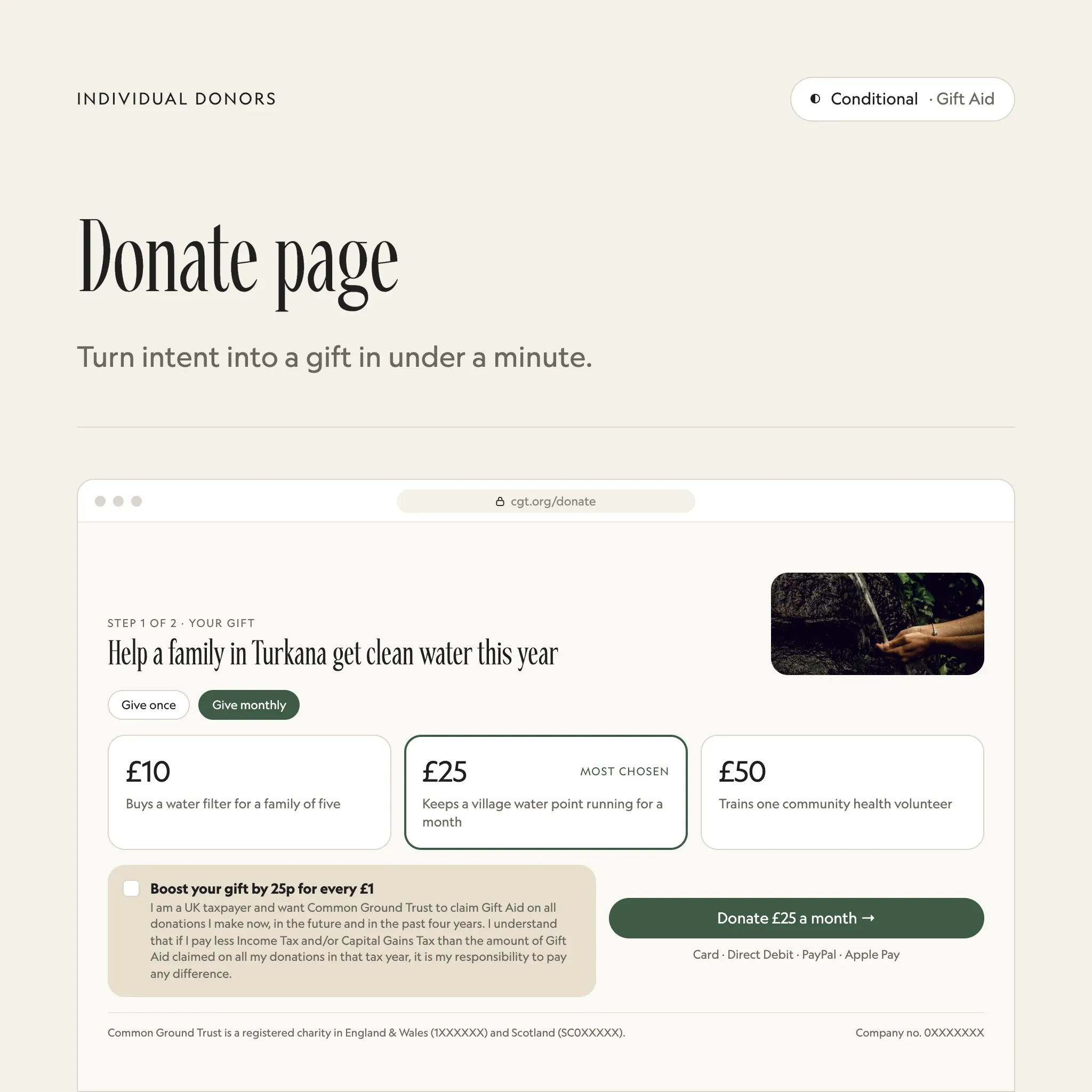
- Turn intent into a gift.
- What goes on it
- Amounts with what each one does, a one-off or monthly choice, the Gift Aid declaration, payment options, and the reassurance that you are who you say you are.
- Conditional: UK charities claiming Gift Aid on gifts taken through the page
- A Gift Aid claim needs a valid declaration: the donor's name and home address, your name, the gifts it covers, confirmation they are to be treated as Gift Aid, and an explanation of the donor's tax liability. HMRC sets the content, not the wording, and publishes no official form.
- Sources
- Go further
- Donation software for charities, compared
- What it is for
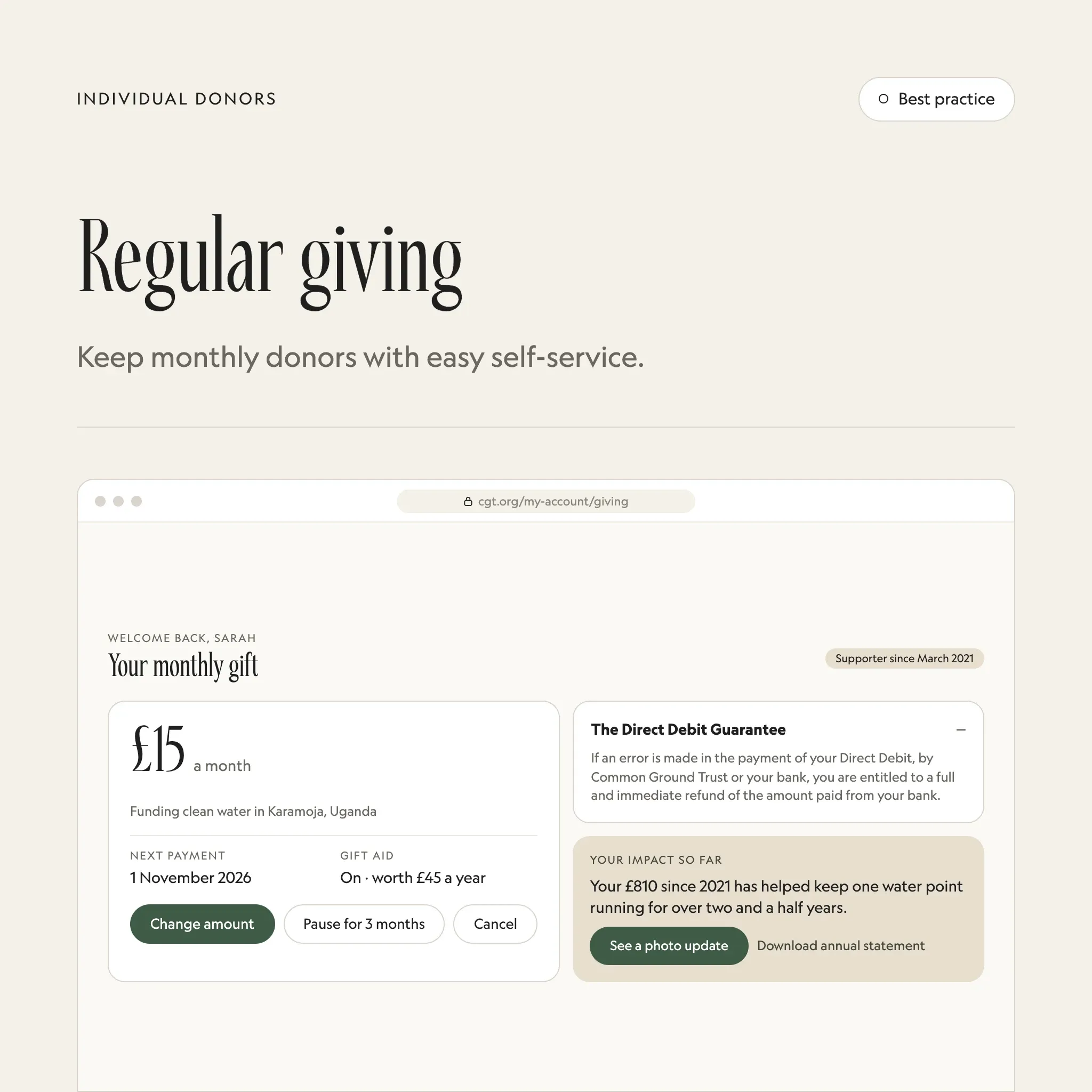
- Keep monthly donors, and let them manage their gift.
- What goes on it
- What a monthly gift does, a way to change, pause or cancel it without phoning, and the Direct Debit Guarantee.
- Best practice
- The Direct Debit Guarantee comes from the Direct Debit scheme, not statute, and Bacs's own instruction template carries it for the payer to keep. The scheme rules that govern how it is shown online are behind a login, so confirm them with your bank or bureau rather than with this page.
- Go further
- The donation journey for returning donors
- What it is for
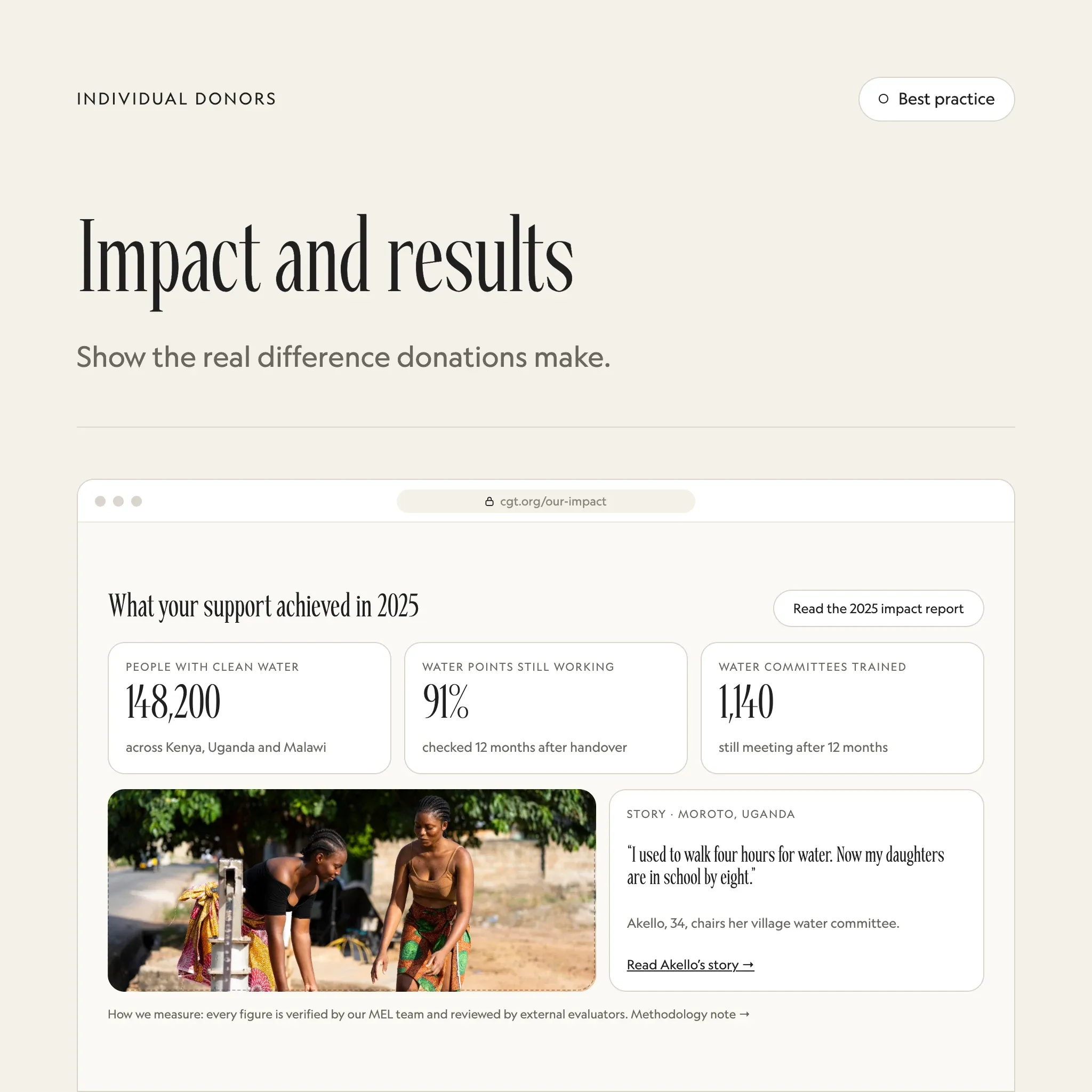
- Show the difference a gift makes.
- What goes on it
- Outcome figures with the method behind them, short stories, and a link to the annual report.
- Best practice
- No duty. In the Charity Commission's 2026 research, 51% of the public chose "makes a real difference" as important to their trust, up from 45% in 2025.
- Go further
- Impact measurement and visualisation
- What it is for
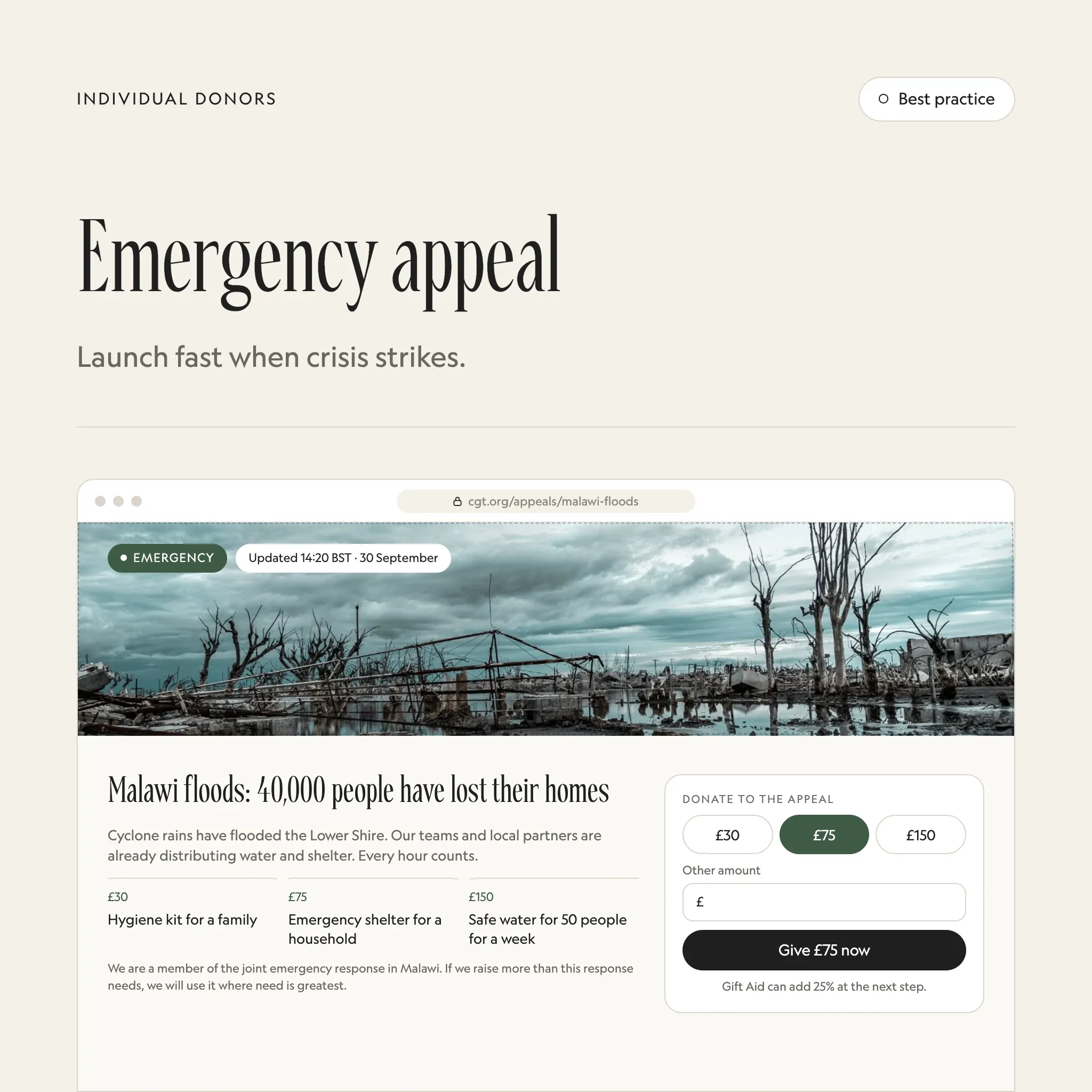
- Catch giving that happens in the moment.
- What goes on it
- The crisis in a paragraph, live updates, a fast way to give, and how the money will be used.
- Best practice
- No duty. The Charities Aid Foundation's UK Giving 2026 report makes "why most donations happen in the moment" one of its themes. The page that matters is the one prepared and signed off before the emergency, not written during it.
- Source
- What it is for
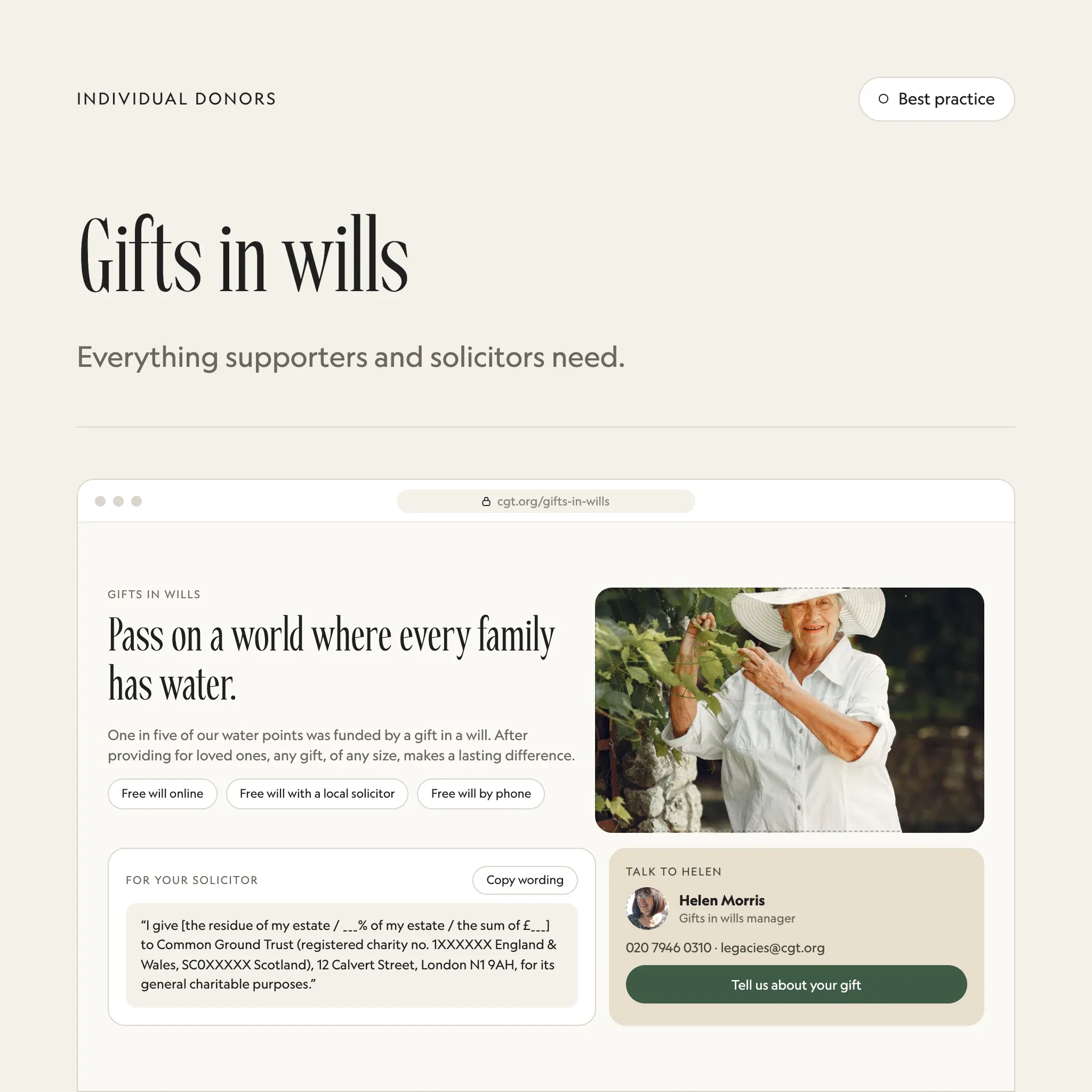
- Give legacy supporters and their solicitors what they need.
- What goes on it
- The wording for a will with your full name and charity number, any free will service, and a way to tell you about a gift.
- Best practice
- No duty to have the page. If you offer suggested wording for a will, the Code of Fundraising Practice requires it to be clear and accurate, to carry your full name, address and registration details, and to say it is not legal advice (rule 14.1.2). A legacy that names you wrongly is one you may have to argue for.
- What it is for
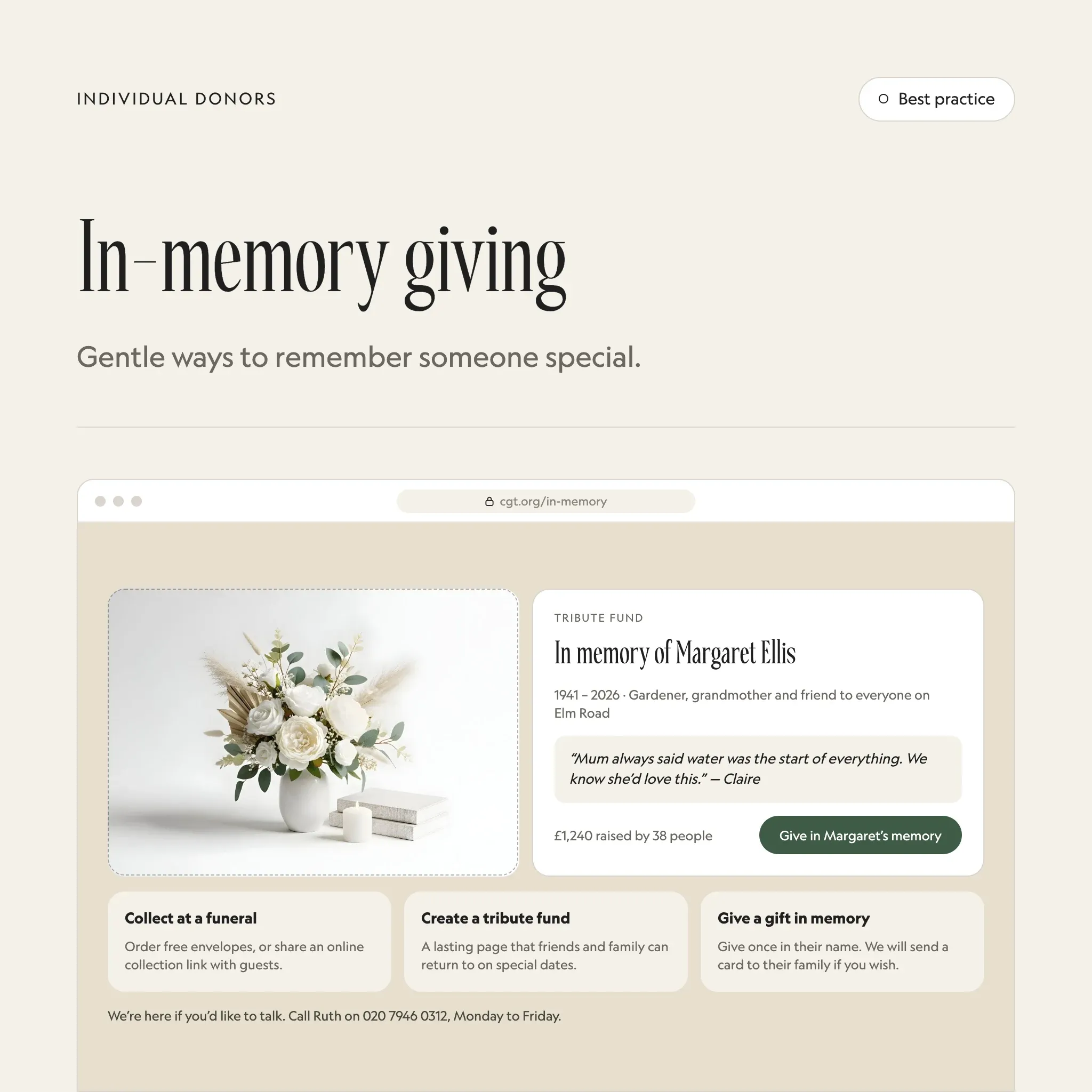
- Support people who are giving in someone's name.
- What goes on it
- Tribute funds, funeral collections and in-memory pages, written with care.
- Best practice
- No duty. The tone of this page is read by people on the worst day of their year.
- What it is for
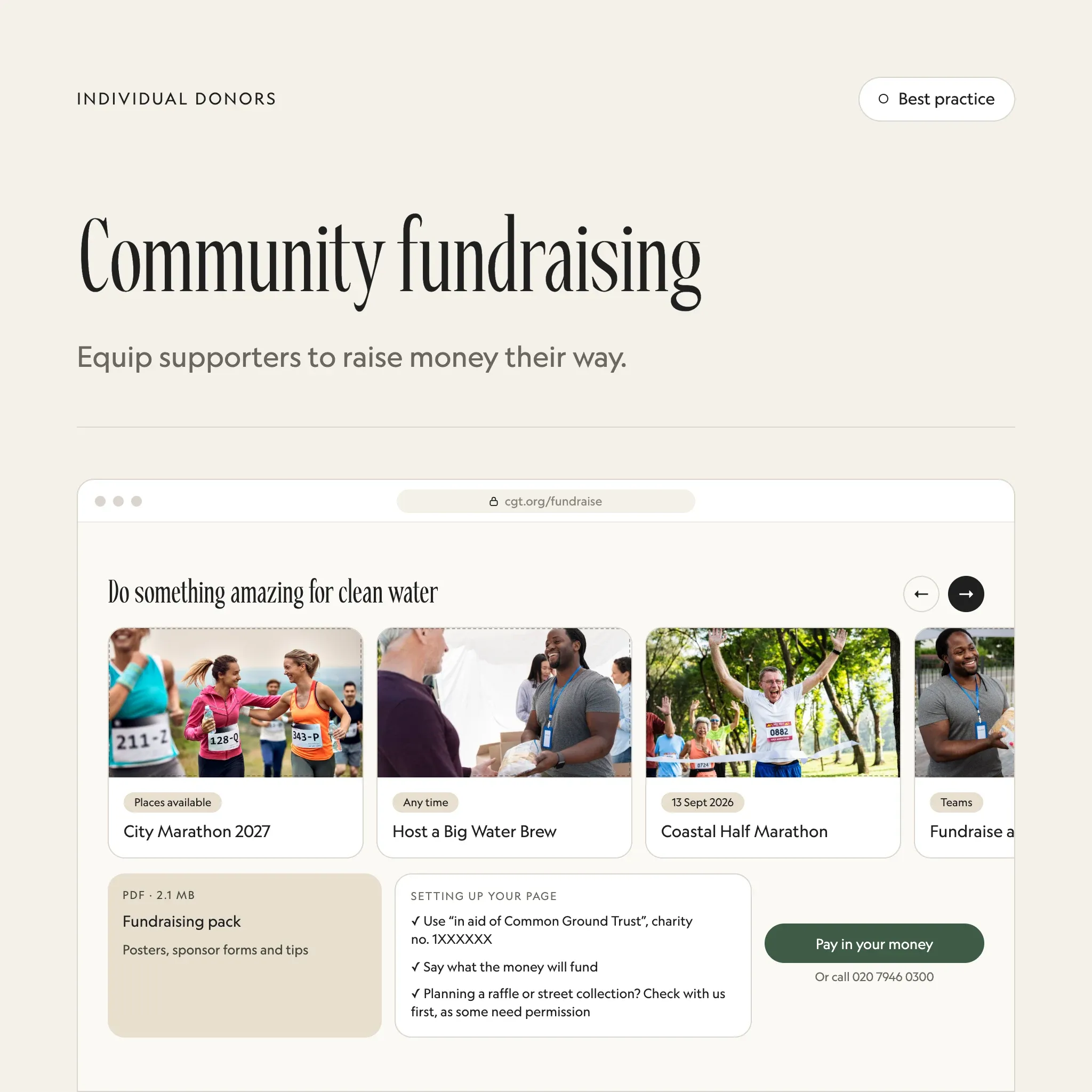
- Equip supporters to raise money their way.
- What goes on it
- A fundraising pack, events, guidance for online fundraising pages, and how to pay in.
- Best practice
- No duty on the charity. The Code of Fundraising Practice rule on guidance for fundraising pages binds online fundraising platforms, not the charities that benefit from them, unless you run such a platform yourself.
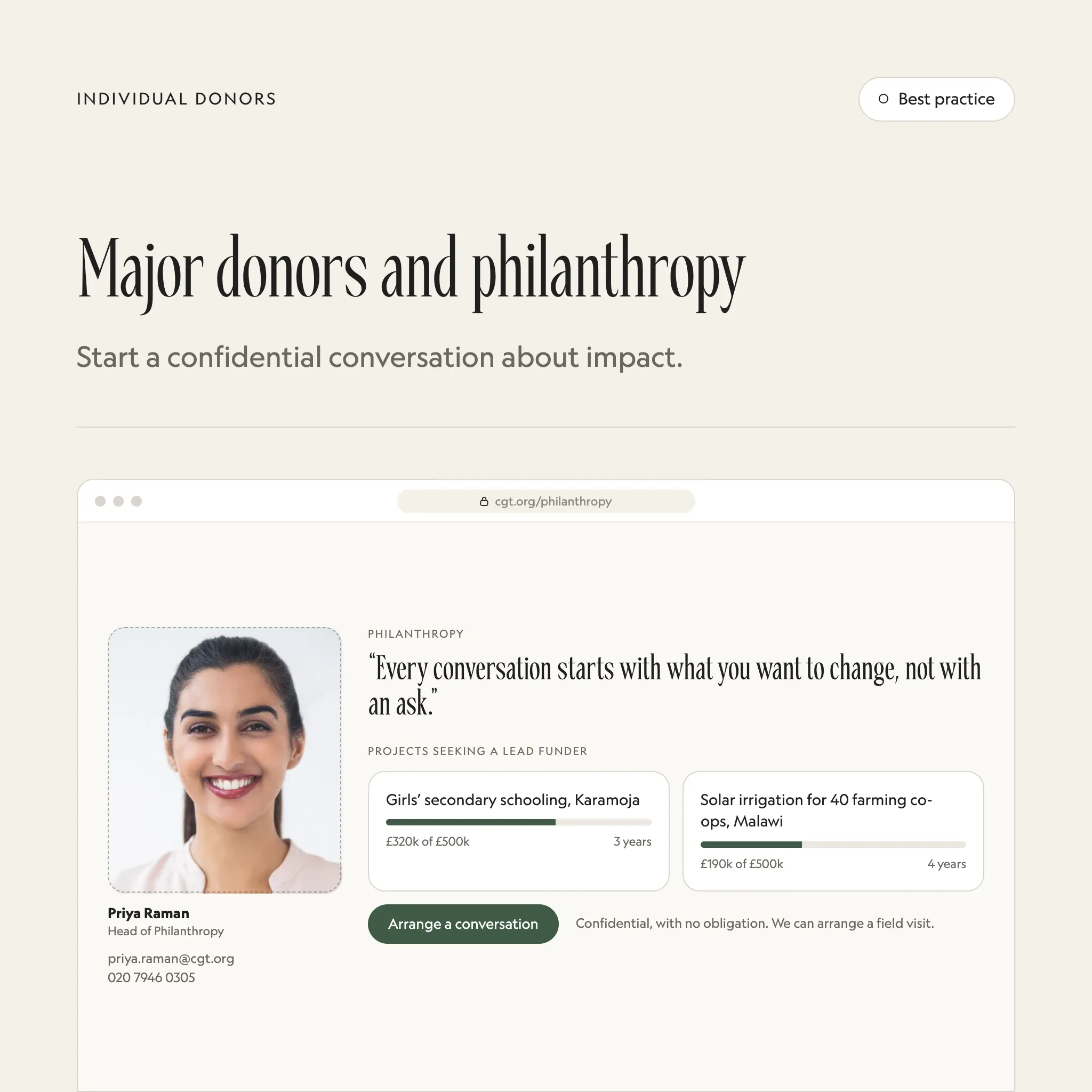
- What it is for
- Open a route to a conversation.
- What goes on it
- A named contact, the projects that need funding, and how you handle confidentiality.
- Best practice
- No duty. A major donor looks for a person to talk to, not a form.
- Go further
- Major donor cultivation online
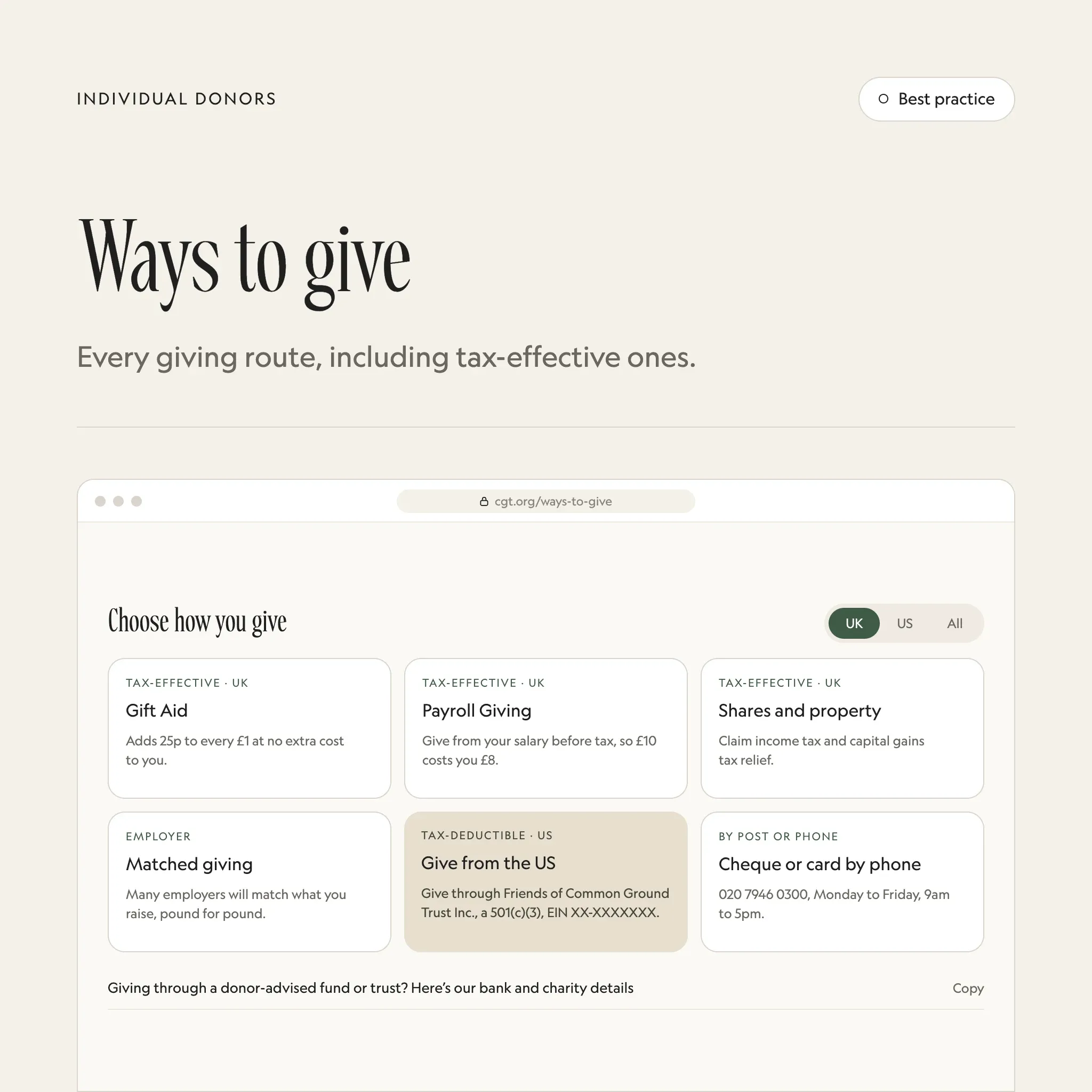
- What it is for
- Remove friction from every route in.
- What goes on it
- Gift Aid, payroll giving, shares, matched giving, and a route for US taxpayers.
- Best practice
- No duty to offer a US route, but a reason to: a US donor generally cannot deduct a gift to a foreign charity, so without a US affiliate or an intermediary the gift costs them more.
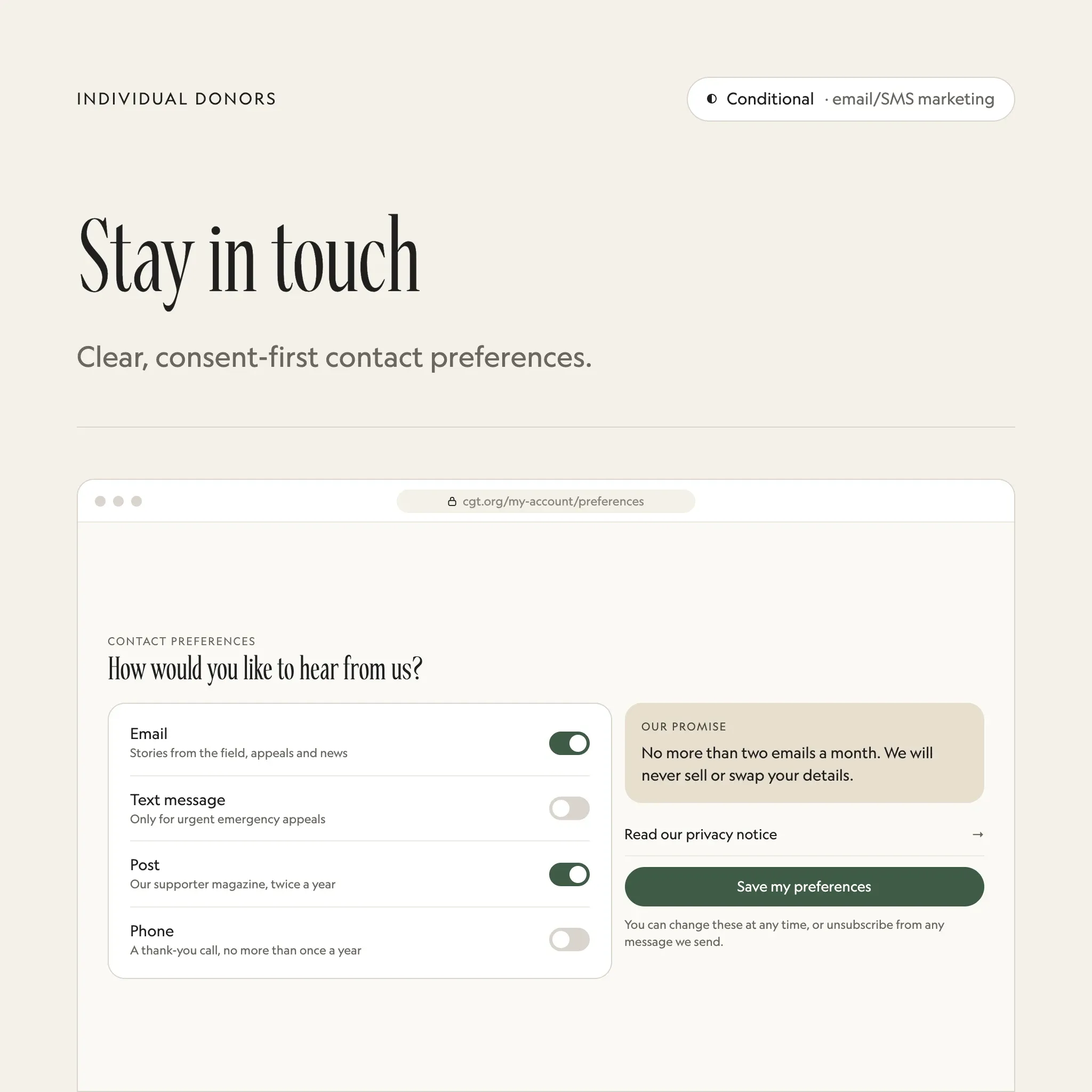
- What it is for
- Build a marketing list lawfully.
- What goes on it
- A choice per channel, how often you will write, an opt-out at the point of sign-up, and the privacy information.
- Conditional: UK charities that email or text supporters with marketing
- PECR bans unsolicited email and text marketing without consent unless a soft opt-in applies. The charity soft opt-in has been in force since 5 February 2026: it needs a simple opt-out when the details are collected, and covers only details collected on or after that date. The privacy information is required at collection under UK GDPR Article 13.
- Sources
- Go further
- The GDPR checklist for a charity website
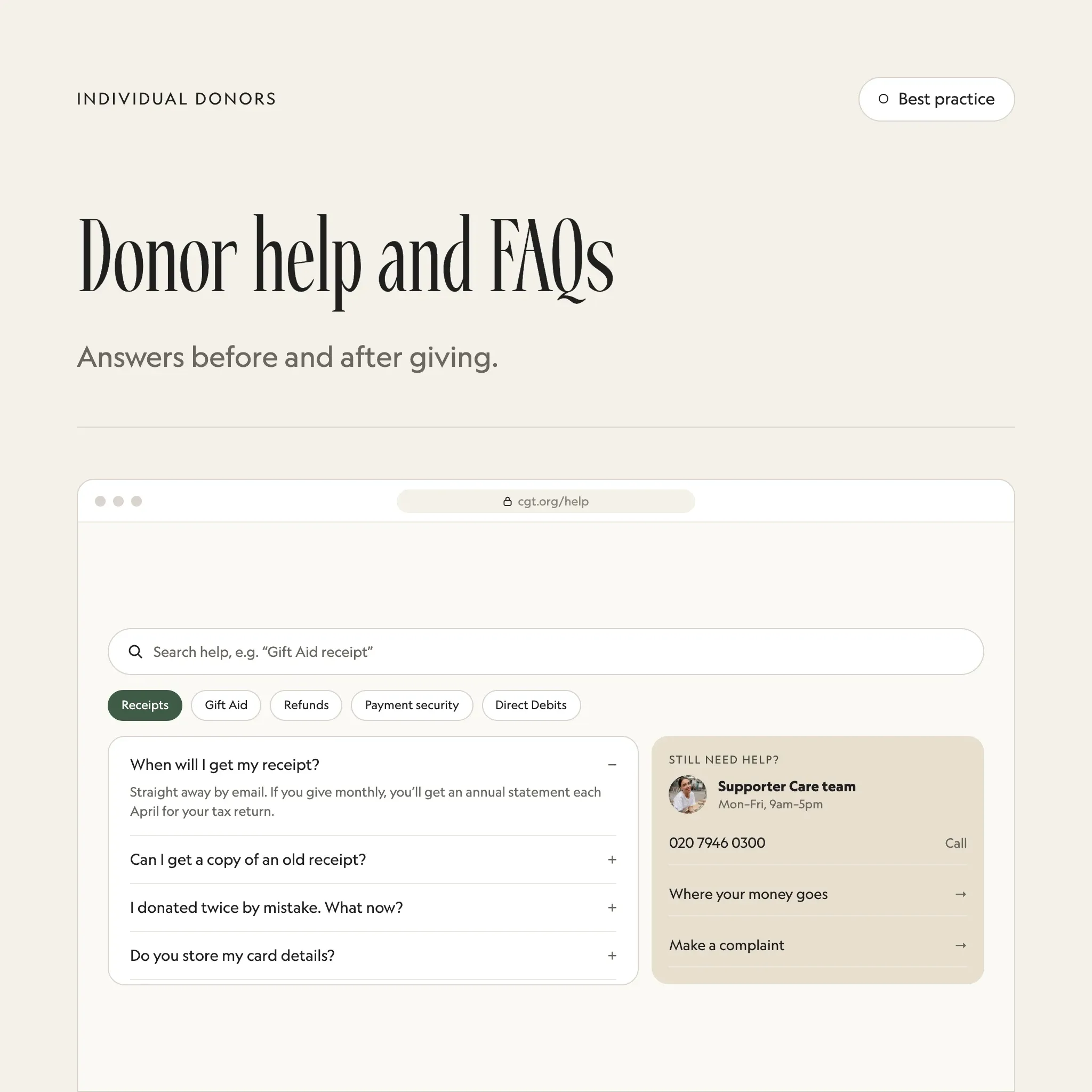
- What it is for
- Answer the doubts before and after a gift.
- What goes on it
- Receipts, Gift Aid, refunds and payment security, with links to complaints (section 80) and where the money goes (section 89).
- Best practice
- No duty. Every question answered here is one fewer email to a small team.
- Go further
- What donors check before they give
Institutional funders
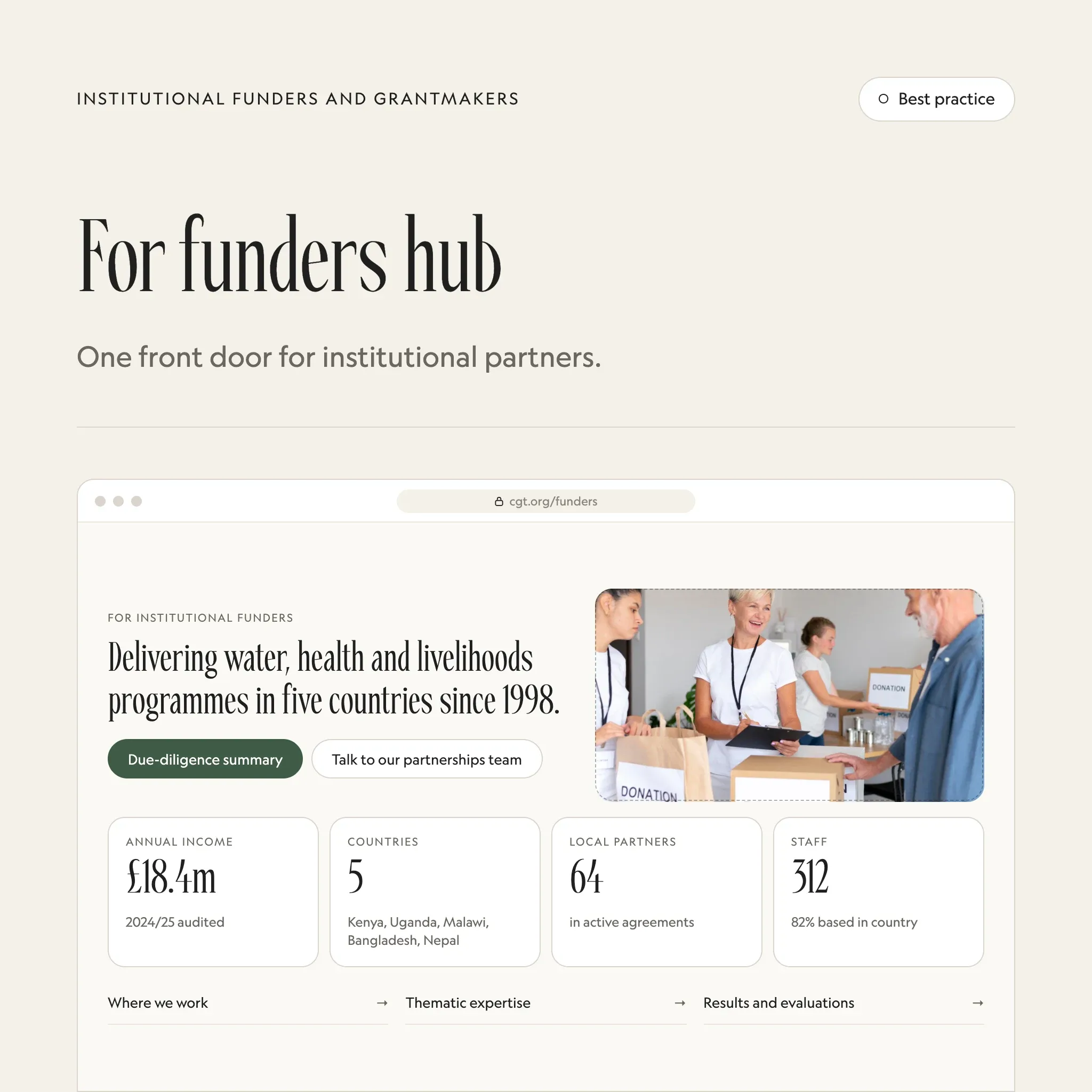
- What it is for
- Give institutional funders a front door.
- What goes on it
- Who you are, where you work, what you are expert in, a contact, and links to everything a due-diligence check will ask for.
- Best practice
- No duty. It collects in one place what a programme officer would otherwise assemble from six pages.
- Go further
- What funders see in due diligence
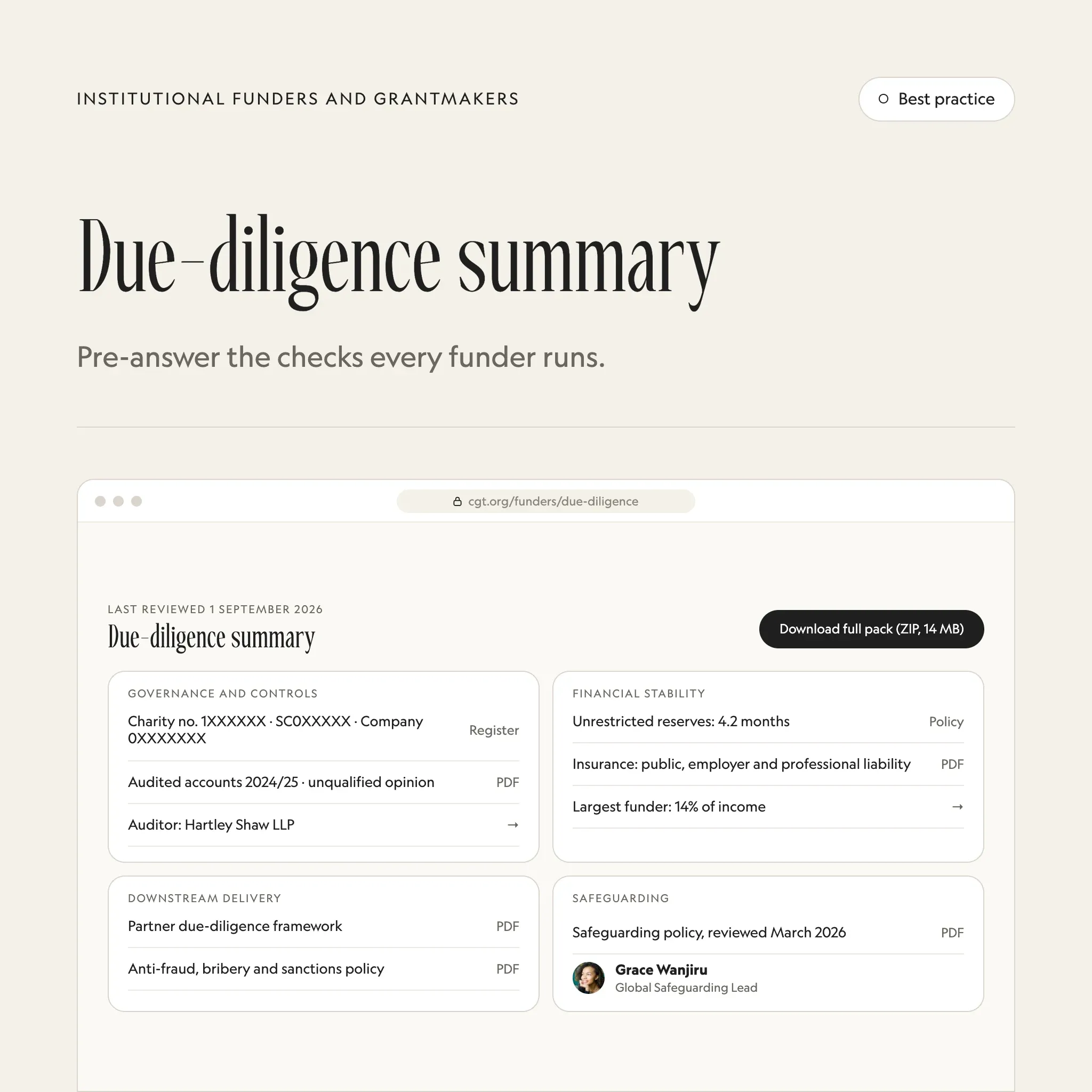
- What it is for
- Answer the checks before they are asked.
- What goes on it
- Registration numbers, the latest accounts, audit status, key policies, the safeguarding lead and insurance.
- Best practice
- No duty to publish. FCDO assesses partners against five pillars: governance and internal controls, ability to deliver, financial stability, downstream delivery, and safeguarding. A page organised the same way answers most institutional funders at once.
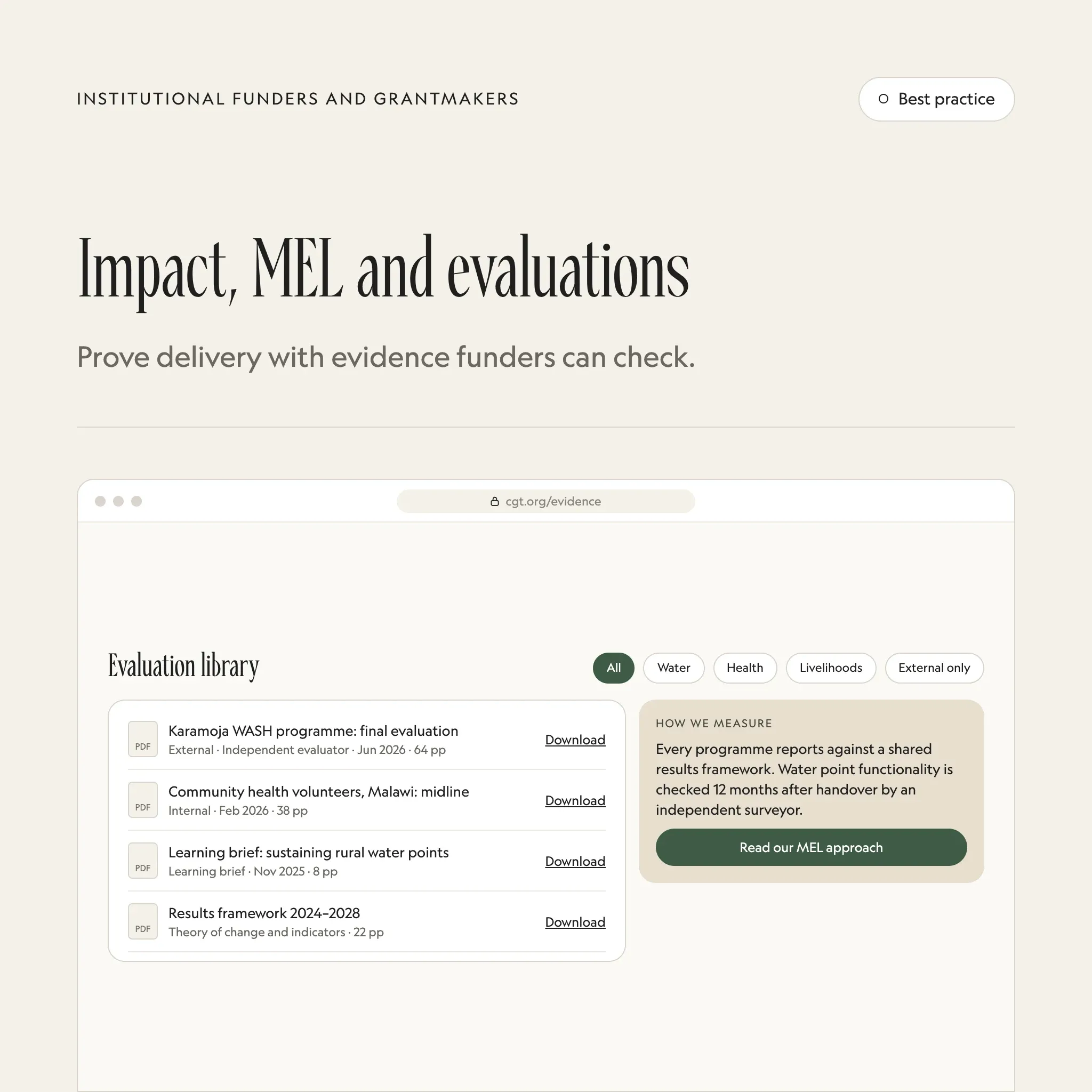
- What it is for
- Prove delivery.
- What goes on it
- Your results framework, evaluation reports, learning briefs and how the data was gathered.
- Best practice
- No duty. An evaluation you publish, including the parts that went wrong, is more credible than a results page that only reports success.
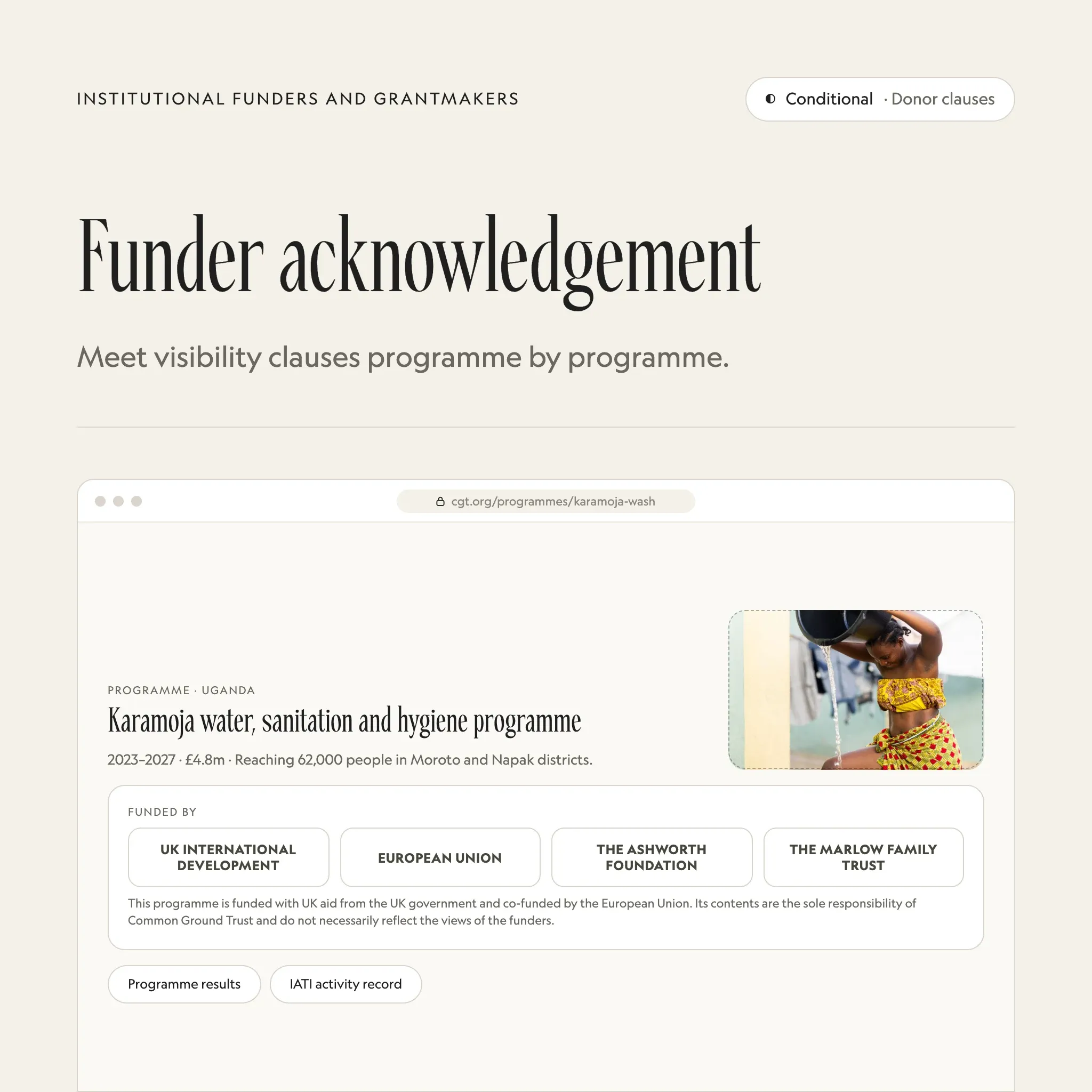
- What it is for
- Credit funders the way the agreement says.
- What goes on it
- Funder logos used correctly and a "funded by" line for each programme.
- Conditional: Programmes funded by FCDO aid or EU external-action funding
- For FCDO partners, branding is a condition of the funding and websites are listed as a place to acknowledge it; the main logo has been UK International Development since 2023. EU funding carries a general obligation to show the emblem and a "Funded by the European Union" statement. Both come from the agreement, not statute.
- Sources
- Go further
- Logo walls as governance
- What it is for
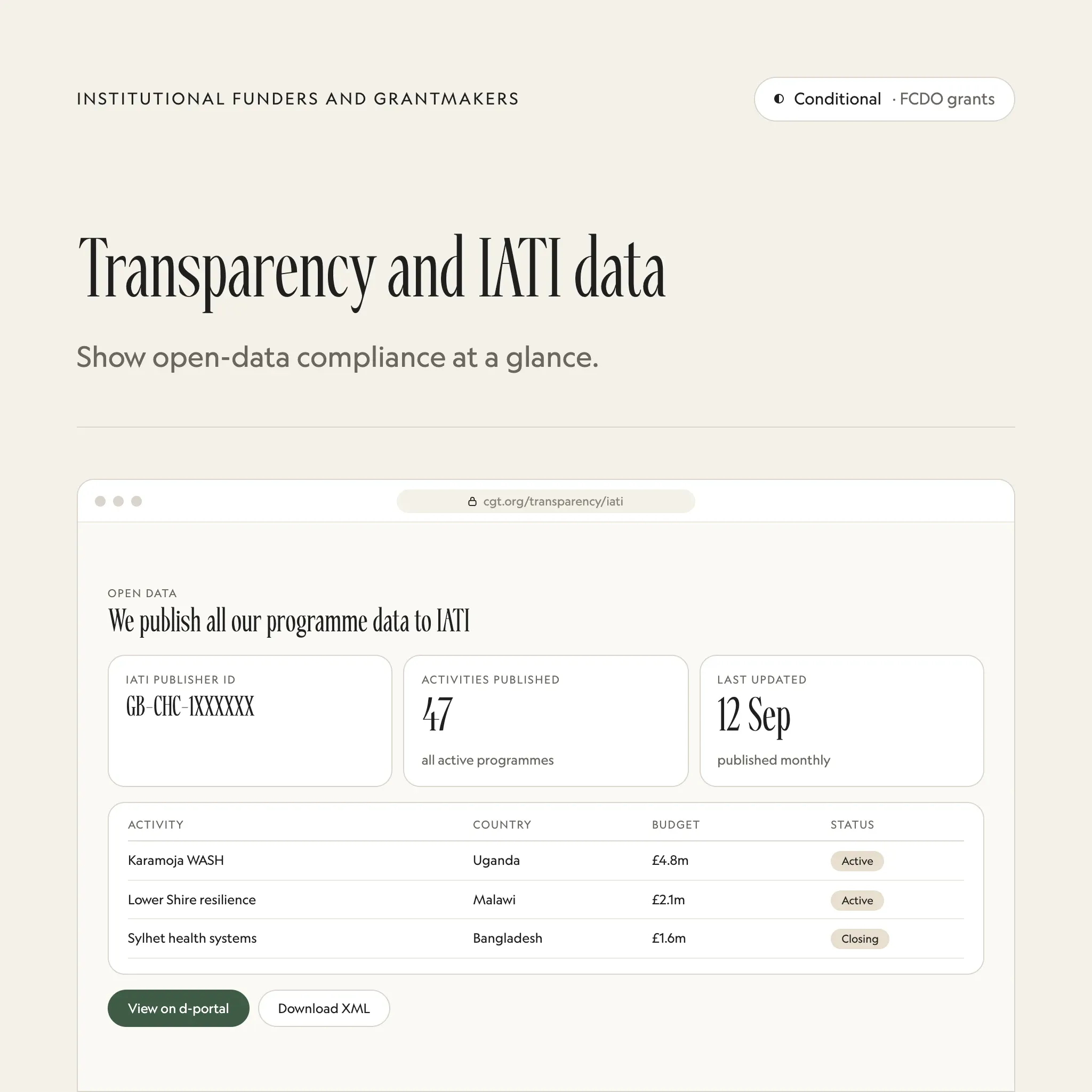
- Show your aid data is open.
- What goes on it
- Your IATI organisation identifier, links to the data in a readable portal, and how often it is updated.
- Conditional: Partners whose FCDO funding agreement includes the IATI clause
- FCDO asks most partners spending aid funding to publish to the IATI standard through their agreements. The data is published through IATI's own systems, not your site (the IATI Registry was replaced by IATI Account in December 2025, so older links need checking); the page on your site that points to it is what a funder actually clicks. See also section 87.
- What it is for
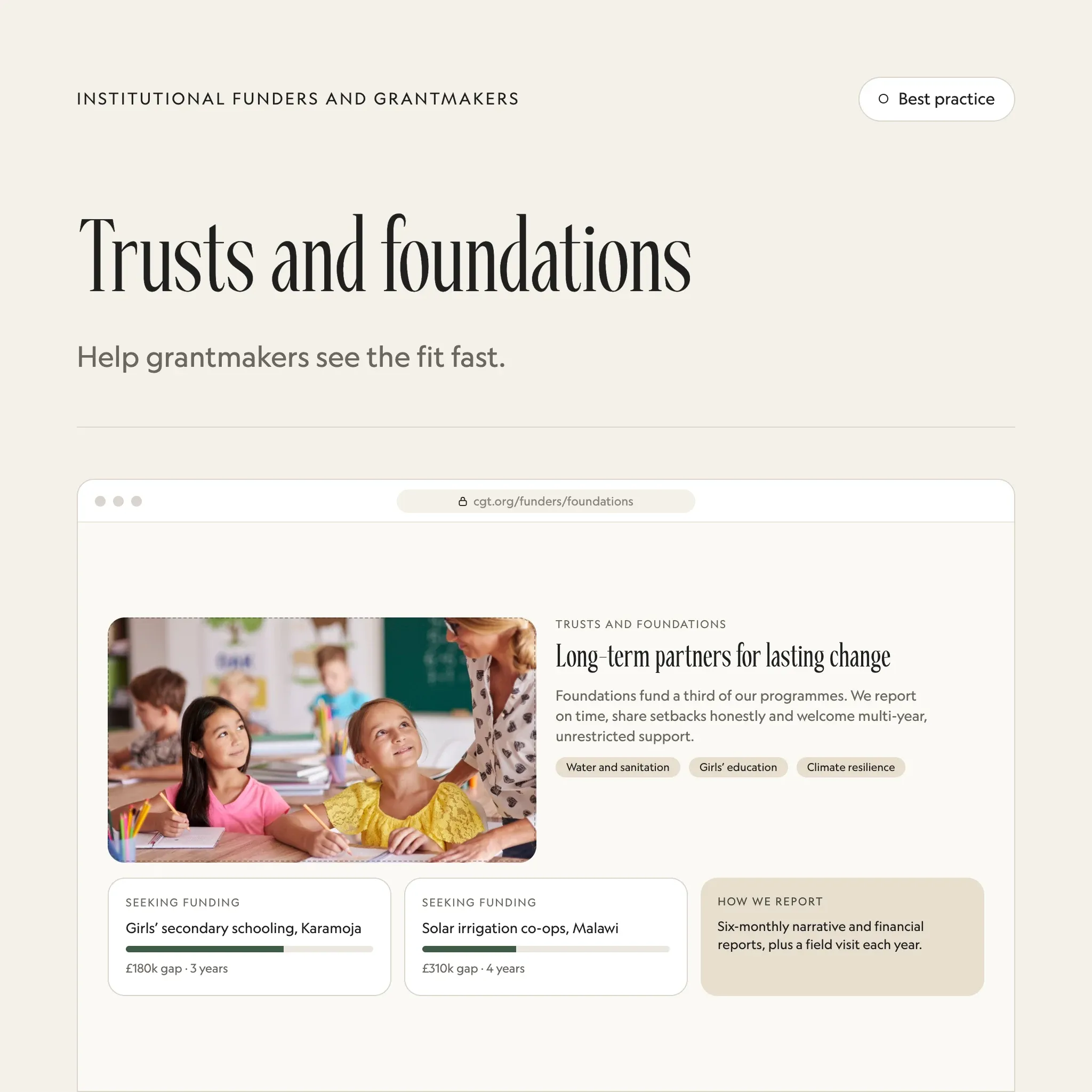
- Meet grantmakers where their priorities are.
- What goes on it
- Your priorities, the projects seeking funding, and how you report on a grant.
- Best practice
- No duty. A trust reviewing an application checks the website against it, and a mismatch between the two is noticed.
- Go further
- How a website supports a grant application
- What it is for
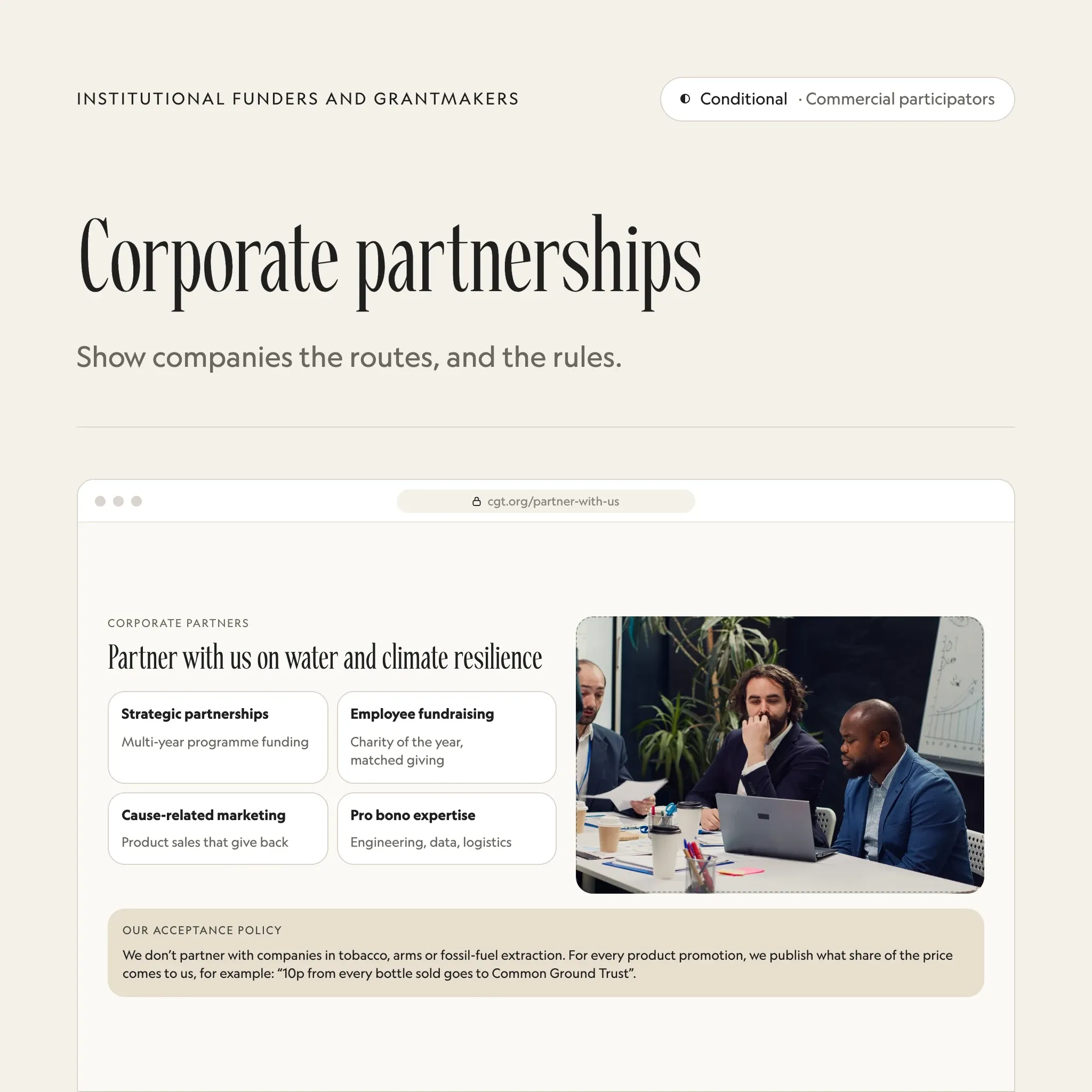
- Work with companies on clear terms.
- What goes on it
- How you partner with companies, your ethical acceptance policy, and what a partner must say when it promotes you.
- Conditional: Promotions by a commercial participator (England and Wales)
- When a company says its sales will benefit your charity, the Charities Act 1992 requires its promotion to name the charity and say how much will go to it. The duty falls on the company's promotion, not on your partnerships page, but the page is where you set the expectation.
- What it is for
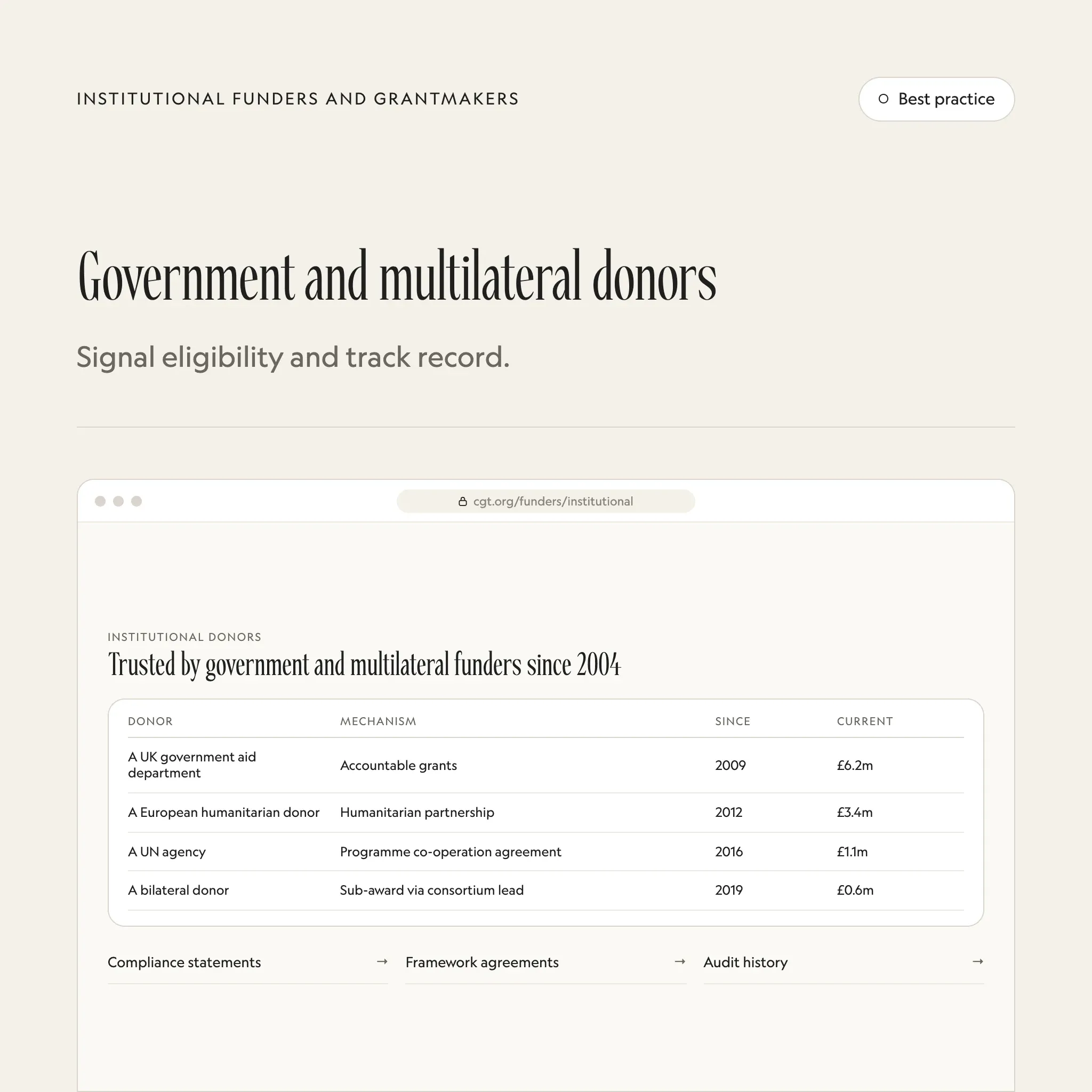
- Show your record with institutional aid.
- What goes on it
- The government and multilateral donors you have worked with, framework agreements, and compliance statements.
- Best practice
- No duty. Name only the funders the agreements allow you to name.
- What it is for
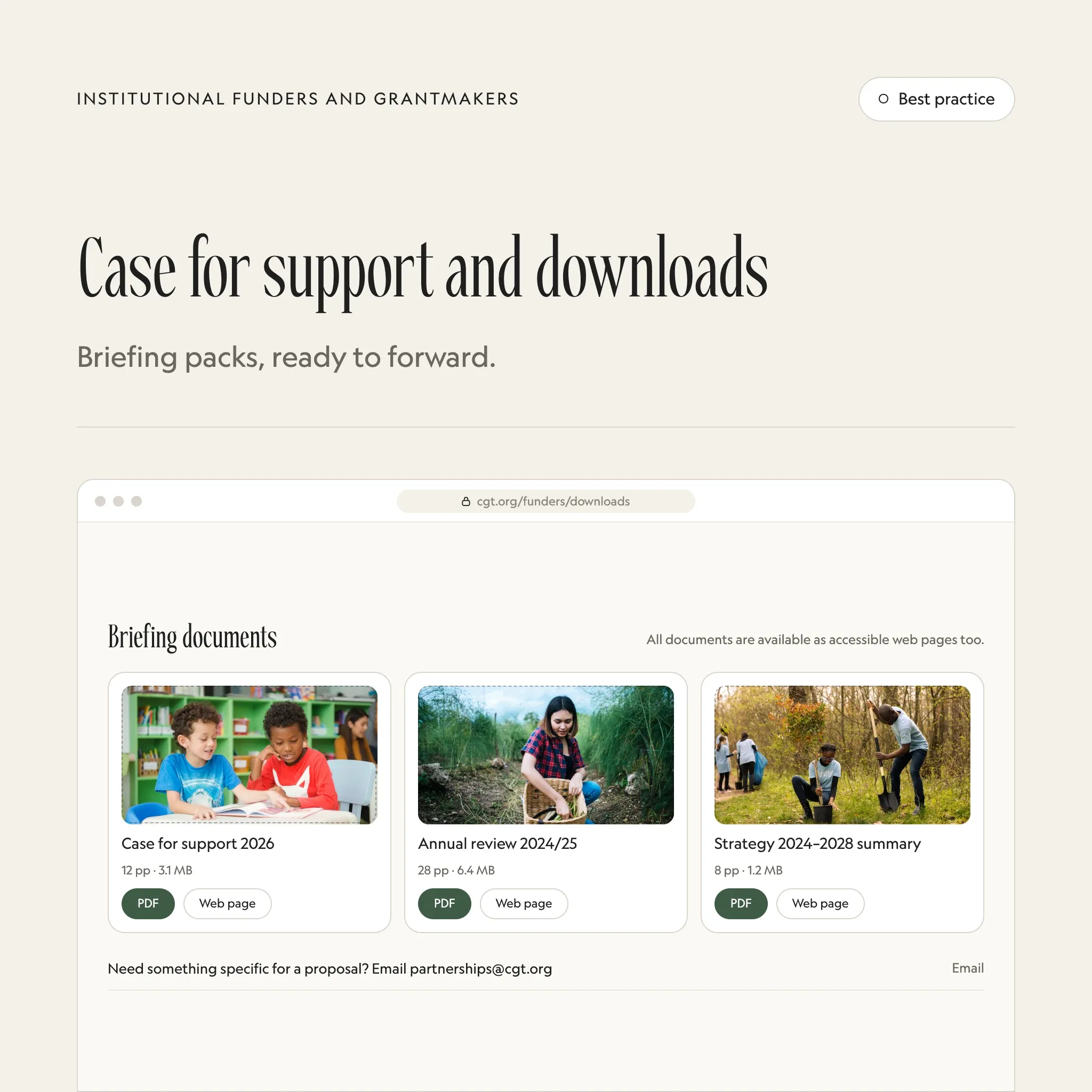
- Hand over a briefing pack.
- What goes on it
- Your case for support, annual review and strategy summary, each as a PDF and an accessible web page.
- Best practice
- No duty. A PDF alone is the version a screen reader user and a phone user both struggle with.
- Go further
- Publishing your annual report online
- What it is for
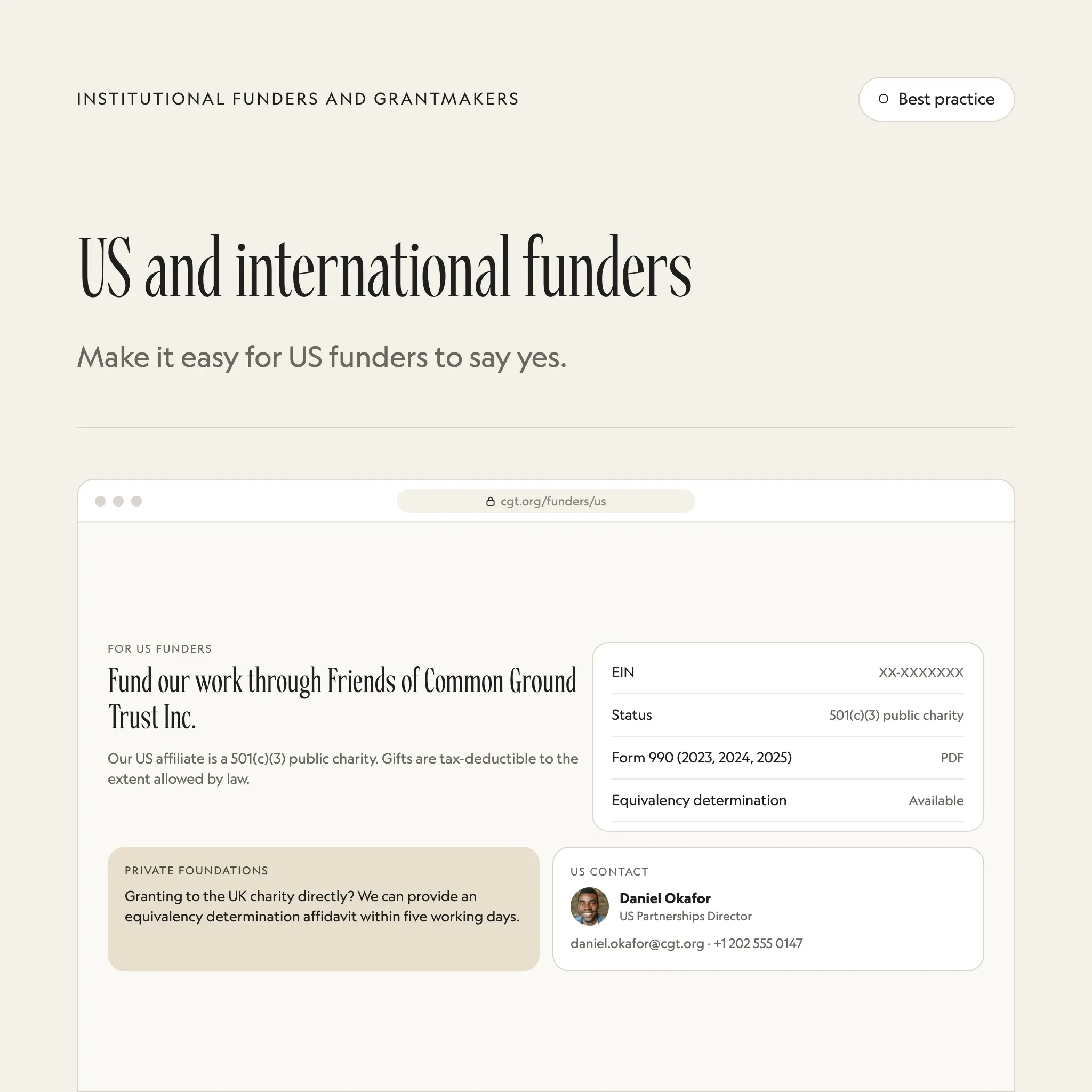
- Answer a US grantmaker's first questions.
- What goes on it
- Your US affiliate and its EIN, or how US gifts reach you, with a link to the US disclosures (section 90).
- Best practice
- No duty on the UK site. The disclosure duties belong to the US entity, which can meet them by publishing its returns online (section 90).
- Go further
- What a US 501(c)(3) should show online
Service users
- What it is for
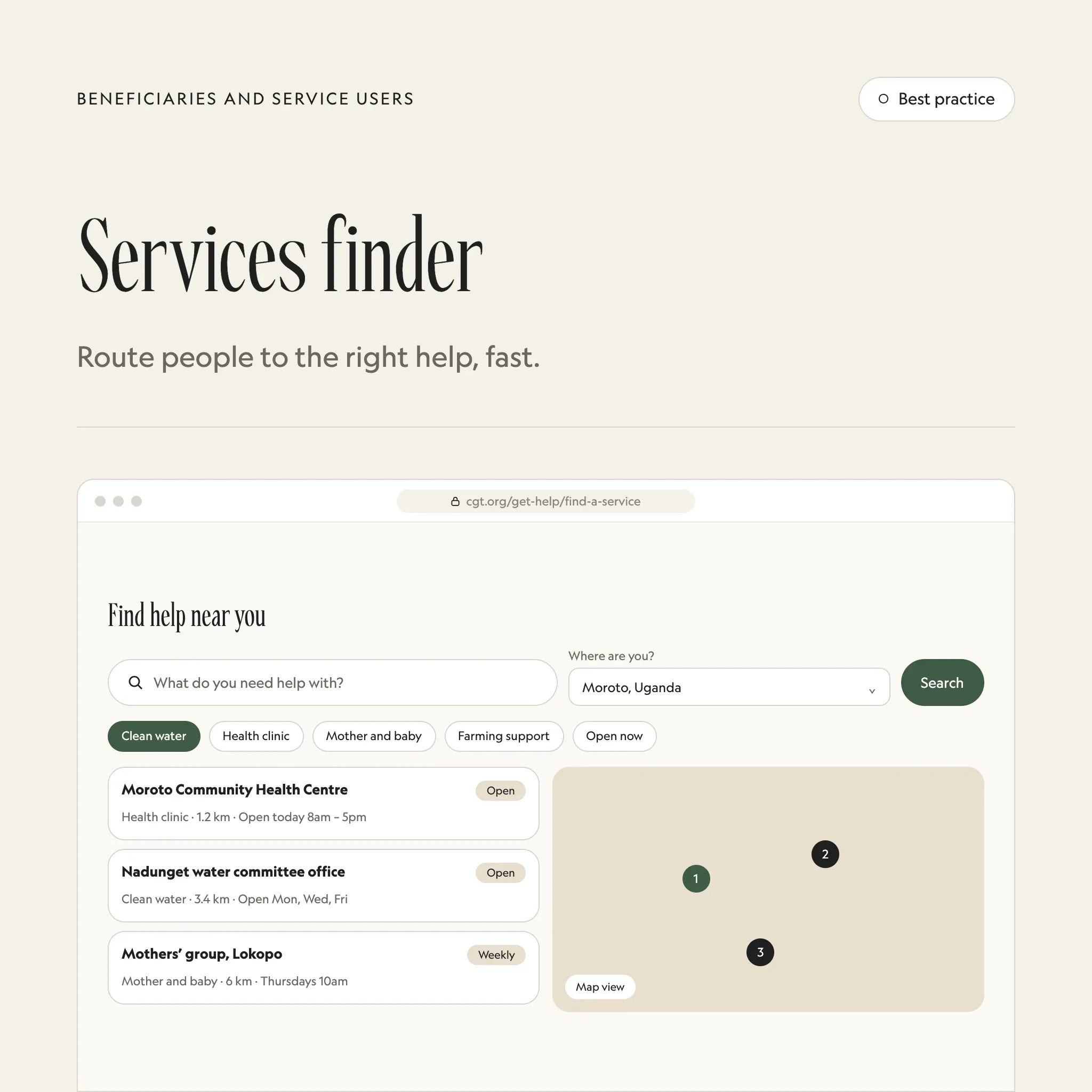
- Route people to the right help quickly.
- What goes on it
- Search by need and by place, a card per service with opening hours, and a map where location matters.
- Best practice
- No law requires a searchable directory. It is the difference between a person finding help and a person phoning the wrong office.
- What it is for
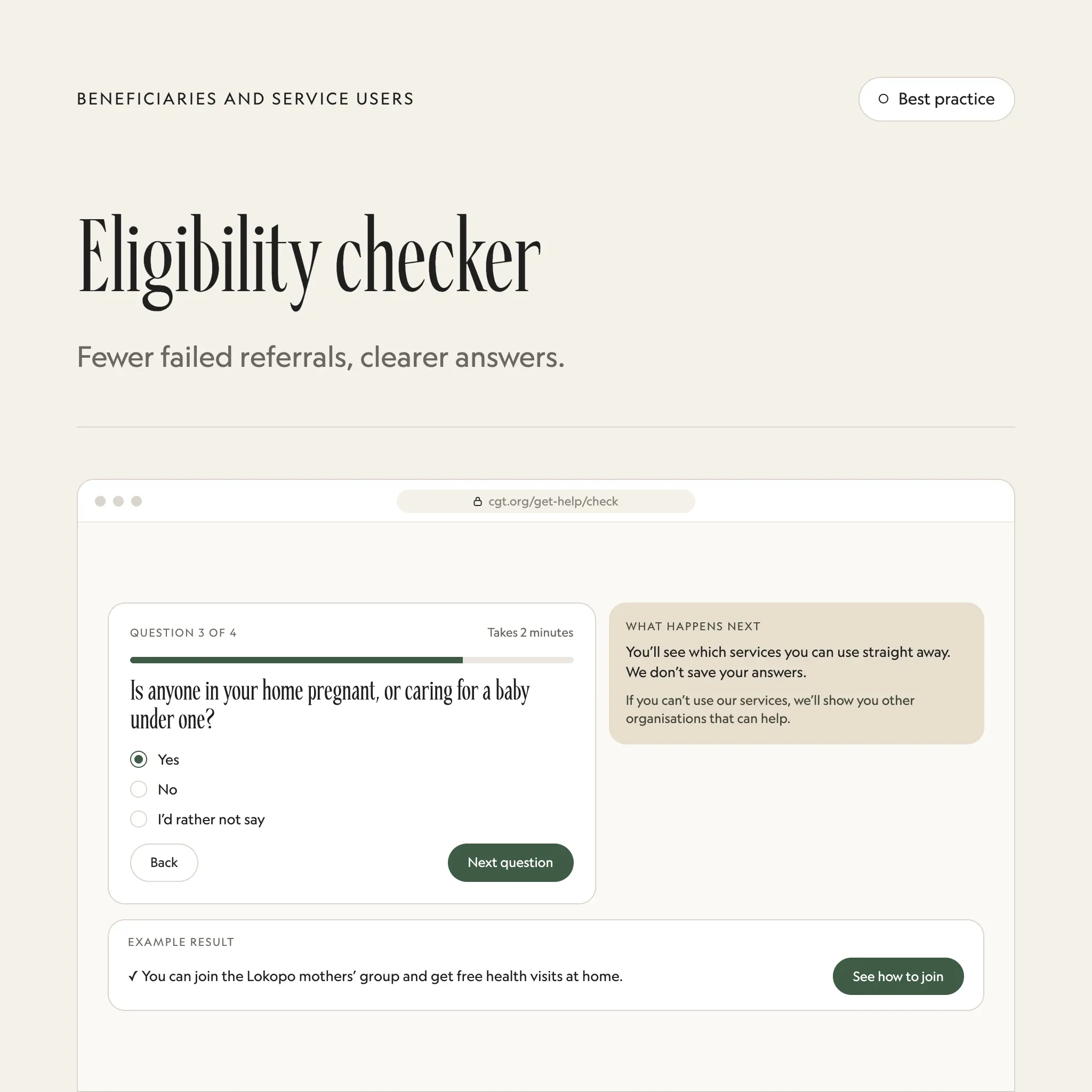
- Cut the number of referrals that fail.
- What goes on it
- Three to five questions, a plain-English answer, and somewhere else to go when the answer is no.
- Best practice
- No law requires one. It spares a person in difficulty a form they were never going to qualify through.
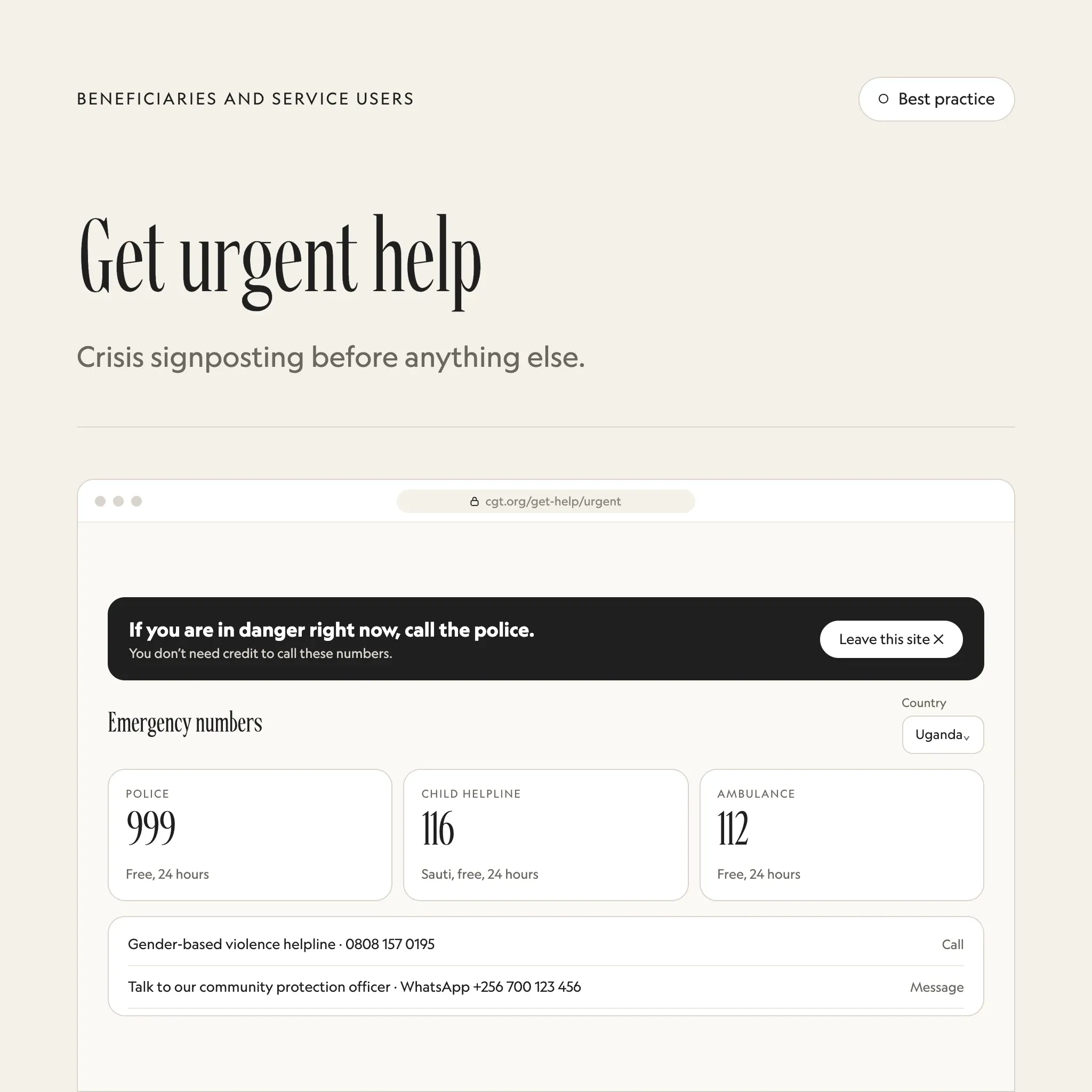
- What it is for
- Put crisis contacts first.
- What goes on it
- An "if you are in danger" line with the emergency number for each country you work in, helplines, and call buttons large enough to hit on a phone.
- Best practice
- No law requires crisis signposting on a charity site. A service that deals with risk and hides the emergency route behind its menu has made a choice about who the site is for.
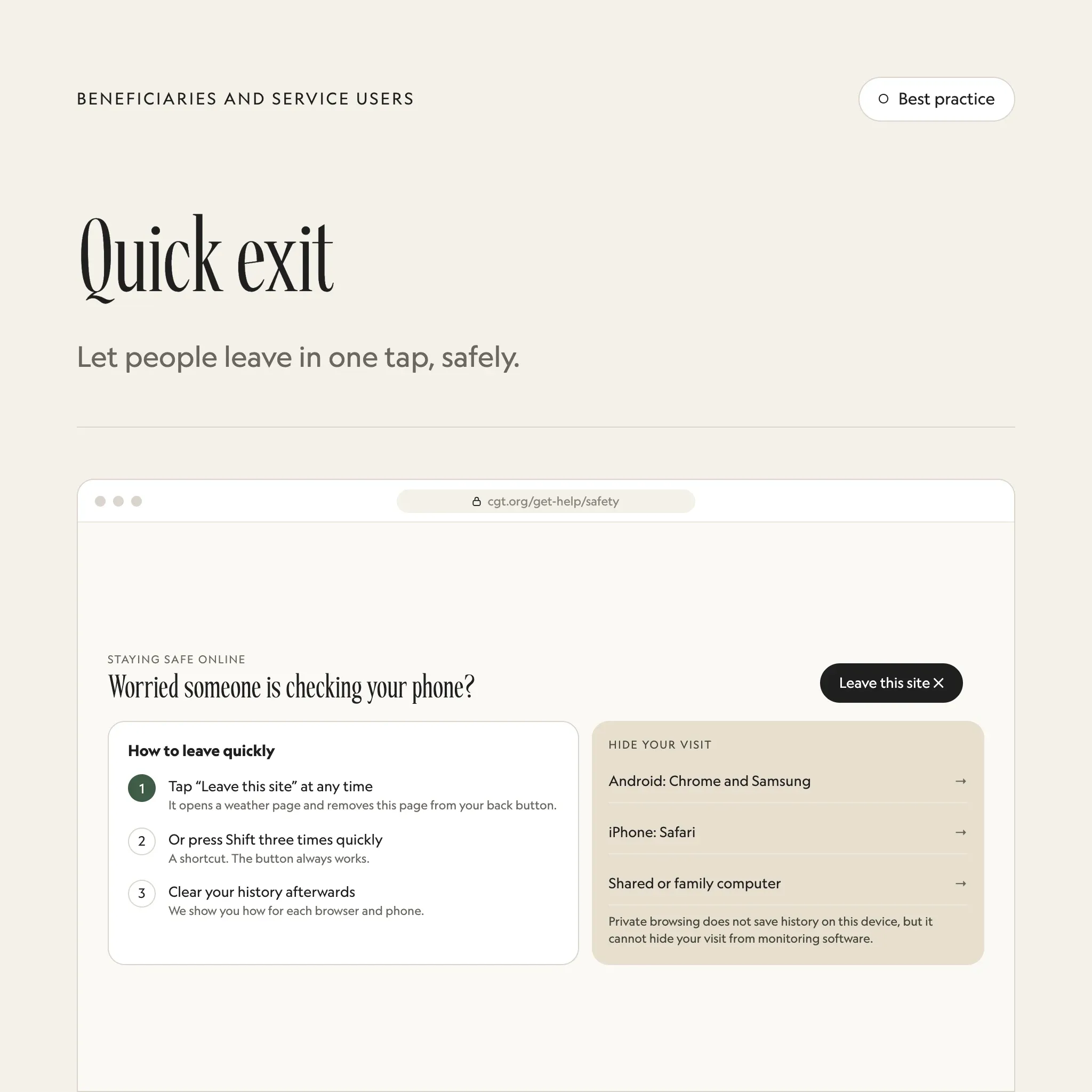
- What it is for
- Let someone at risk leave the site in one tap.
- What goes on it
- A persistent exit button that keyboard users can reach, an optional shortcut on top of it, and guidance on clearing browsing history, because the button does not.
- Best practice
- No statutory duty. It is the expected convention for services whose users may be watched by the person harming them, such as domestic abuse support.
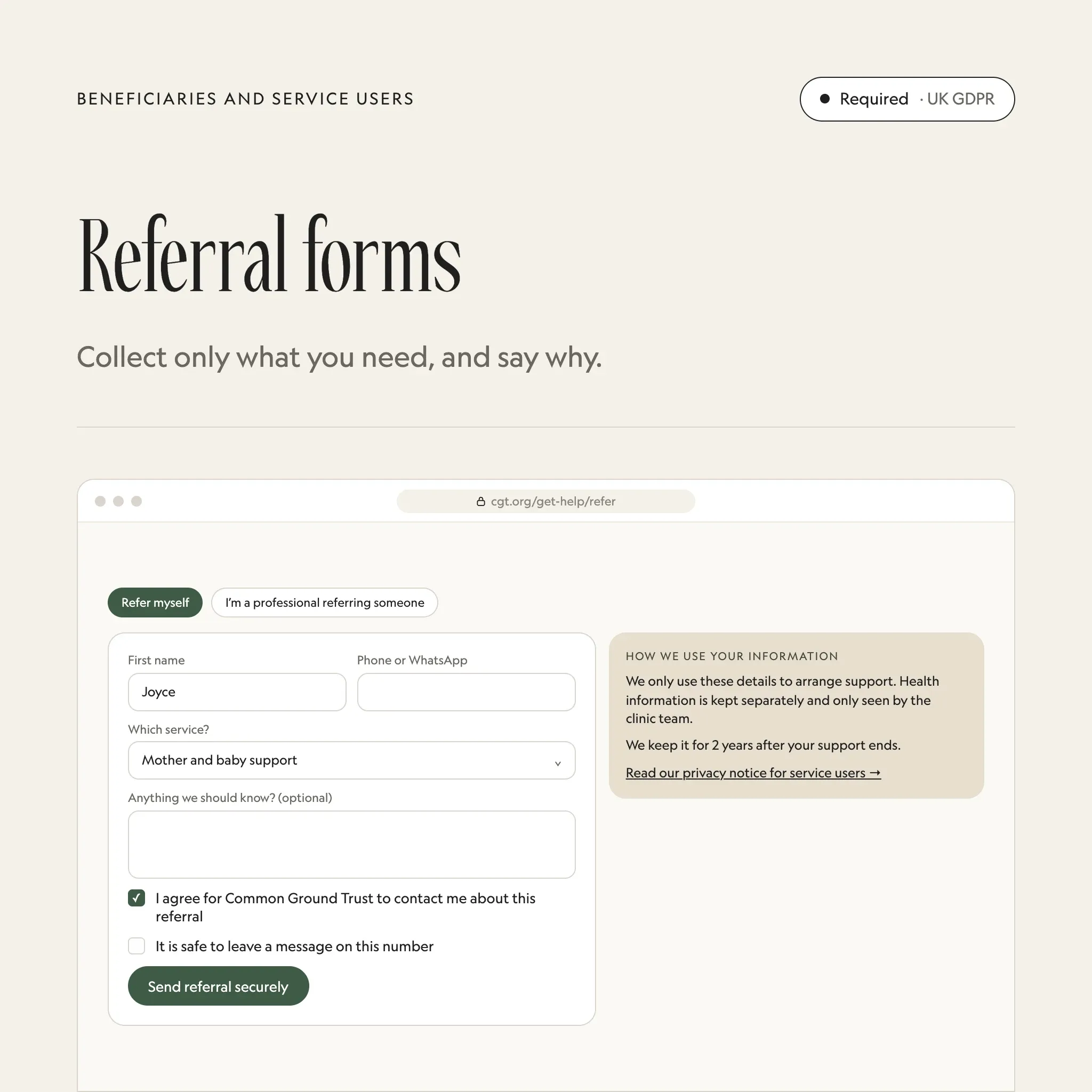
- What it is for
- Accept self and professional referrals lawfully.
- What goes on it
- The fewest fields that will do, the privacy information at the point of collection, consent wording, and secure submission.
- Required: Any form that collects personal data (UK and EU)
- Article 13 of the UK GDPR requires privacy information when data is collected from the person it is about, so the form must carry or link to it. When a professional refers someone else, Article 14 applies to that person instead. Health information is special category data under Article 9, which shapes the consent wording rather than adding a page.
- Go further
- The GDPR checklist for a charity website
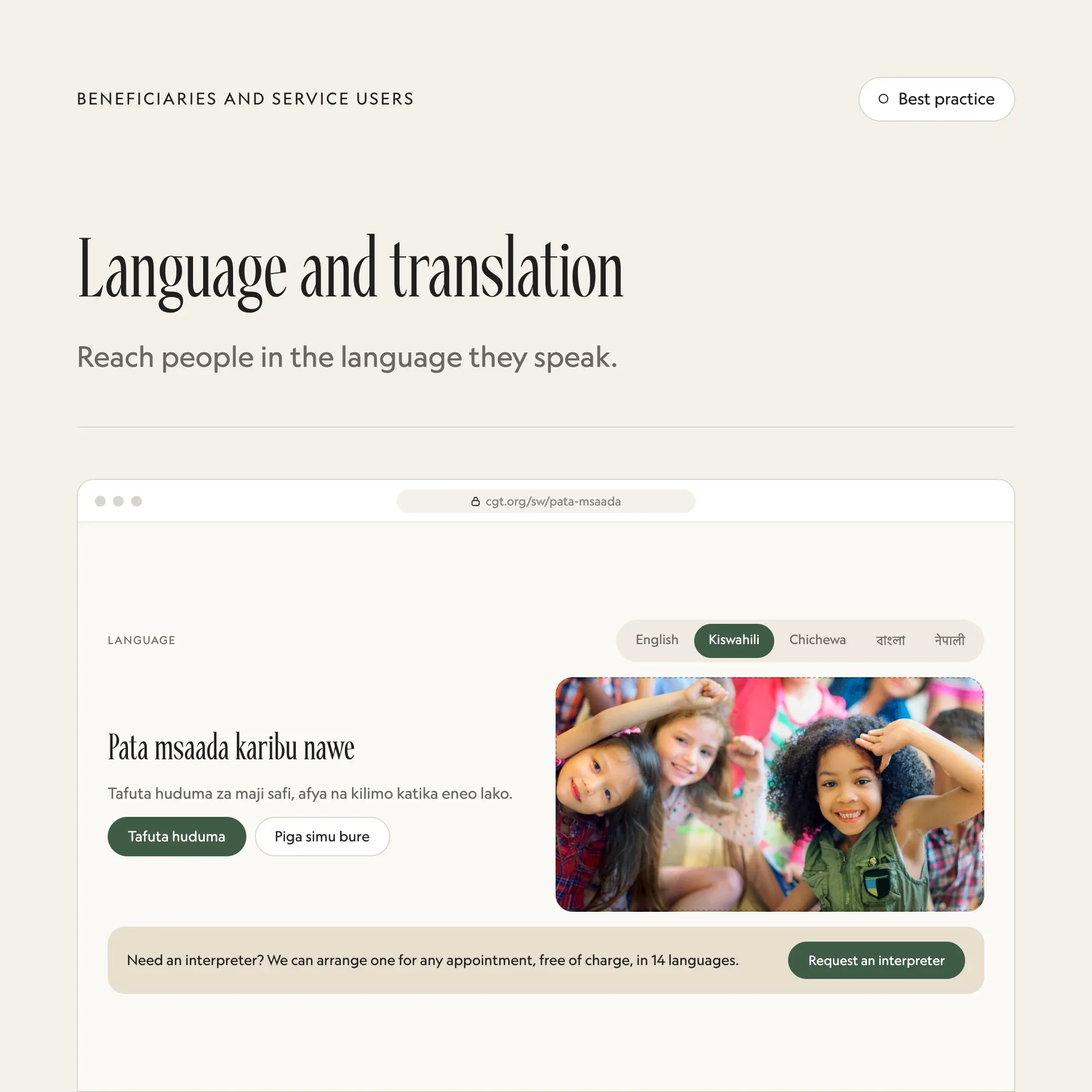
- What it is for
- Reach people who do not read English.
- What goes on it
- A language switcher that names each language in its own script, the key pages translated, and an offer of an interpreter.
- Best practice
- No general duty. The Welsh Language Standards bind only a body the Welsh Language Commissioner has issued a compliance notice to. A charity delivering public services in Wales under a government or council arrangement falls in a category that could be brought in, but only by regulations and a notice.
- Sources
- What it is for
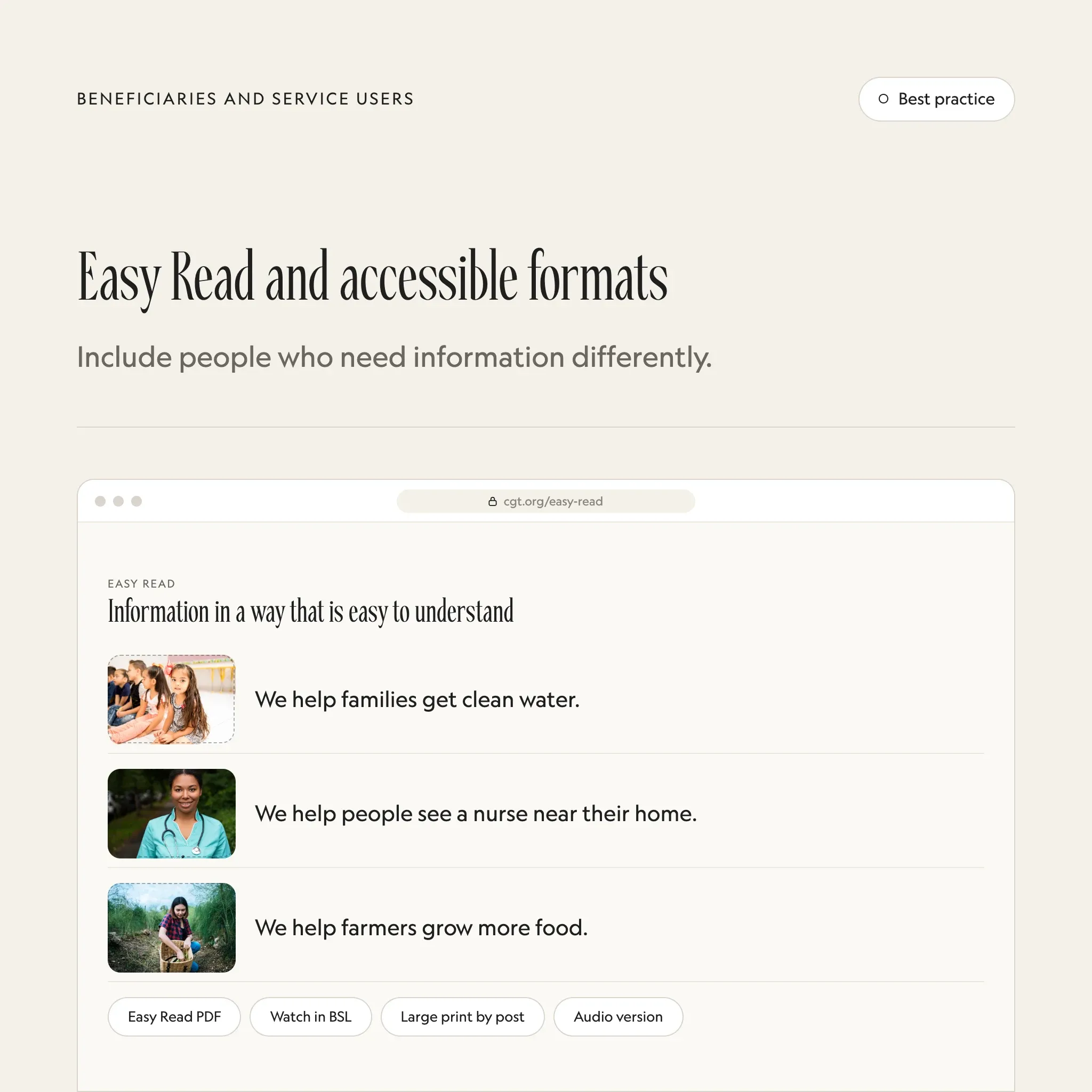
- Include people with learning disabilities and other access needs.
- What goes on it
- Easy Read pages, BSL video, and large print or audio on request.
- Best practice
- In Great Britain a service provider owes disabled people a reasonable-adjustment duty that anticipates need, and it covers providing information in an accessible format. No provision names Easy Read, BSL or large print, so the formats are your judgement, but the duty behind them is not optional.
- What it is for
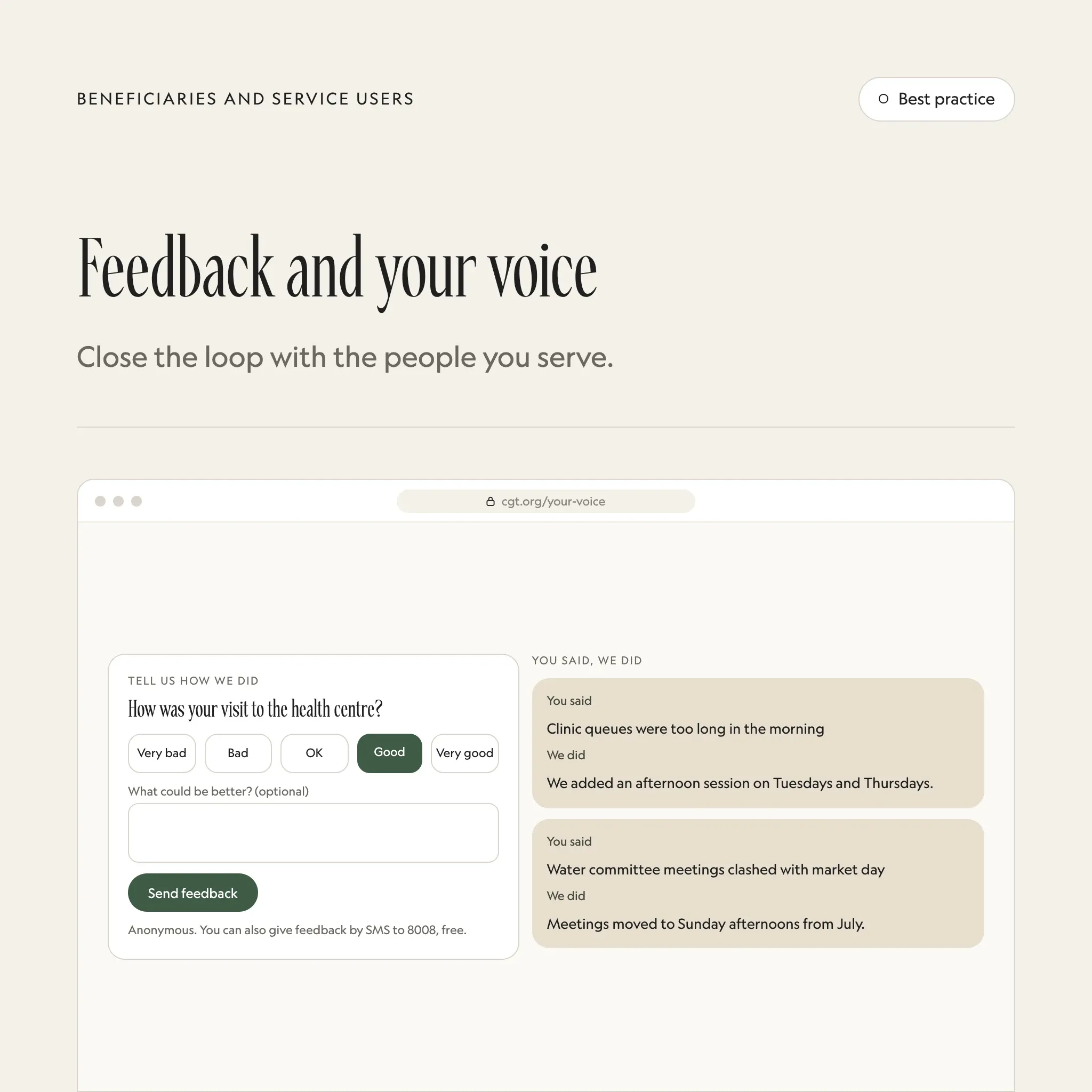
- Close the loop with the people you serve.
- What goes on it
- A short feedback form, a "you said, we did" record, and ways to take part.
- Best practice
- No legal duty. In the Charity Commission's 2026 research, 18% of the public chose listening to feedback from supporters and service users as important to their trust. The Core Humanitarian Standard, a voluntary standard, covers participation (Commitment 1) and learning from feedback (Commitment 7).
- What it is for
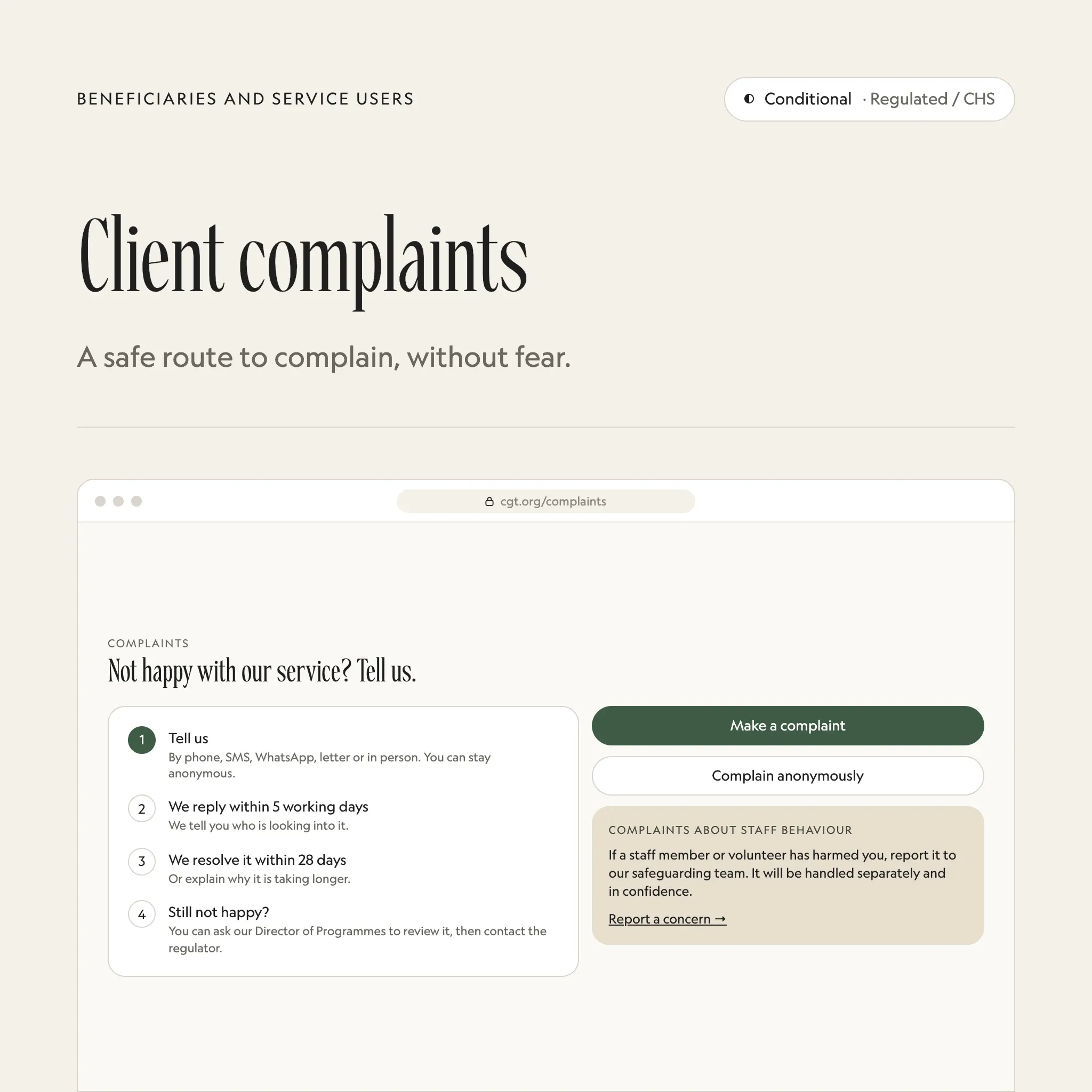
- Give people a safe, simple way to complain.
- What goes on it
- The steps, the timescales, whether anonymity is possible, and where to go next if you do not resolve it.
- Conditional: Providers registered with the CQC in England. Otherwise best practice
- Regulation 16 requires a CQC-registered provider to run an accessible complaints system, and CQC guidance says information on how to complain must be available to everyone using the service. Neither names a website; it is simply the route most people will try first. For humanitarian organisations, Commitment 5 of the Core Humanitarian Standard is a certification commitment, not a legal one.
- Sources
- What it is for
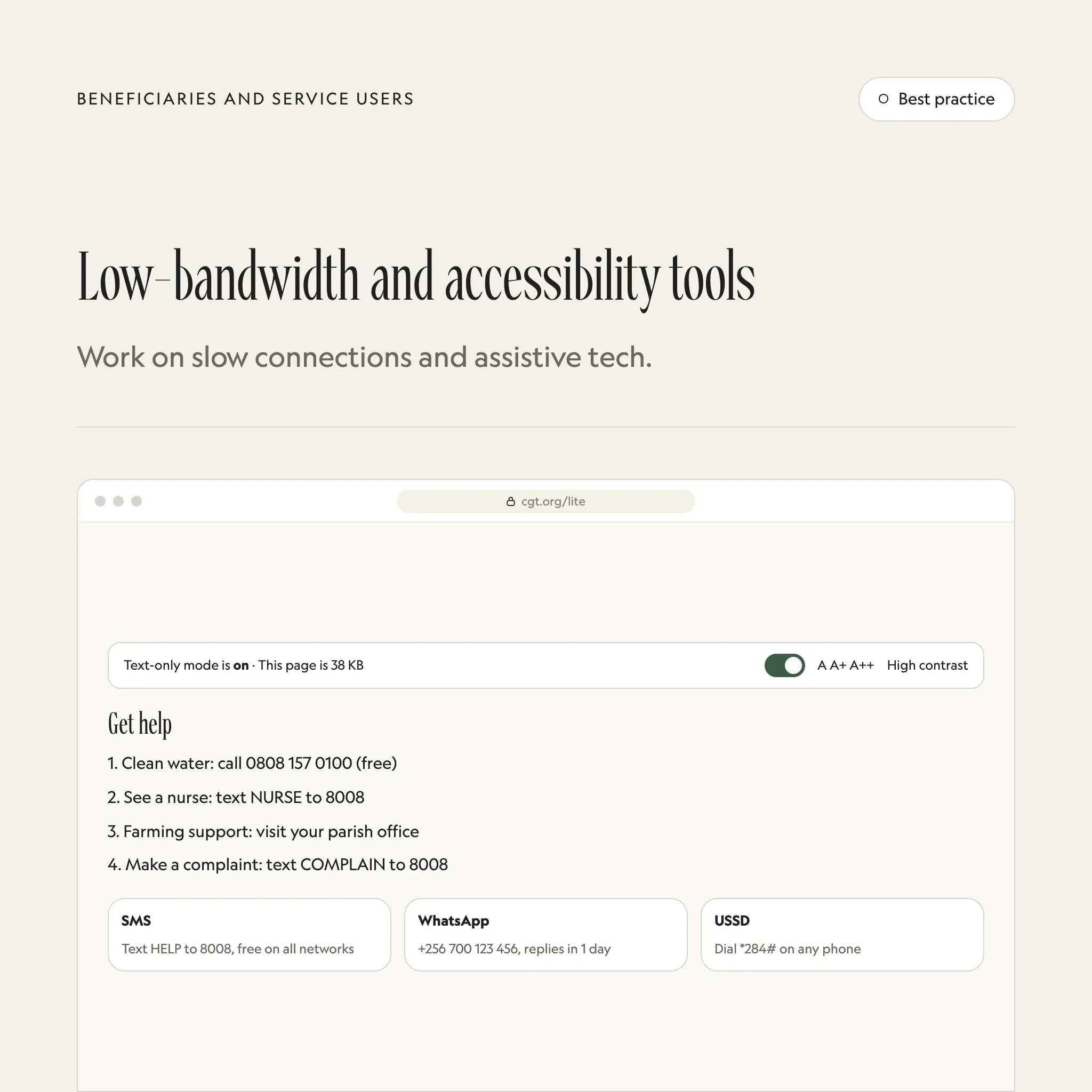
- Work on a slow connection and an old phone.
- What goes on it
- Light pages, a text-only route to the essentials, and contact by SMS or messaging app.
- Best practice
- No law requires it. For an international NGO, the people a programme serves are often the ones on the weakest connection.
Volunteers and candidates
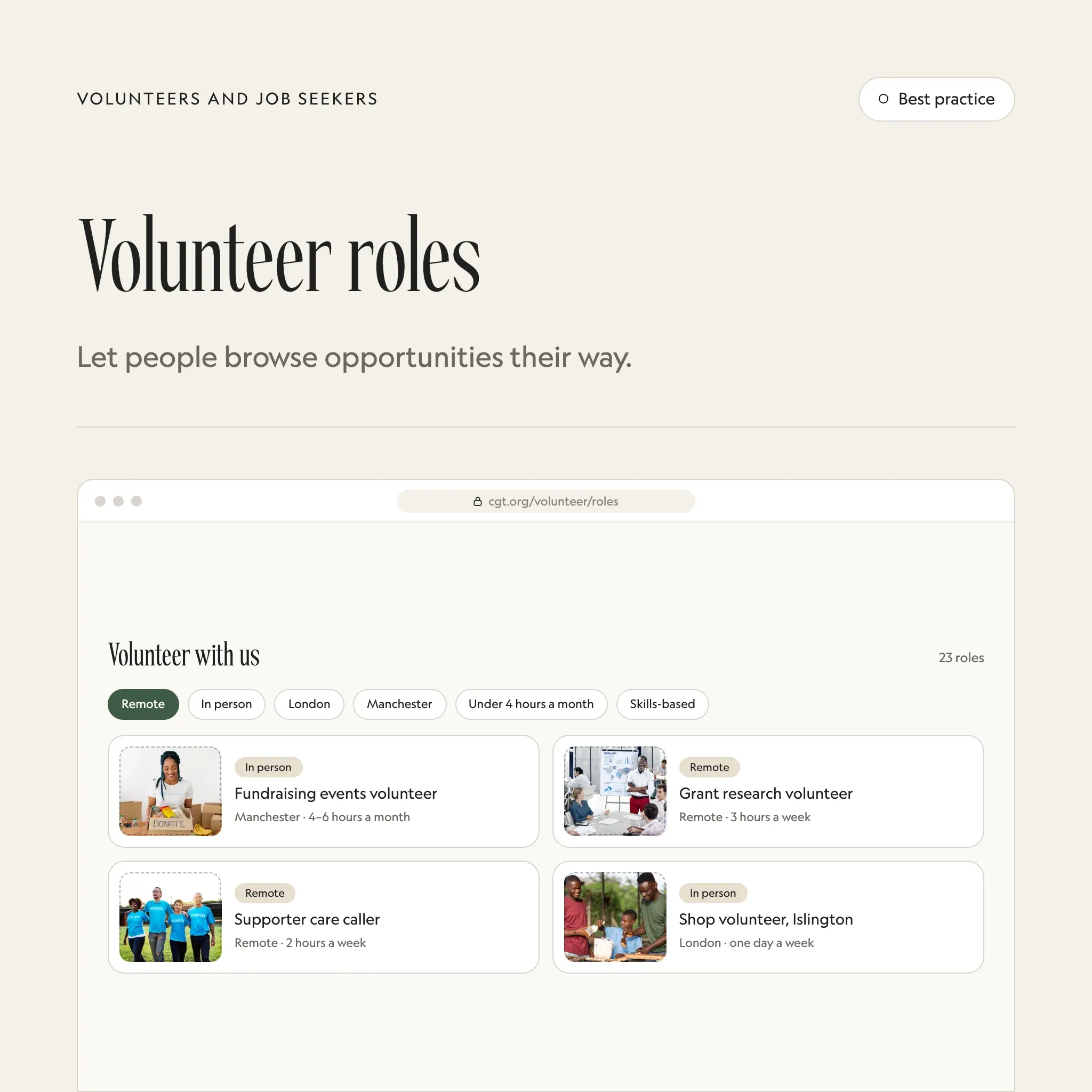
- What it is for
- Let people find a role that fits.
- What goes on it
- Filters for remote or in person, time, place and skills, with a card per role.
- Best practice
- No law requires it. NCVO's 2023 survey found 18% of volunteers in Great Britain volunteered only remotely, which is the case for a remote filter.
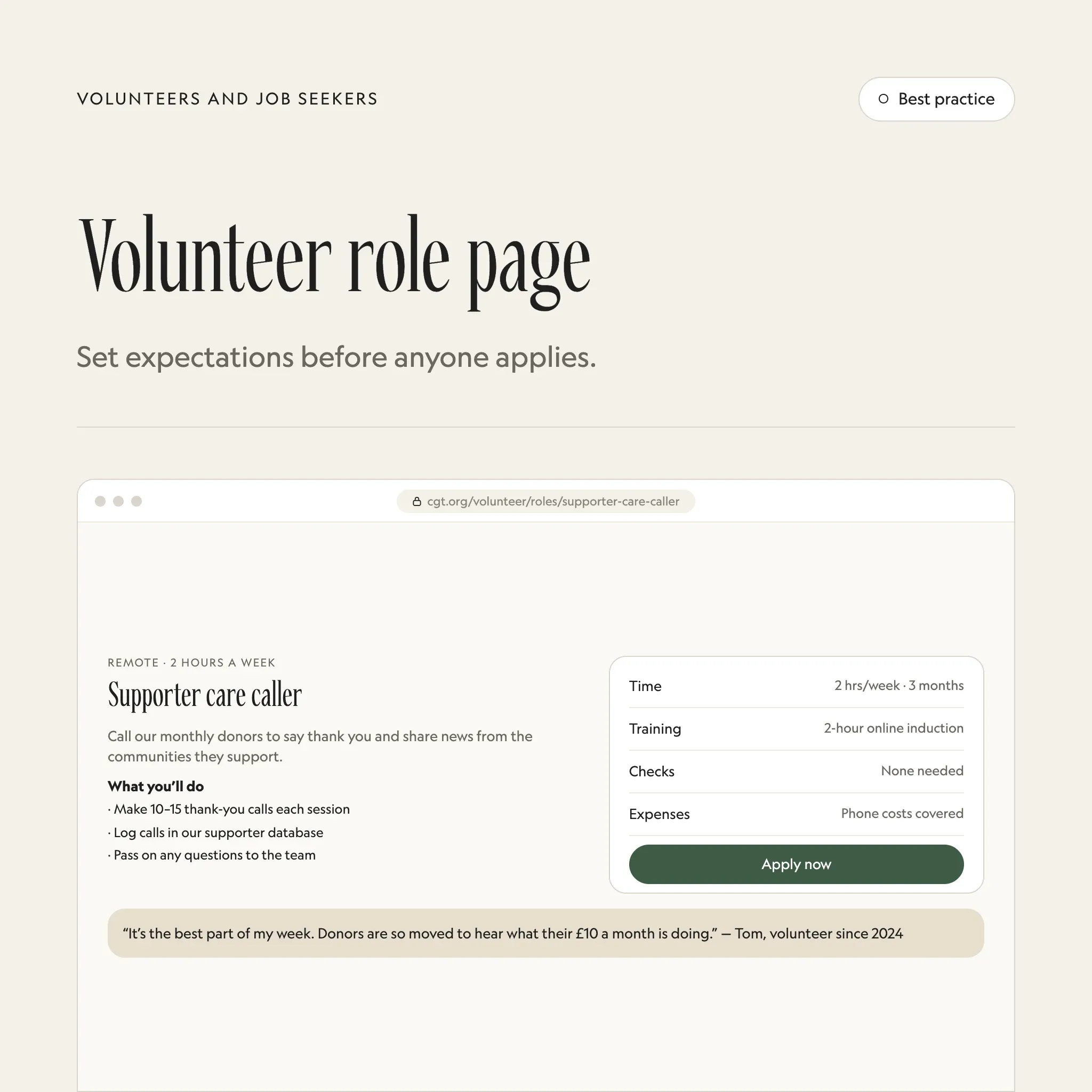
- What it is for
- Set expectations before anyone applies.
- What goes on it
- Tasks, time, training, any check the role needs, what expenses are paid, and what difference it makes.
- Best practice
- No law requires the page. Where the role needs a criminal record check, applicants must be told in advance (section 36), and the role page is the natural place to do it.
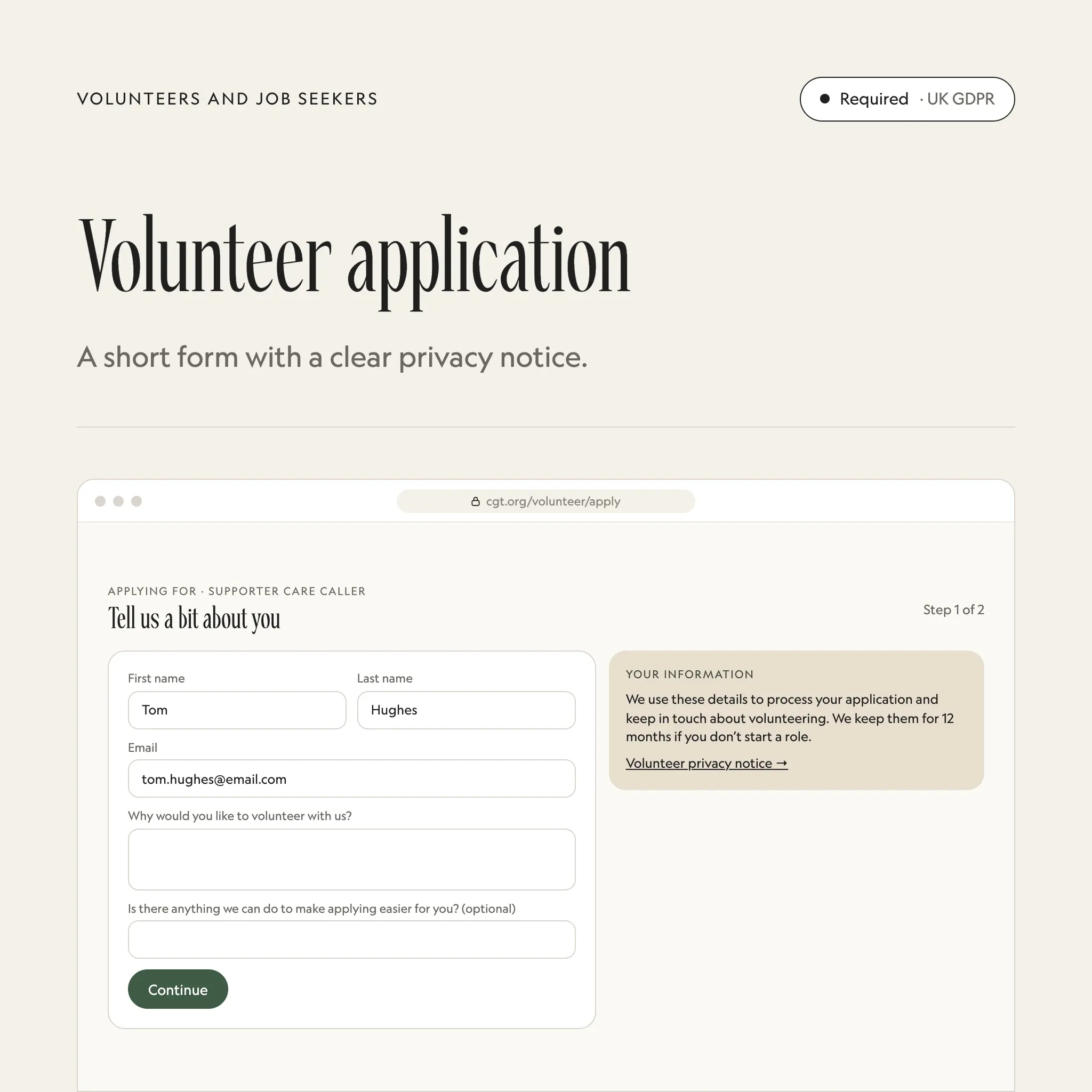
- What it is for
- Take applications lawfully.
- What goes on it
- A short form, the privacy information at the point of collection, and a question about adjustments.
- Required: Any application form that collects personal data (UK and EU)
- Article 13 of the UK GDPR makes the privacy information required. The adjustments question is good practice, not a legal duty: volunteers without a contract are generally outside the Equality Act's employment protections.
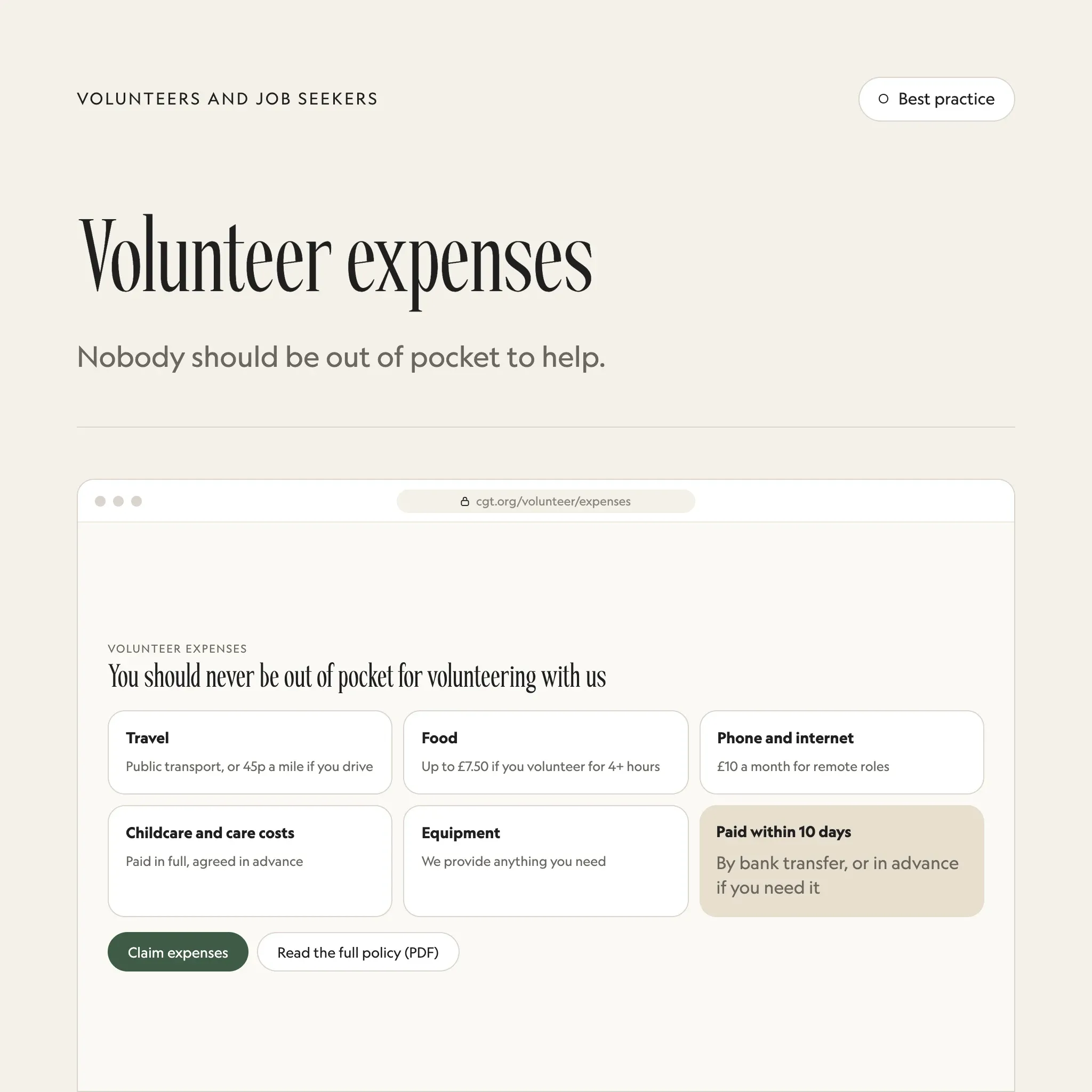
- What it is for
- Remove the cost of volunteering.
- What goes on it
- What is covered, how to claim, and how long payment takes.
- Best practice
- No law requires a published policy. In NCVO's 2023 survey, 14% of people in Great Britain who had not volunteered in the past year gave being out of pocket as a reason.
- What it is for
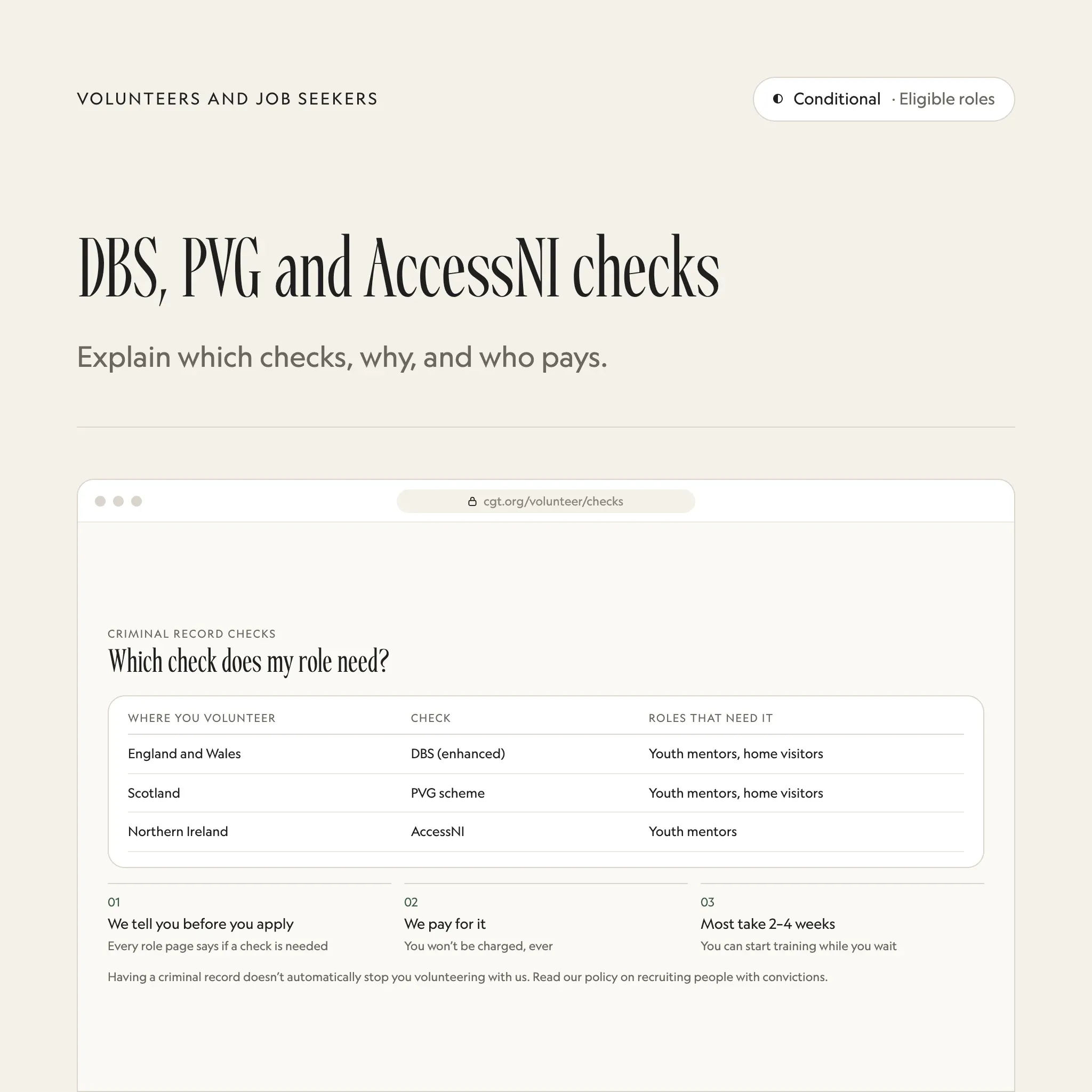
- Explain which roles need a check, and how it works.
- What goes on it
- Which check applies in each UK nation (DBS, PVG, AccessNI), the process, who pays, and your policy on ex-offenders.
- Conditional: Roles eligible for a DBS, PVG or AccessNI check
- There is no duty to publish a page. But a registered body using DBS checks must tell applicants in advance that a check is required and have a written policy on recruiting ex-offenders available on request (a charity checking through an umbrella body should do the same), and AccessNI users need the same policy. In Scotland, PVG membership has been a legal requirement for regulated roles, paid or voluntary, since 1 April 2025.
- Sources
- Go further
- Safeguarding in digital communications
- What it is for
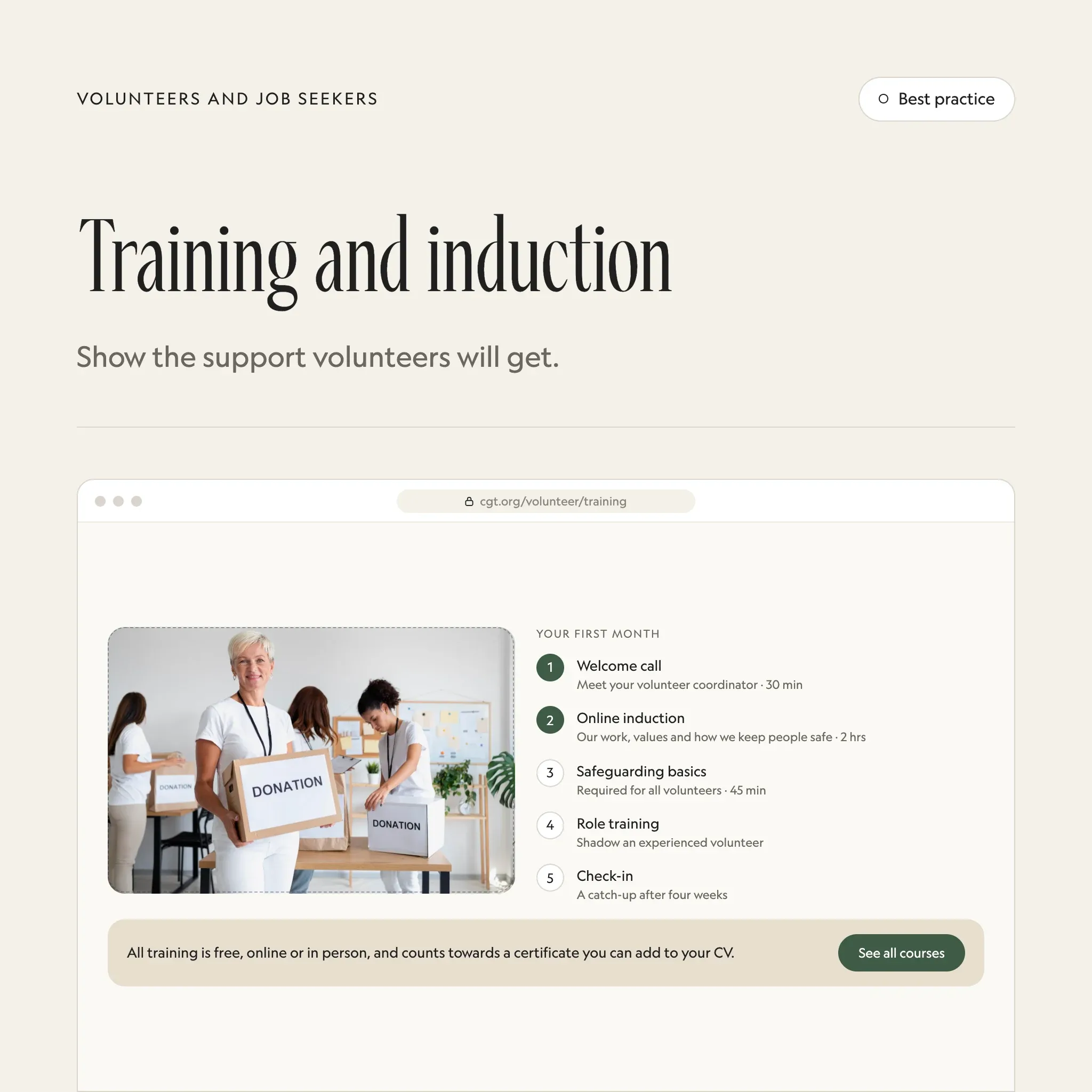
- Show the support a volunteer will get.
- What goes on it
- The induction pathway, any e-learning, and safeguarding training.
- Best practice
- No law requires publishing it. It answers the question most new volunteers are too polite to ask.
- What it is for
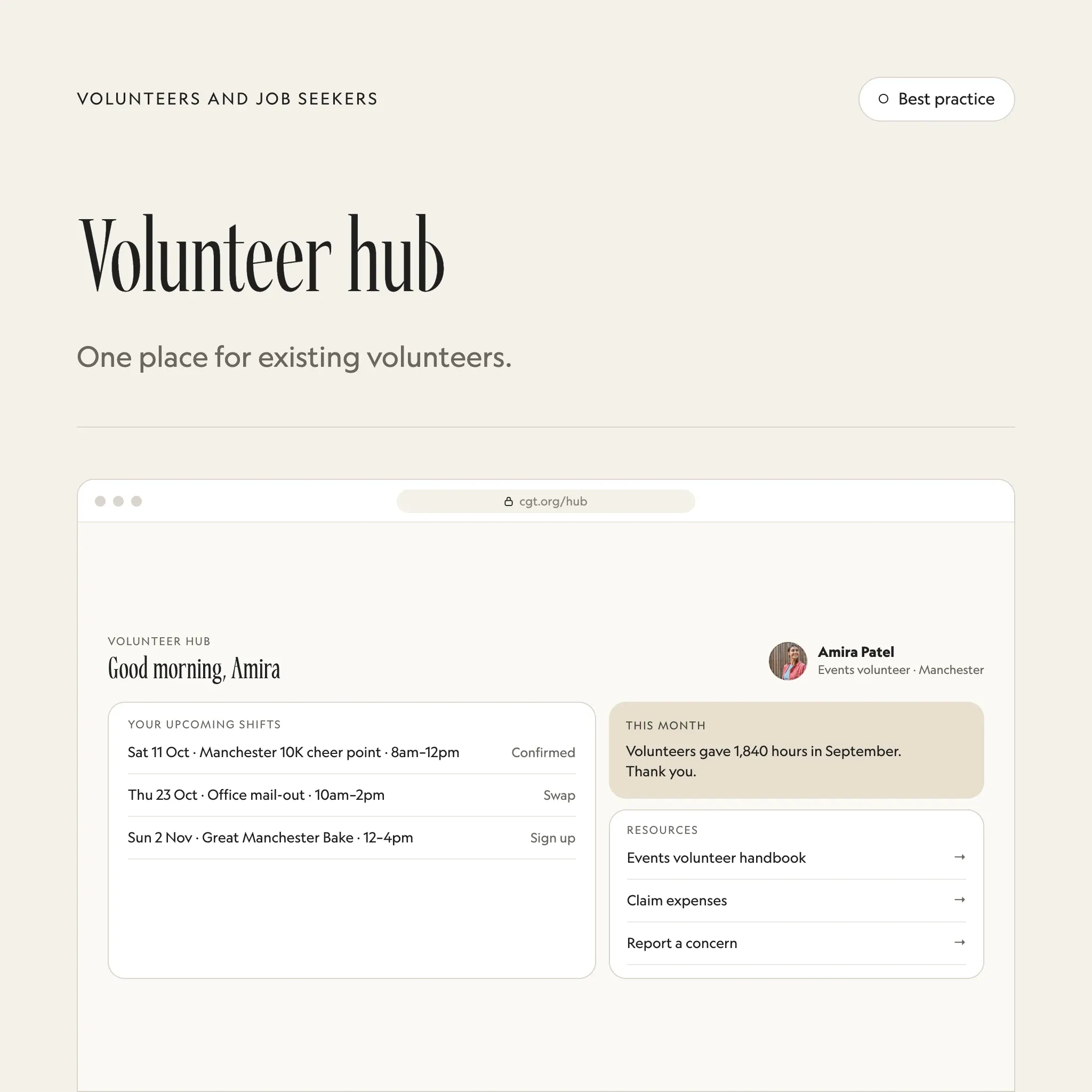
- Serve the volunteers you already have.
- What goes on it
- Rotas, resources, news and a secure sign-in.
- Best practice
- No law requires one. If it holds personal data it inherits every data protection duty the rest of the site has.
- What it is for
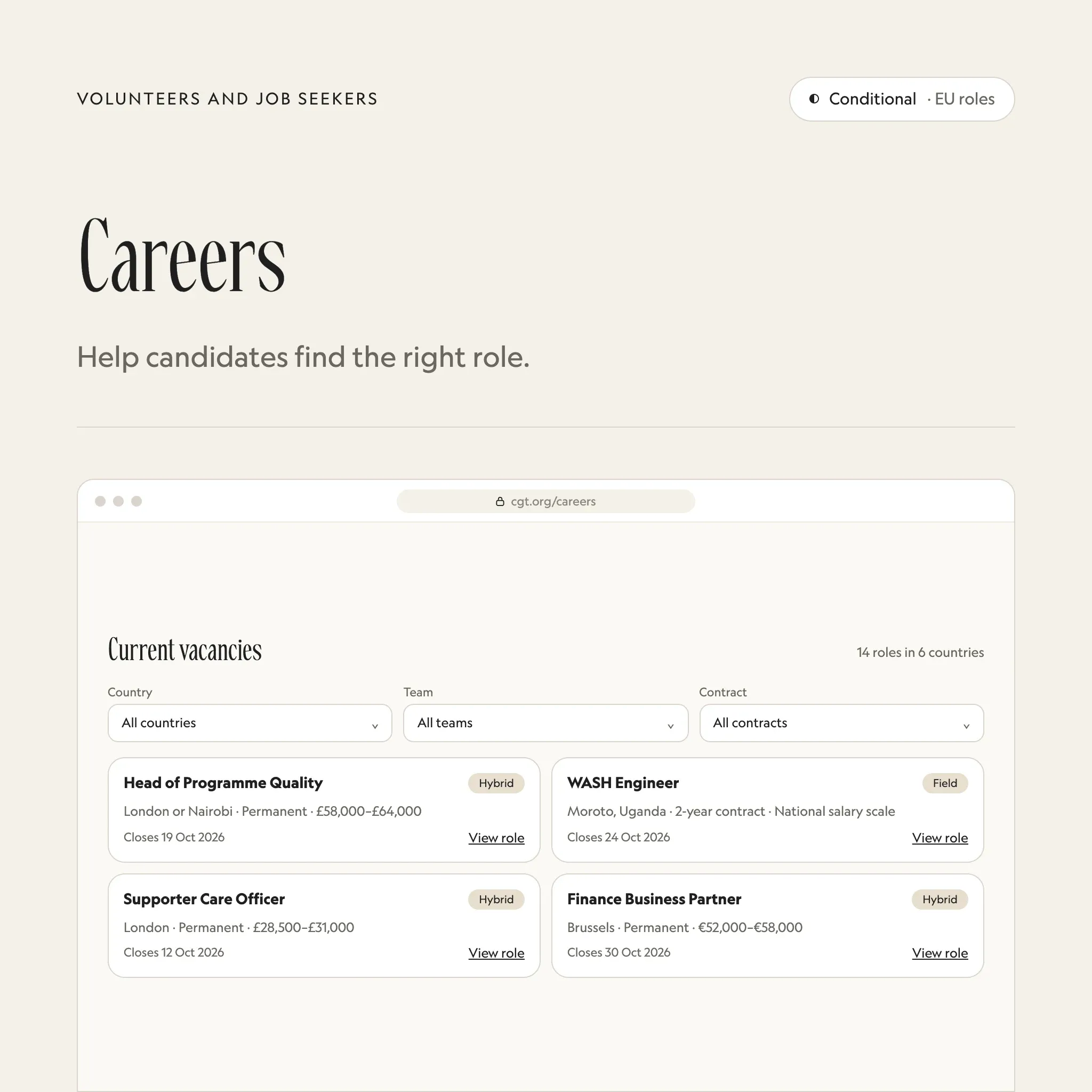
- Attract candidates.
- What goes on it
- Vacancies filterable by country and function, closing dates, and a job pack for each role.
- Conditional: Roles based in an EU member state. Otherwise best practice
- The EU Pay Transparency Directive had to be transposed by 7 June 2026, and it binds employers through each country's own law. It requires gender-neutral vacancy notices and job titles, and gives applicants the right to know the starting pay or its range before interview. There is no UK equivalent.
- Sources
- Seen on
- Tearfund: Work with us
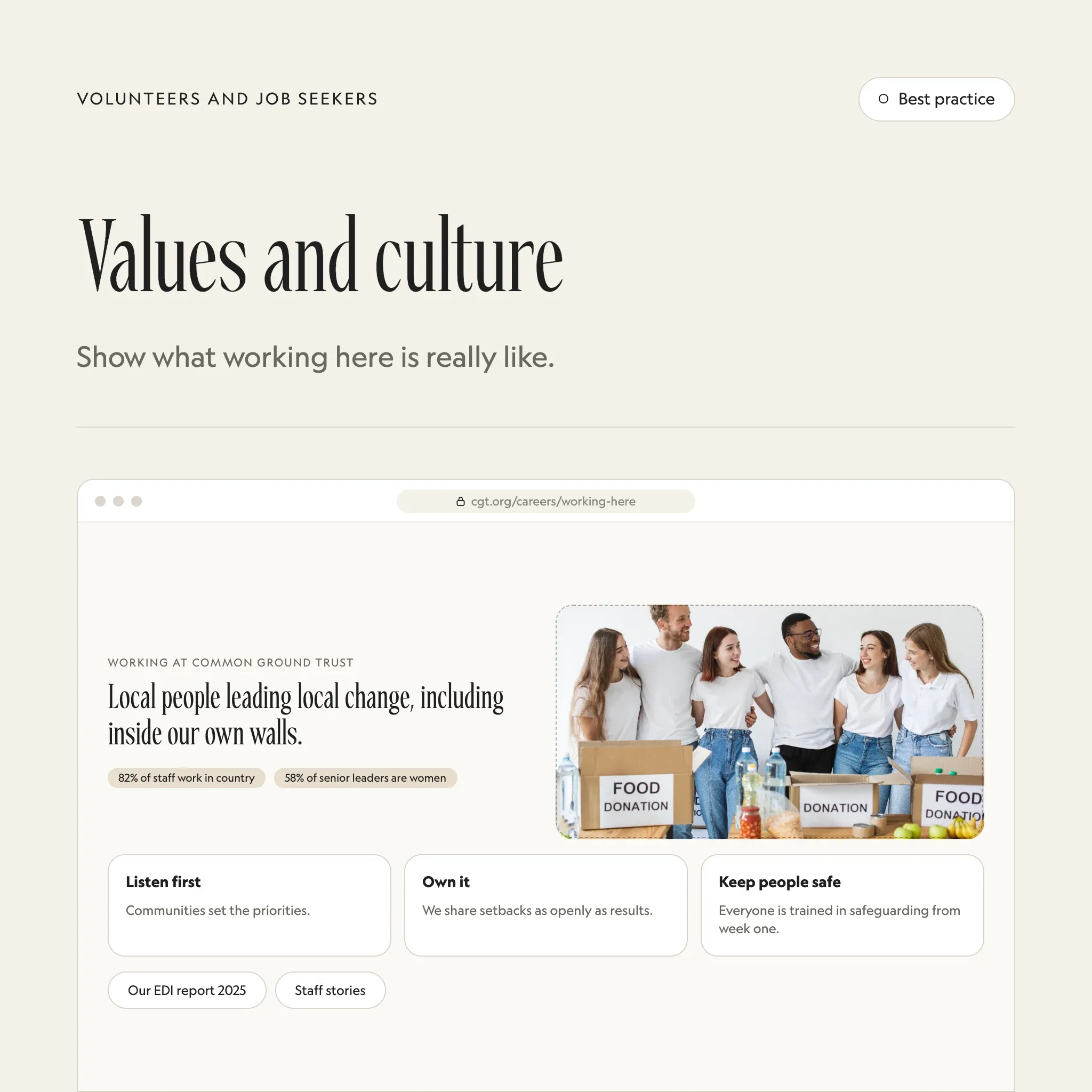
- What it is for
- Say what working here is like.
- What goes on it
- Values, staff voices, equality data, and your safeguarding commitment.
- Best practice
- No law requires a values page. A safeguarding commitment on the careers page tells a candidate, and a funder, that it is part of hiring and not only of policy.
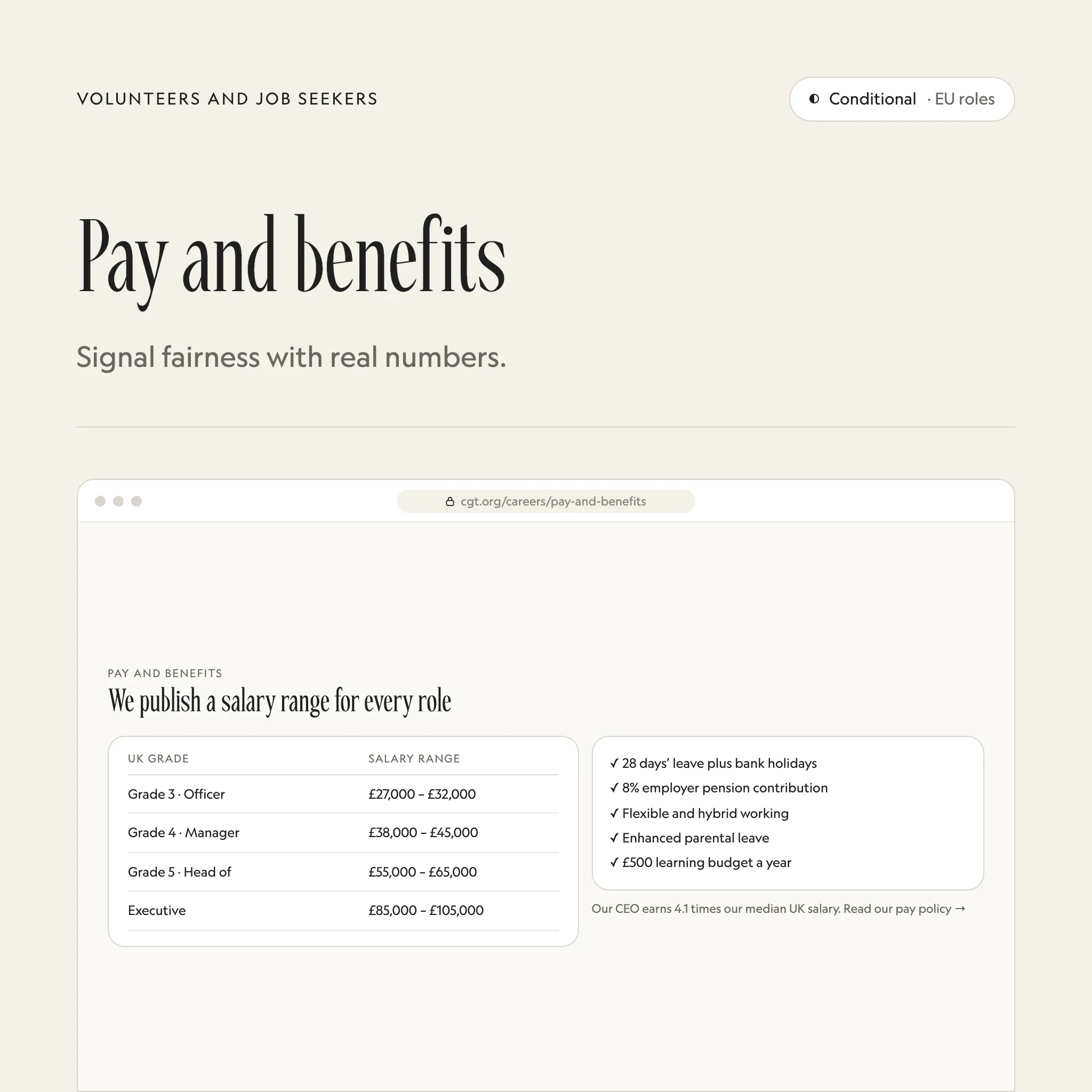
- What it is for
- Signal that reward is fair.
- What goes on it
- Salary bands, benefits, flexible working and your pay policy.
- Conditional: Roles based in an EU member state. Otherwise best practice
- Under the EU Directive an applicant must be told the starting pay or its range "such as in a published job vacancy notice, prior to the job interview or otherwise", so the advert is one way to comply, not the only one, unless a country's own law says otherwise. Employers may not ask applicants about their pay history.
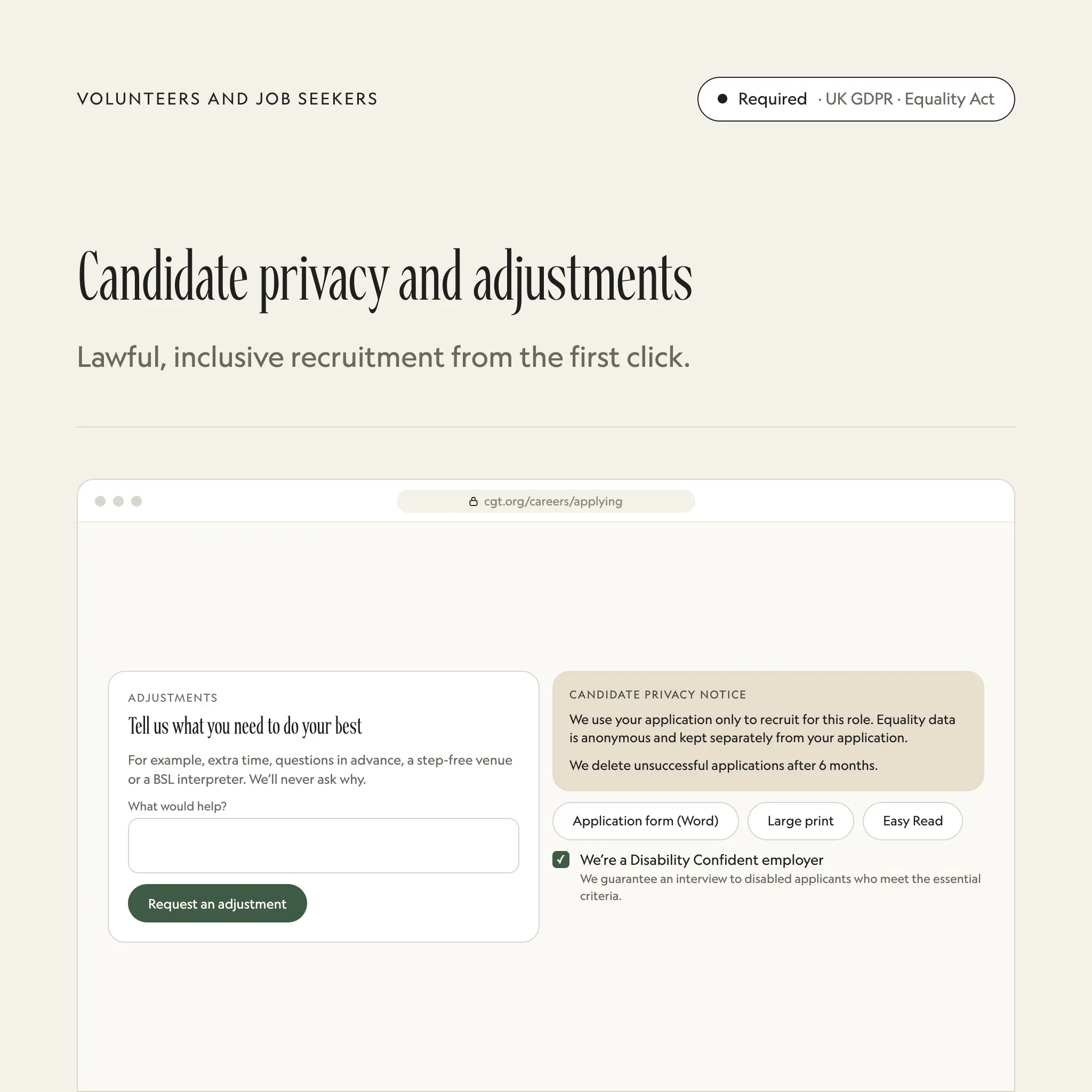
- What it is for
- Run a lawful, inclusive hiring process.
- What goes on it
- A candidate privacy notice, a route to ask for adjustments, and accessible formats for the job pack.
- Required: The privacy notice, wherever applicant data is collected (UK and EU)
- Article 13 of the UK GDPR makes the candidate privacy notice required. The adjustments route is best practice: an employer's duty to make adjustments for a disabled applicant arises once it knows, or could reasonably be expected to know, that one is applying, and the Act expressly allows asking what adjustments the assessment will need.
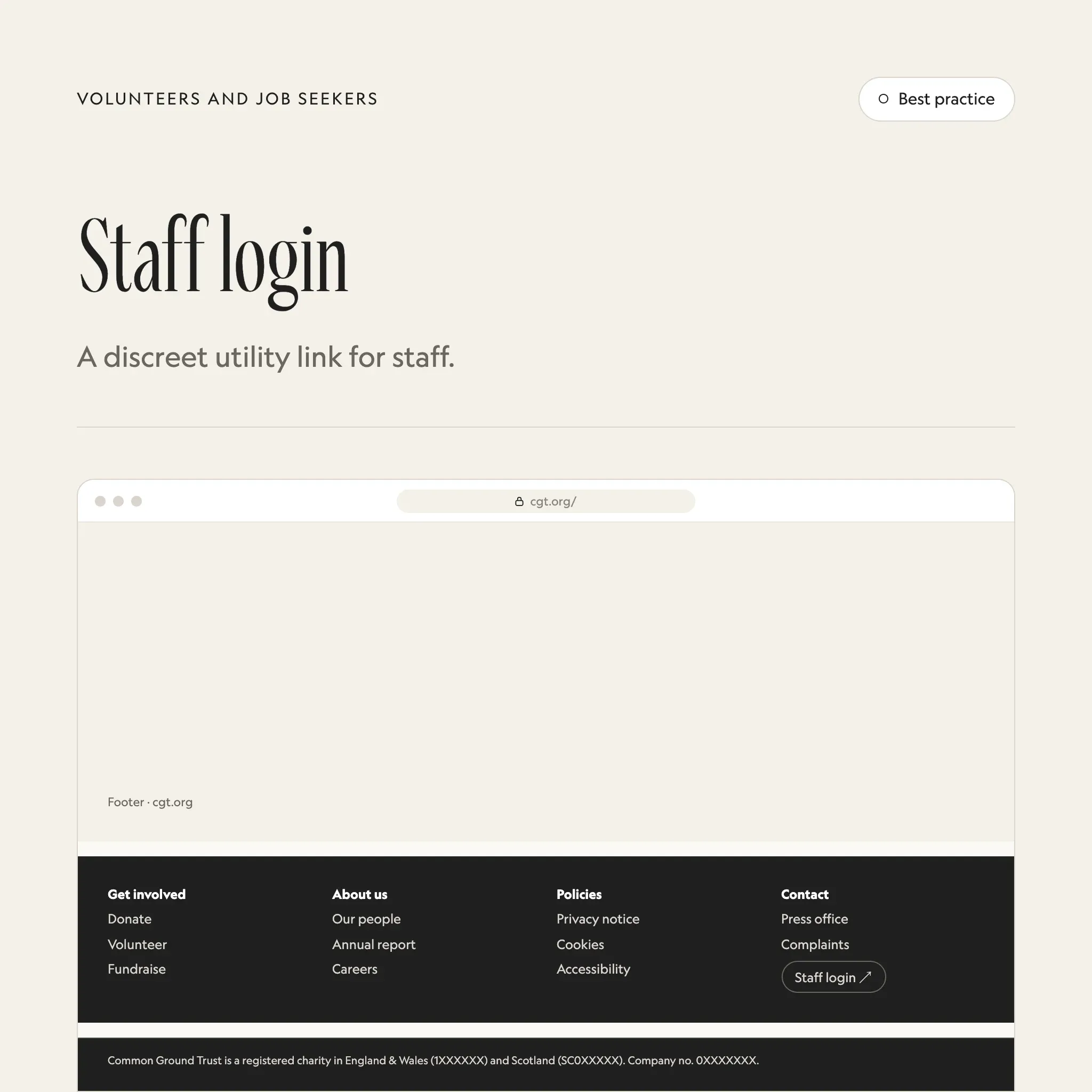
- What it is for
- Give colleagues a discreet route in.
- What goes on it
- A small link in the footer or utility bar to the intranet or single sign-on.
- Best practice
- No law requires one. Keep it discreet: a sign-in page is also a target, and it belongs behind the organisation's own identity provider rather than a shared password.
Partners and peers
- What it is for
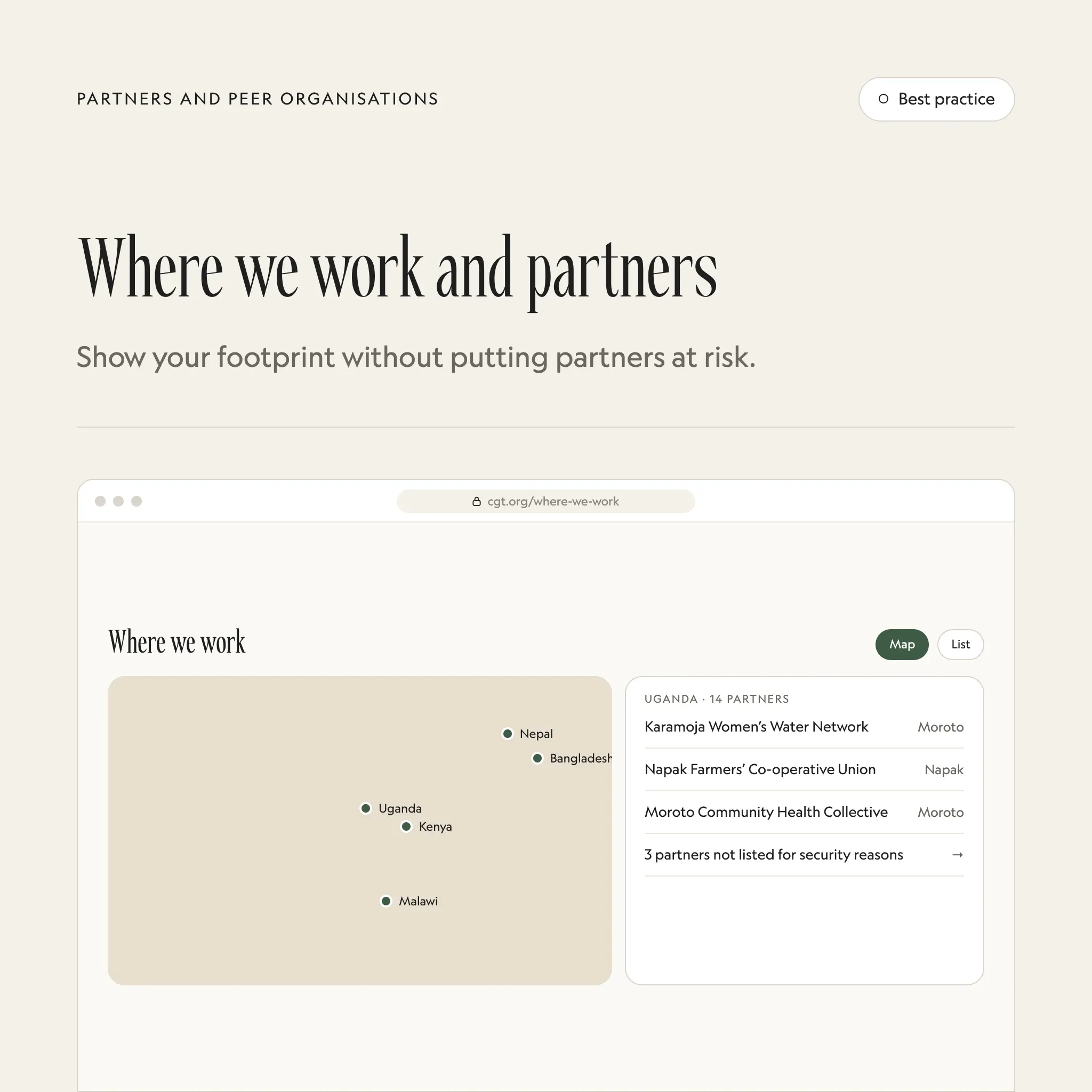
- Show your footprint and who you work with.
- What goes on it
- A country map, the partners you can safely name, and links to each programme.
- Best practice
- No rule requires a partner list or map. In some contexts naming a partner puts people at risk, so the list is risk-assessed and redacted before it is published, not after.
- What it is for
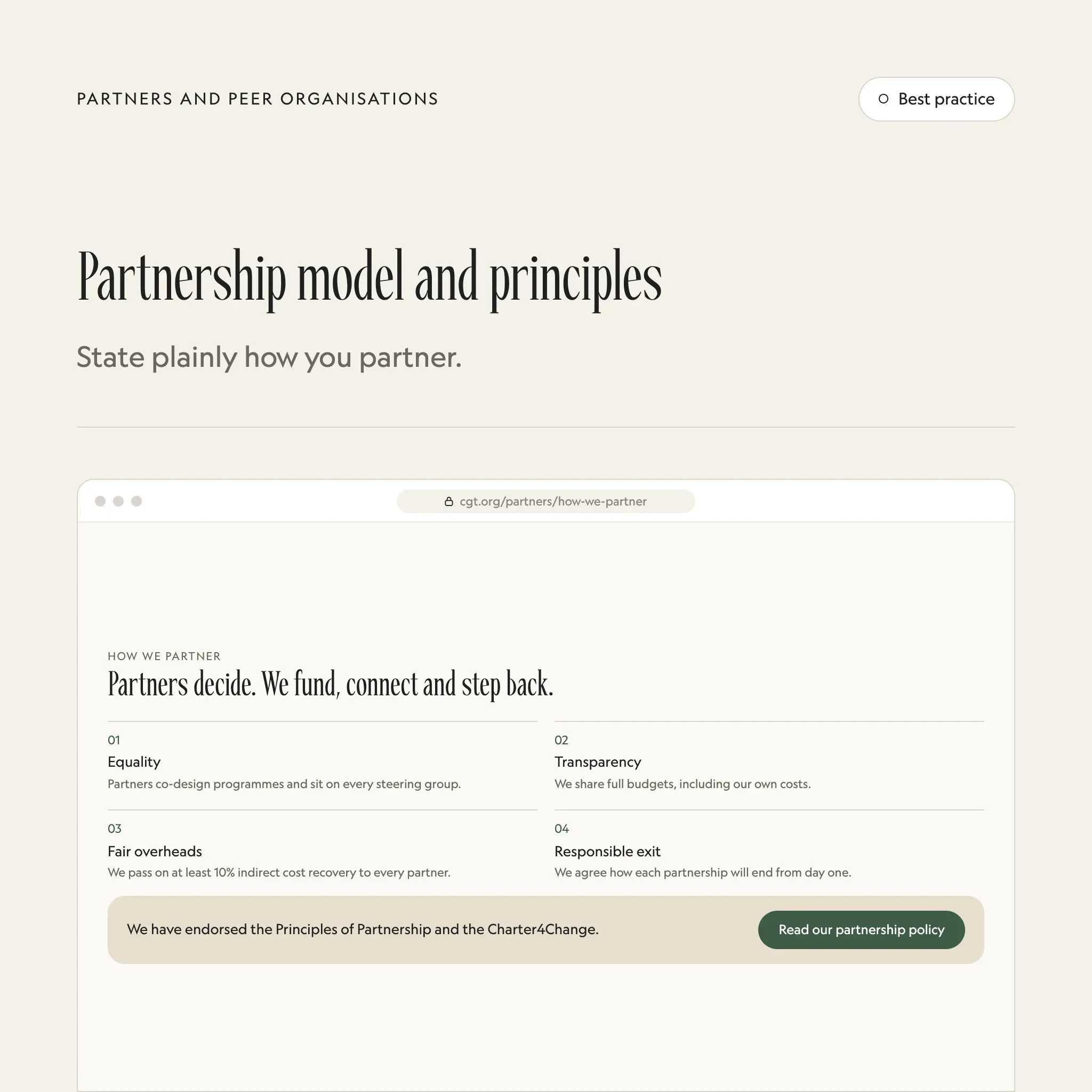
- State how you work with local organisations.
- What goes on it
- Your principles of partnership, how decisions are shared, your overhead policy, and how a partnership ends.
- Best practice
- Voluntary. Charter4Change signatories commit to reaffirm the Principles of Partnership, but nothing says they must be published on a website.
- What it is for
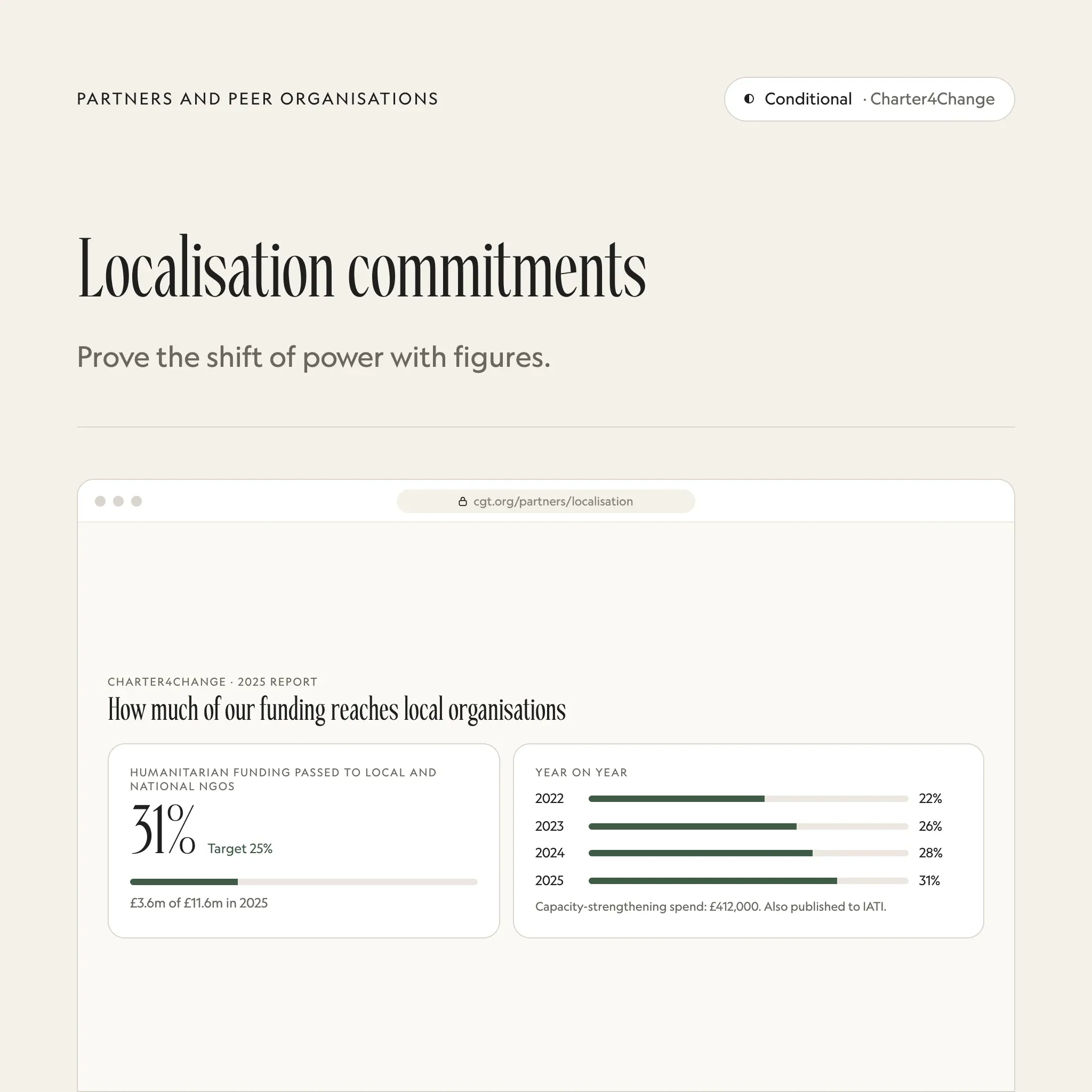
- Show how much funding reaches local organisations.
- What goes on it
- The share of humanitarian funding passed to local and national NGOs, capacity-strengthening spend, and the trend year on year.
- Conditional: Charter4Change signatories (a voluntary commitment, not law)
- Signatories commit to publish the amount or percentage of humanitarian funding they pass to national NGOs. The Charter puts it in public accounts and to the IATI standard; a web page is where most readers will actually look for it.
- What it is for
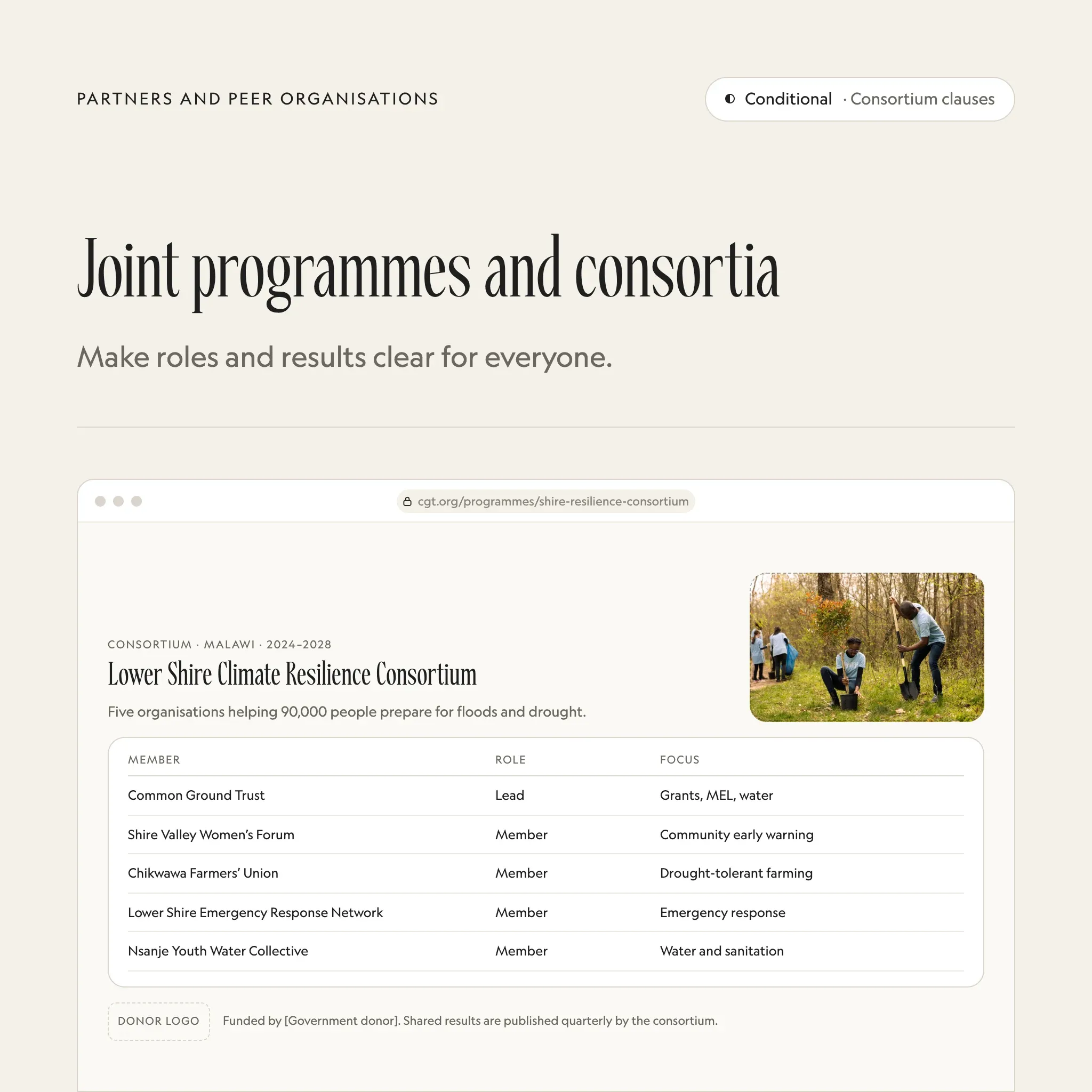
- Show what you deliver with others.
- What goes on it
- A page per consortium, who leads, each member's role, shared results, and funder acknowledgement.
- Conditional: Programmes whose funder sets visibility rules, such as FCDO-funded aid
- The trigger is the funding agreement, not law, and what it requires is acknowledgement rather than a consortium page. FCDO's branding guidance asks funded partners to acknowledge UK funding and use its logo, websites included.
- What it is for
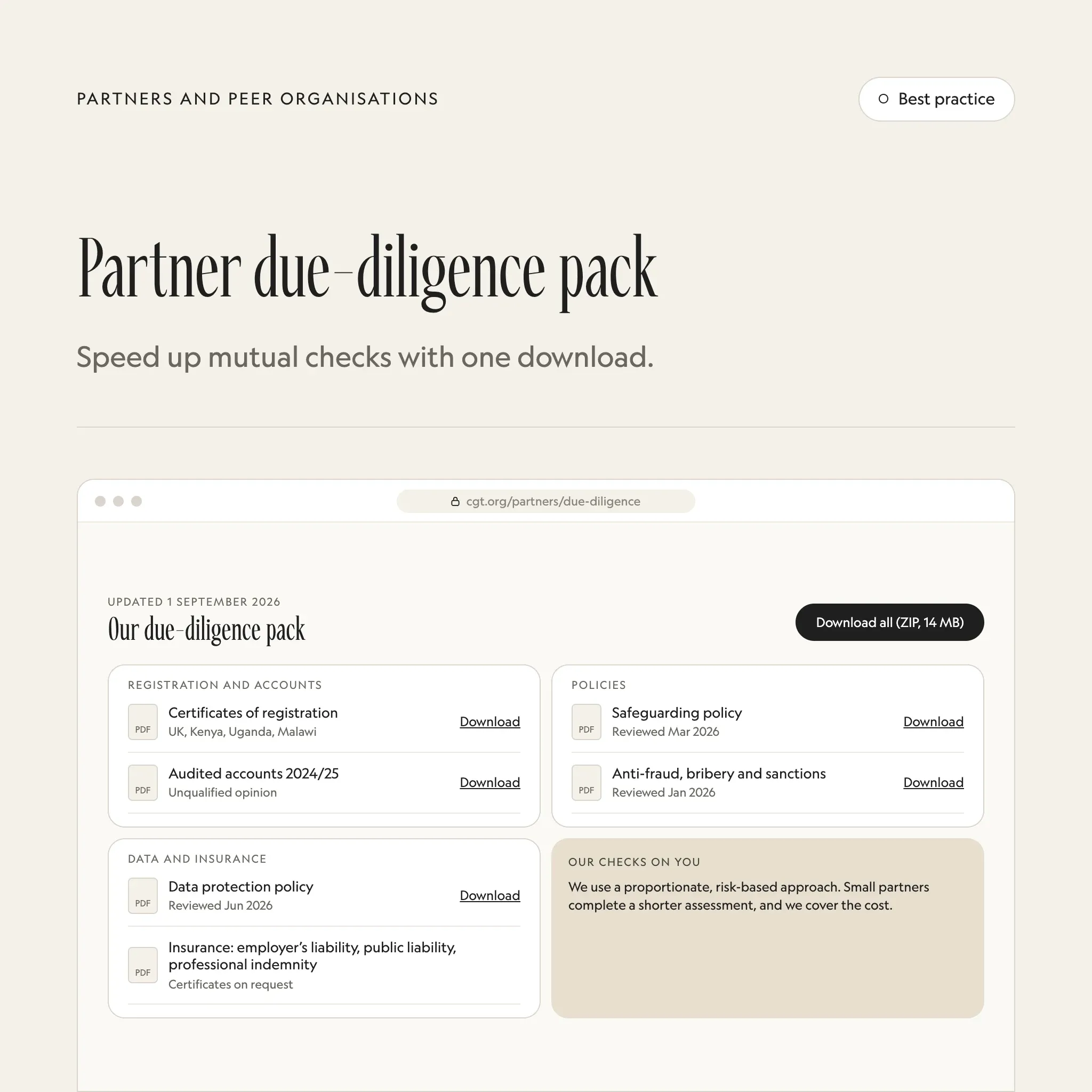
- Speed up due diligence in both directions.
- What goes on it
- Registration documents, accounts, the policies a partner will ask for (safeguarding, fraud, sanctions, data), insurance, and a date on each.
- Best practice
- Nothing requires a public pack. FCDO assesses partners against five pillars and expects them to do due diligence on their own downstream partners, so the same documents are requested over and over. Publishing them once is a convenience to everyone asking.
- What it is for
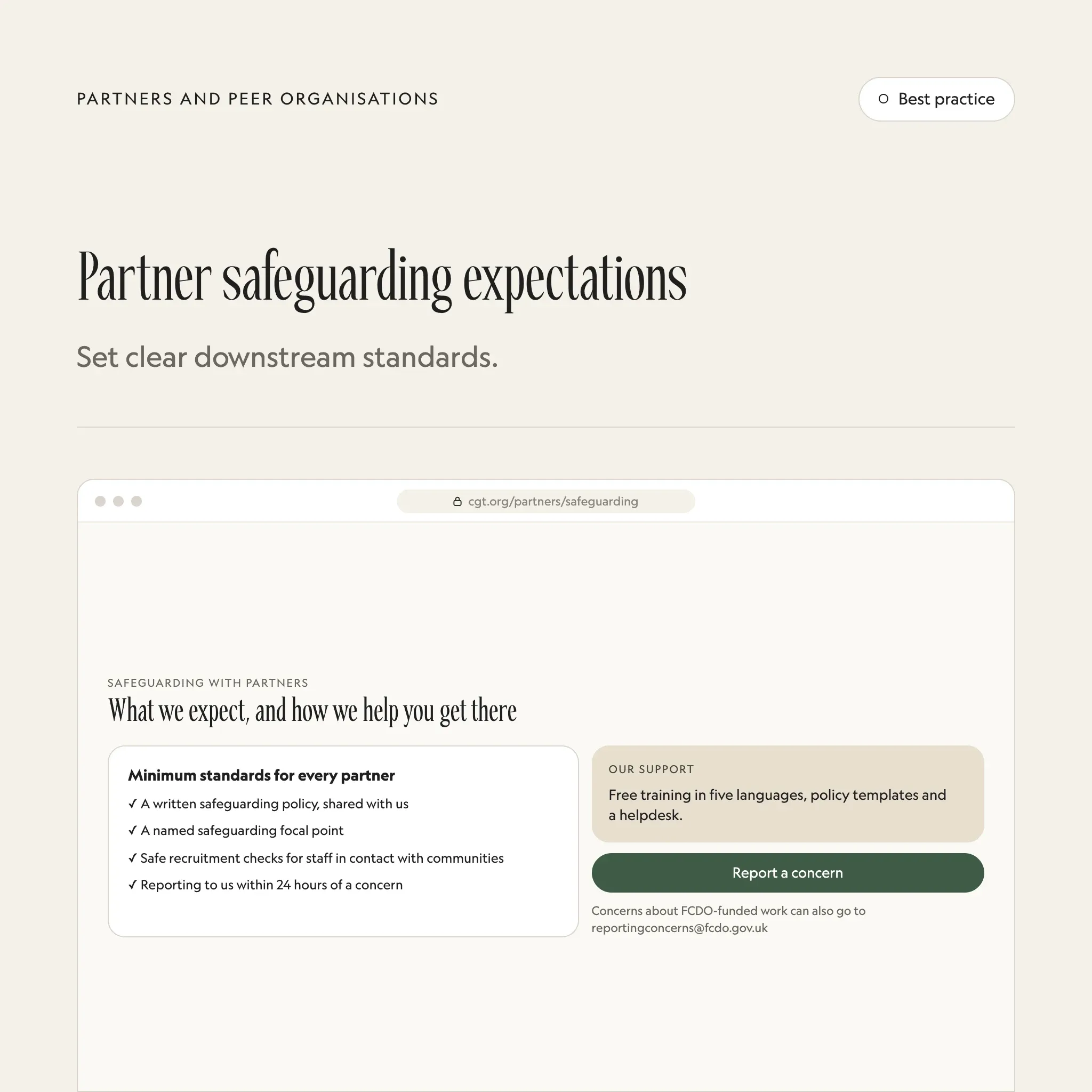
- Set the standard across the delivery chain.
- What goes on it
- Minimum standards, how to report a concern, the training you offer, and a link to your safeguarding page (section 82).
- Best practice
- FCDO's due-diligence guidance asks whether you share your safeguarding policy with downstream partners. That is a question answered to the funder, not a duty to publish, but a page is the easiest way to show you do it.
- Go further
- Safeguarding pages and reporting a concern
- What it is for
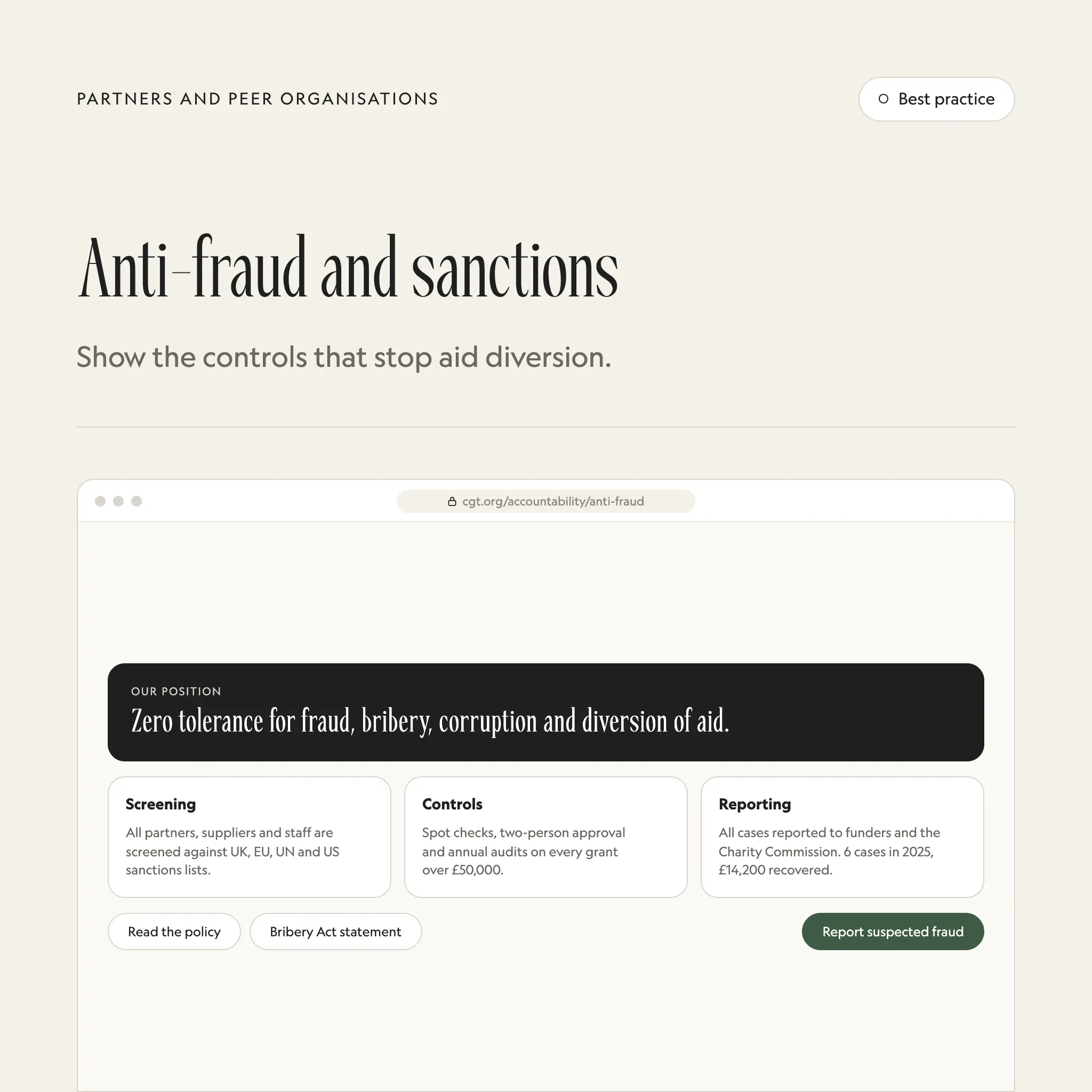
- Show how you stop aid being diverted.
- What goes on it
- A zero-tolerance statement, how you screen partners, and a confidential reporting route.
- Best practice
- Fraud, bribery and sanctions law all apply to you, but none requires a published statement. FCDO's counter-fraud standards set expectations on controls and say themselves that using the document is not mandatory.
- What it is for
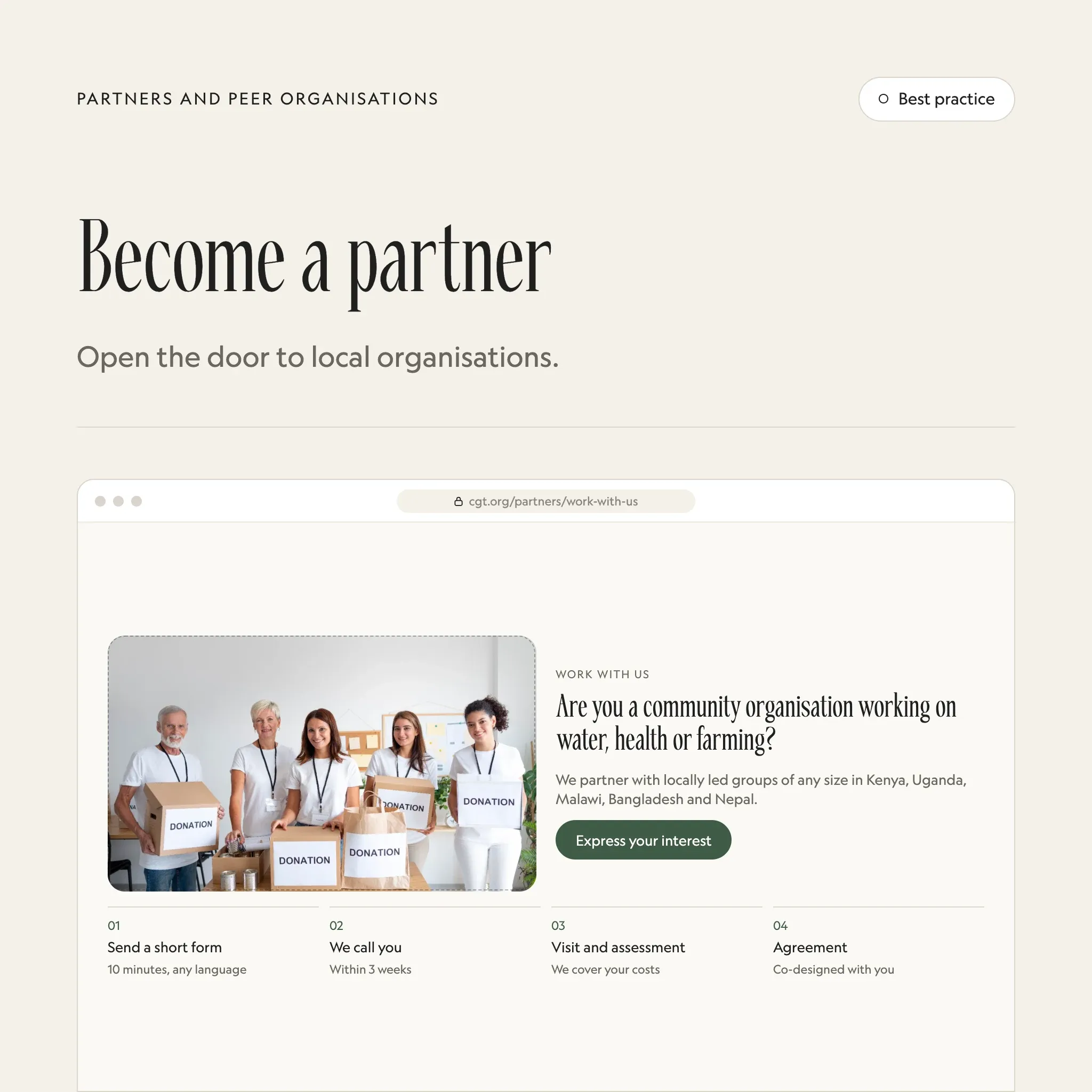
- Open a door for local organisations.
- What goes on it
- Who you partner with, your criteria, an expression-of-interest form, and how long each step takes.
- Best practice
- No duty. Without it, the only way in for a local organisation is knowing someone already inside.
- What it is for
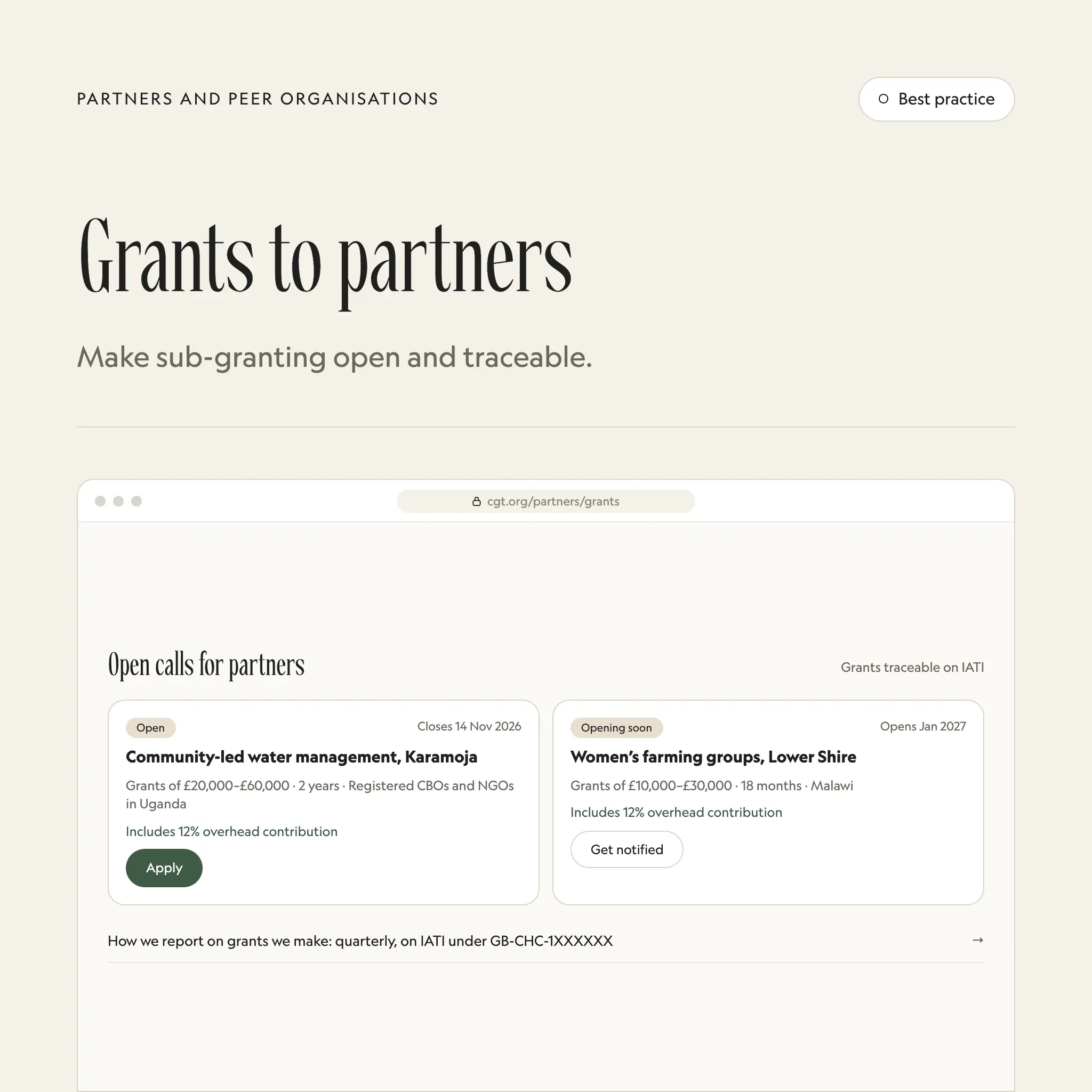
- Make sub-granting transparent.
- What goes on it
- Open calls with their status, eligibility, overhead policy and reporting.
- Best practice
- Neither FCDO's standards nor Charter4Change require open calls to be published. They govern how sub-granting is done and reported; publishing the calls is how you show it is fair.
- What it is for
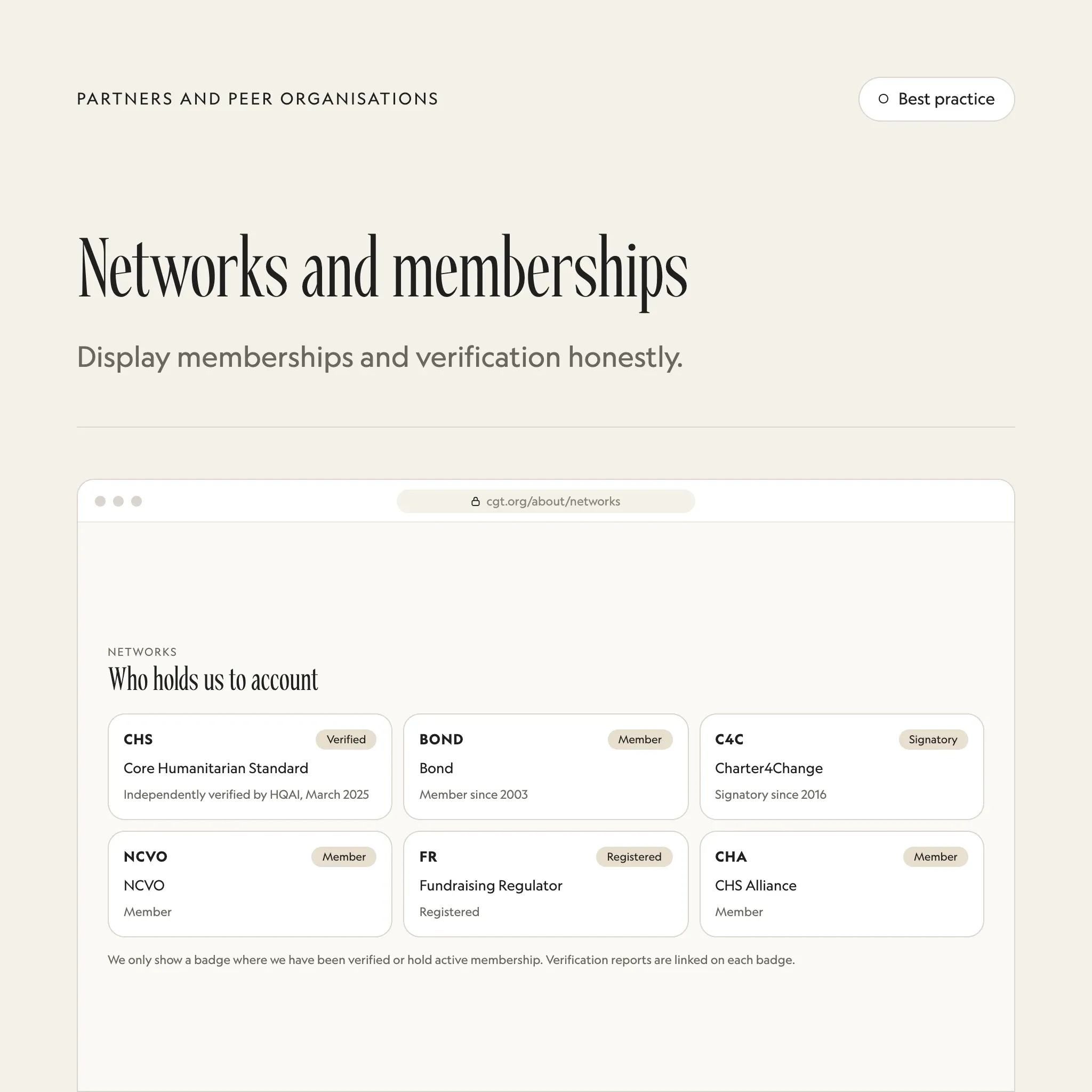
- Show the standards and alliances you belong to.
- What goes on it
- Each network, what membership means, and a badge only where you have earned one.
- Best practice
- No duty to list memberships, but a rule on what you may claim: an organisation may say it complies with the Core Humanitarian Standard only if it has been independently verified against it.
- What it is for
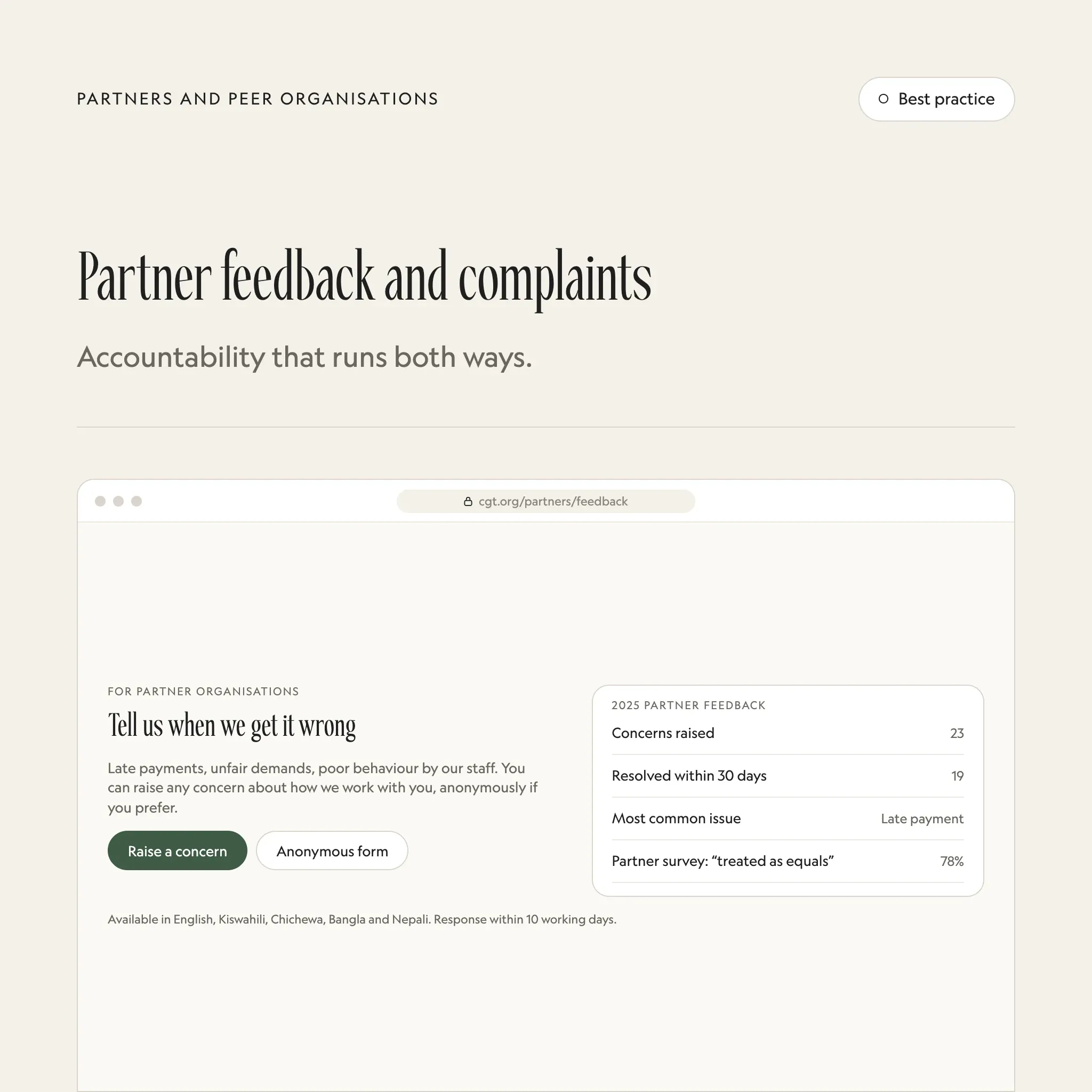
- Let partners hold you to account.
- What goes on it
- A complaints route for partners, in their languages, with response times and a yearly summary.
- Best practice
- No law requires it. The Core Humanitarian Standard's guidance says organisations working with partners should agree how complaints will be raised and handled, including against each other.
- What it is for
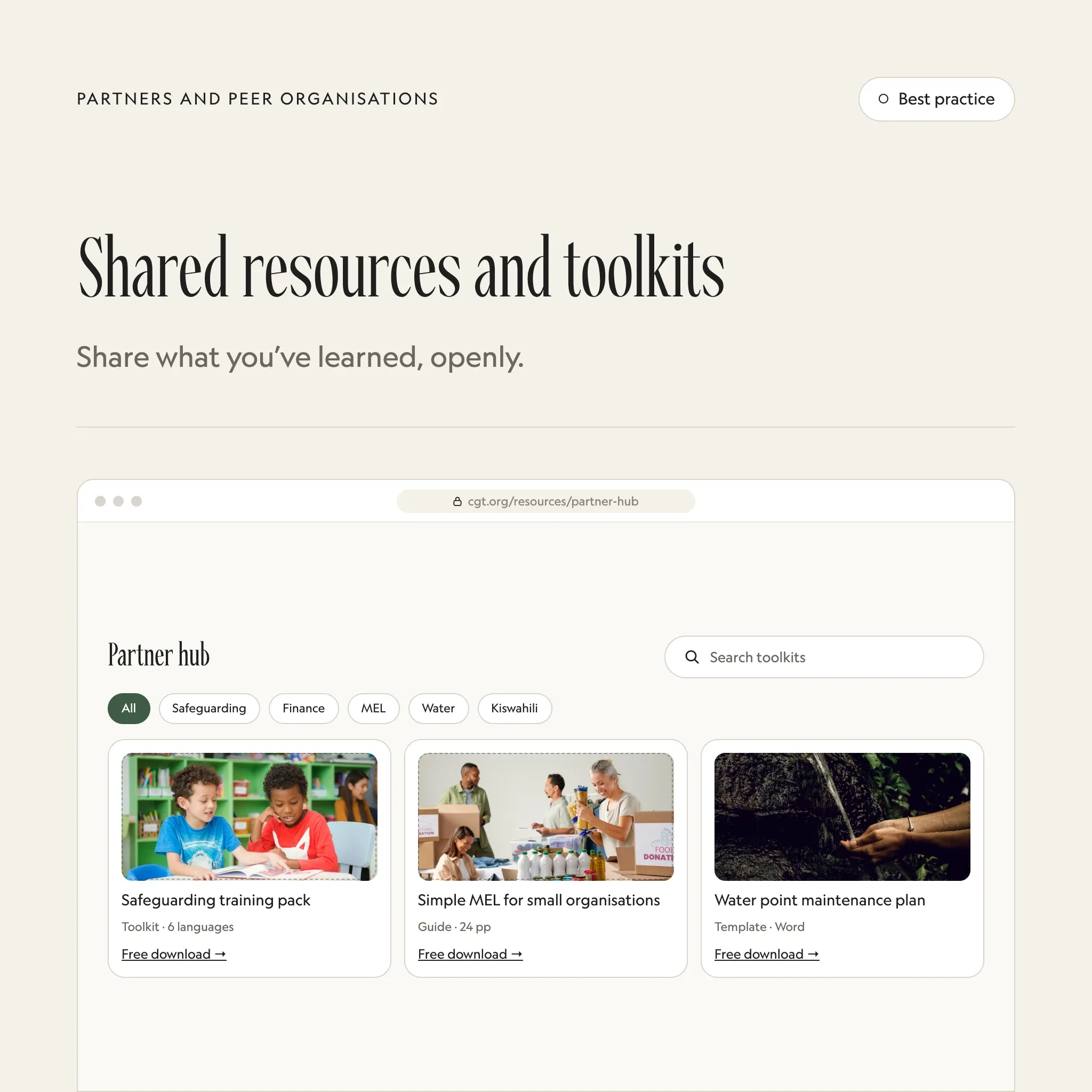
- Share what you know.
- What goes on it
- Toolkits, training and templates, in the languages your partners use.
- Best practice
- No duty. It is also the page most likely to be read by people who will never donate, which is the point of it.
Media and press
- What it is for
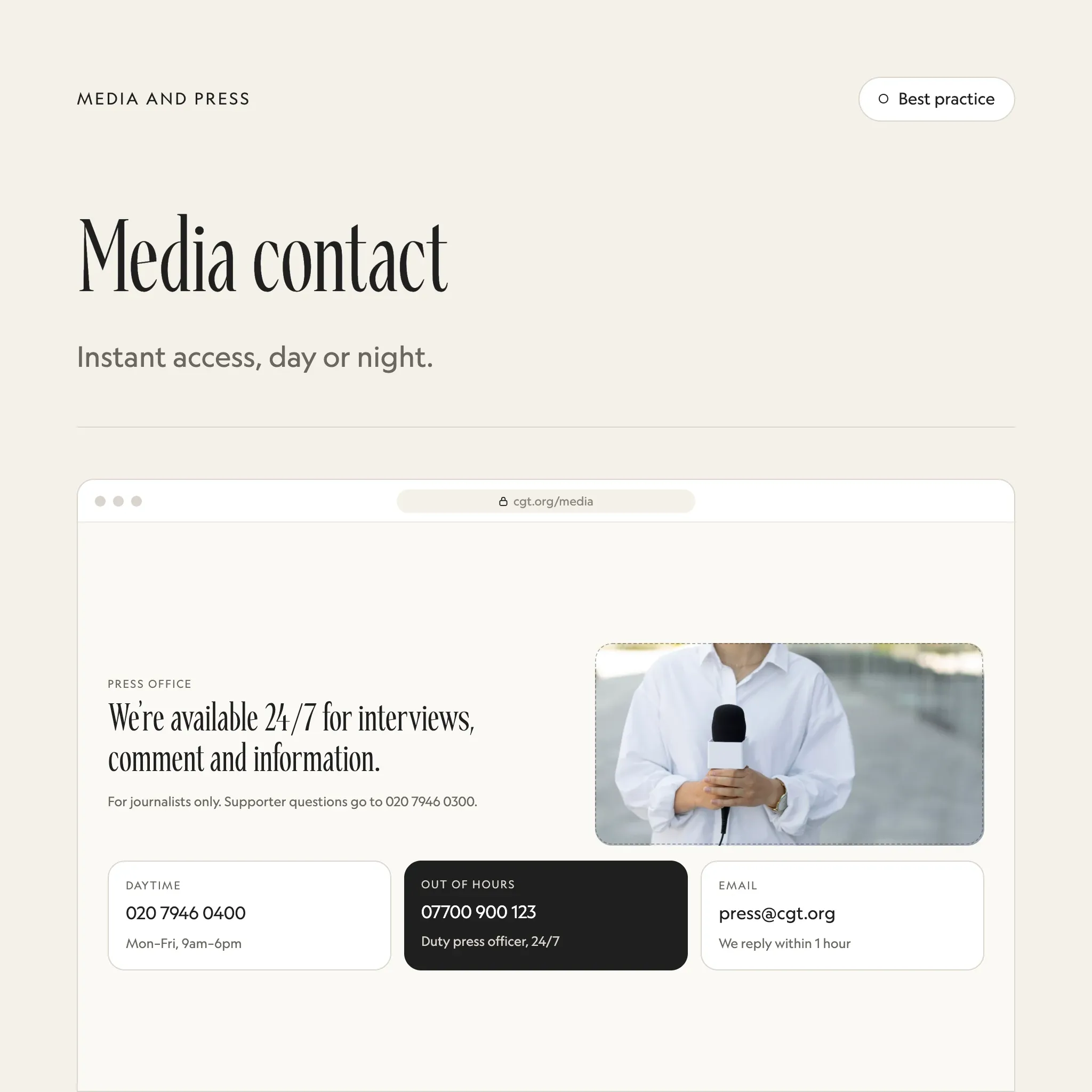
- Let a journalist reach you now.
- What goes on it
- A press email, a daytime number, an out-of-hours number if you have one, and how fast you answer.
- Best practice
- No duty. A journalist on deadline who cannot find a number rings someone else, and the story runs without you.
- Go further
- What journalists need from your press page
- What it is for
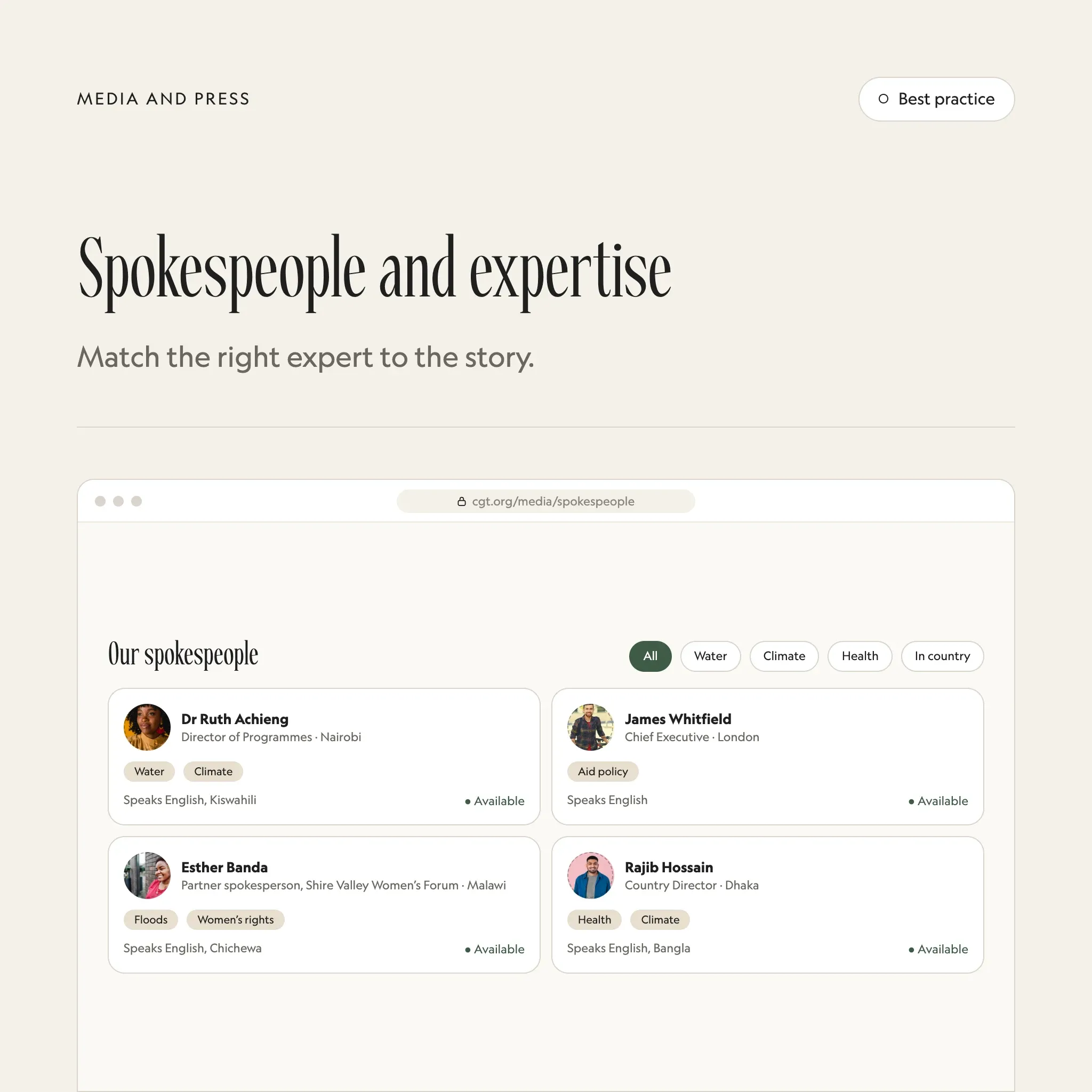
- Match experts to stories.
- What goes on it
- Profiles with areas of expertise, languages, location and availability, including local partners who can speak.
- Best practice
- Voluntary. Charter4Change signatories commit to include local actors as spokespeople when security allows, which is about practice rather than a page.
- Source
- What it is for
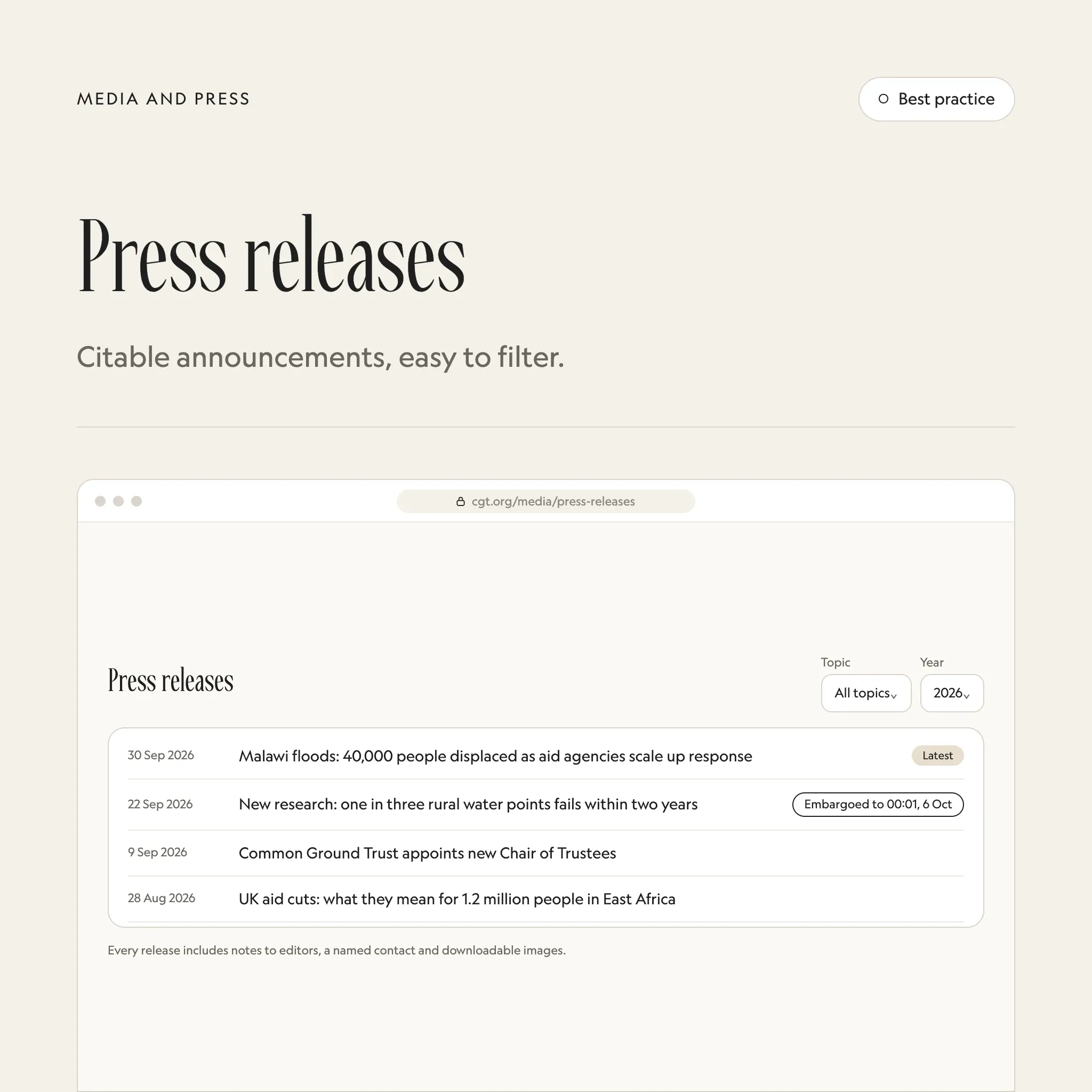
- Give journalists something they can cite.
- What goes on it
- A dated, searchable archive, embargo status, notes to editors and a contact on each.
- Best practice
- No duty. In Cision's 2025 survey of more than 3,000 journalists, 72% named press releases as the most useful thing PR teams provide.
- What it is for
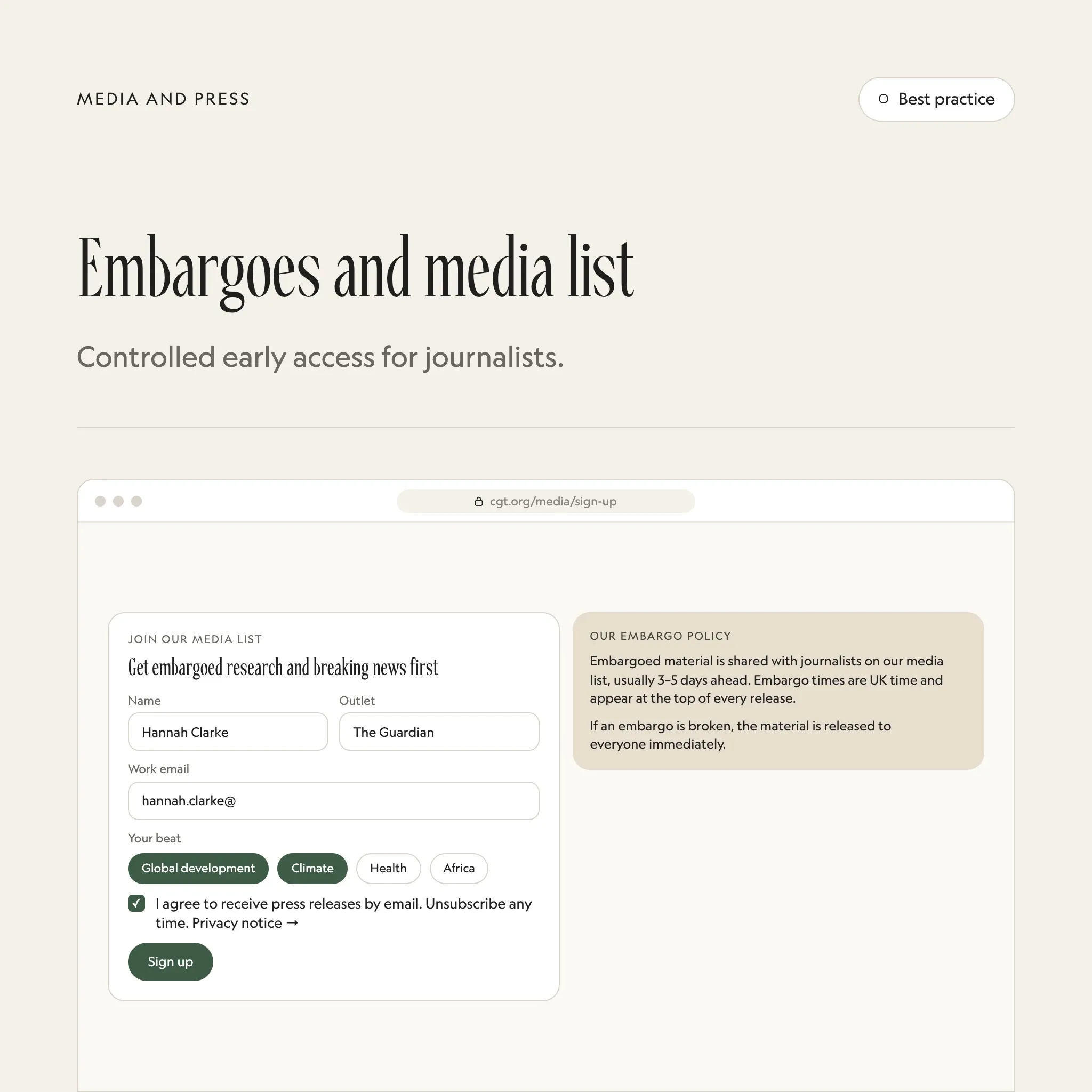
- Give early access on clear terms.
- What goes on it
- Your embargo policy and a sign-up by beat and region.
- Best practice
- No duty to run a media list. If you do, the sign-up collects personal data and needs privacy information at the point of collection.
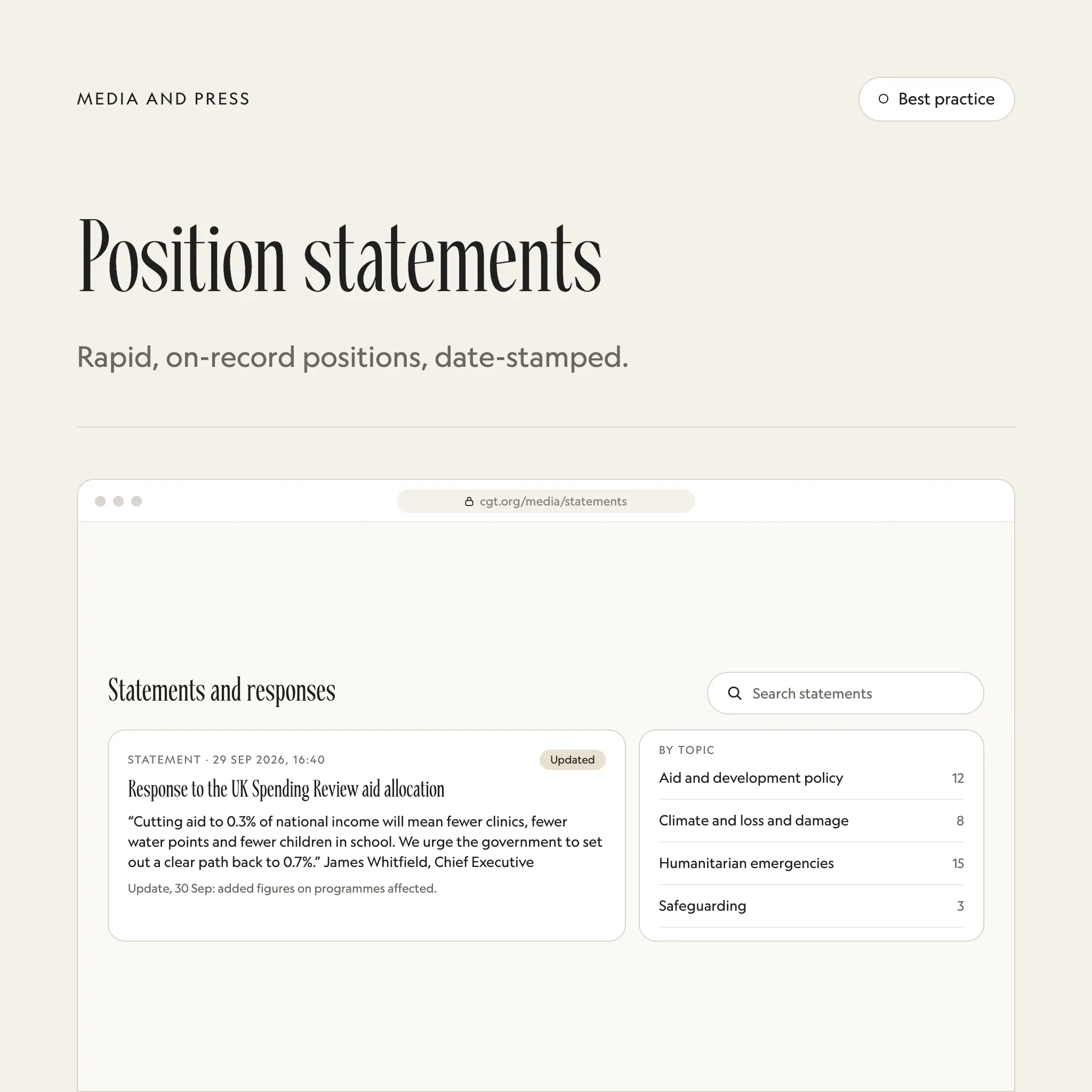
- What it is for
- Put your positions on the record, dated.
- What goes on it
- Statements by topic with the date, and a log of what changed.
- Best practice
- No duty. A dated statement is the one a journalist can quote without ringing to check it is still true.
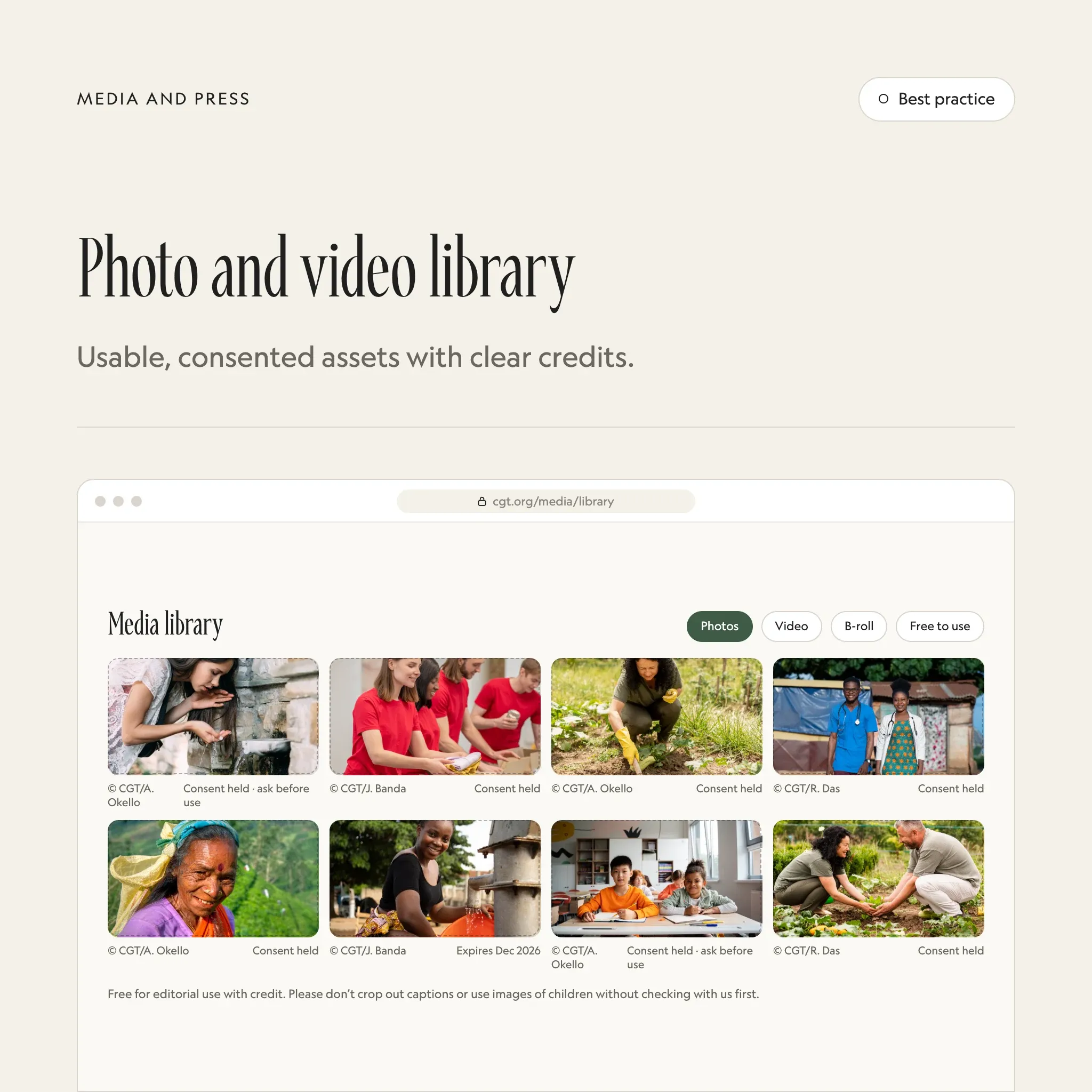
- What it is for
- Offer images that are consented and credited.
- What goes on it
- Search, download sizes, captions, credits, and the consent and usage limits on each image.
- Best practice
- No law requires a library. Photographs of recognisable people are usually personal data, so the library needs a lawful basis and records of consent: a condition on how you run it, not a reason to have one.
- Go further
- Ethical nonprofit photography
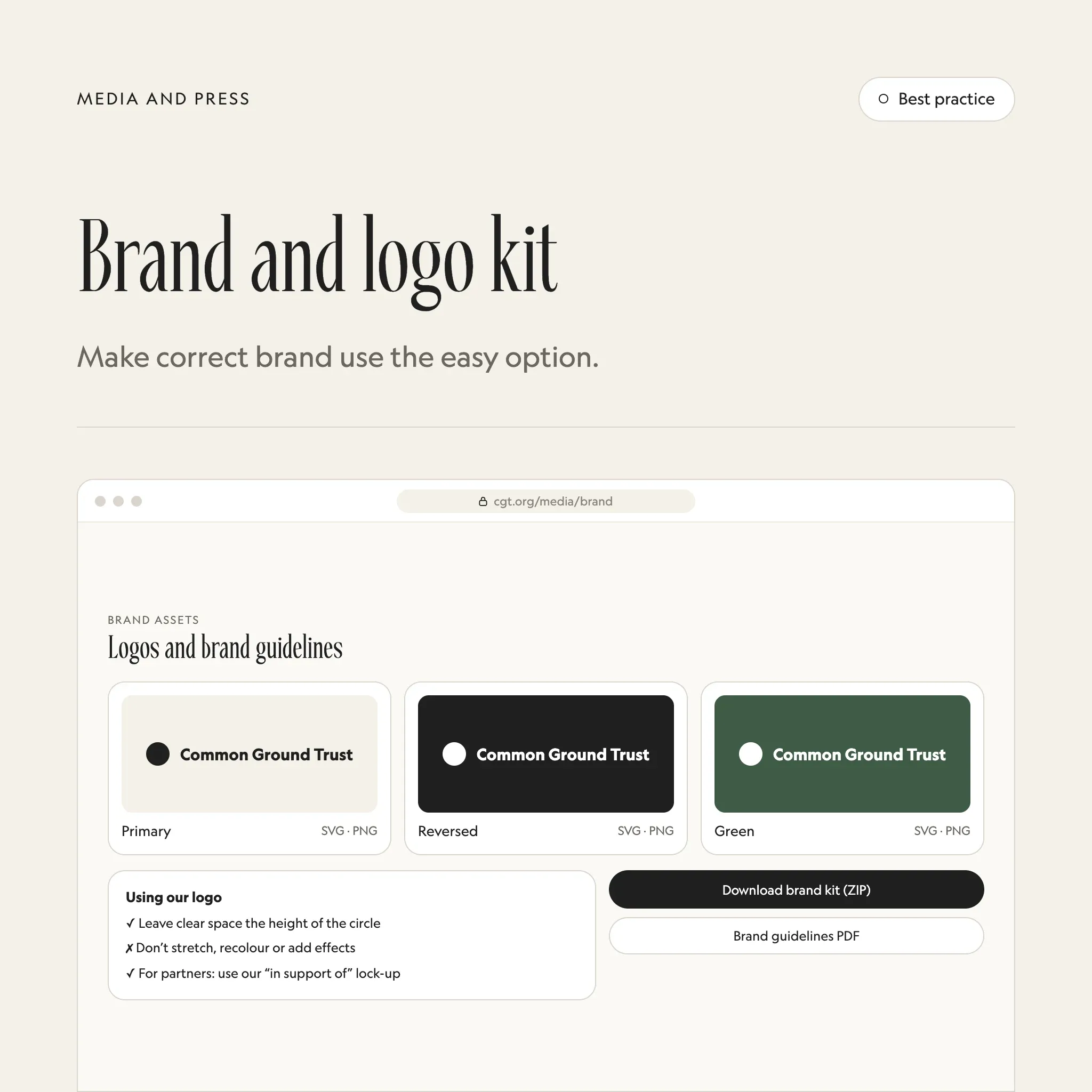
- What it is for
- Help people use your brand correctly.
- What goes on it
- Logo files, colours and the rules for using them.
- Best practice
- No duty. Without one, your logo appears in the press as whatever a search engine found first.
- Go further
- Nonprofit logo standards
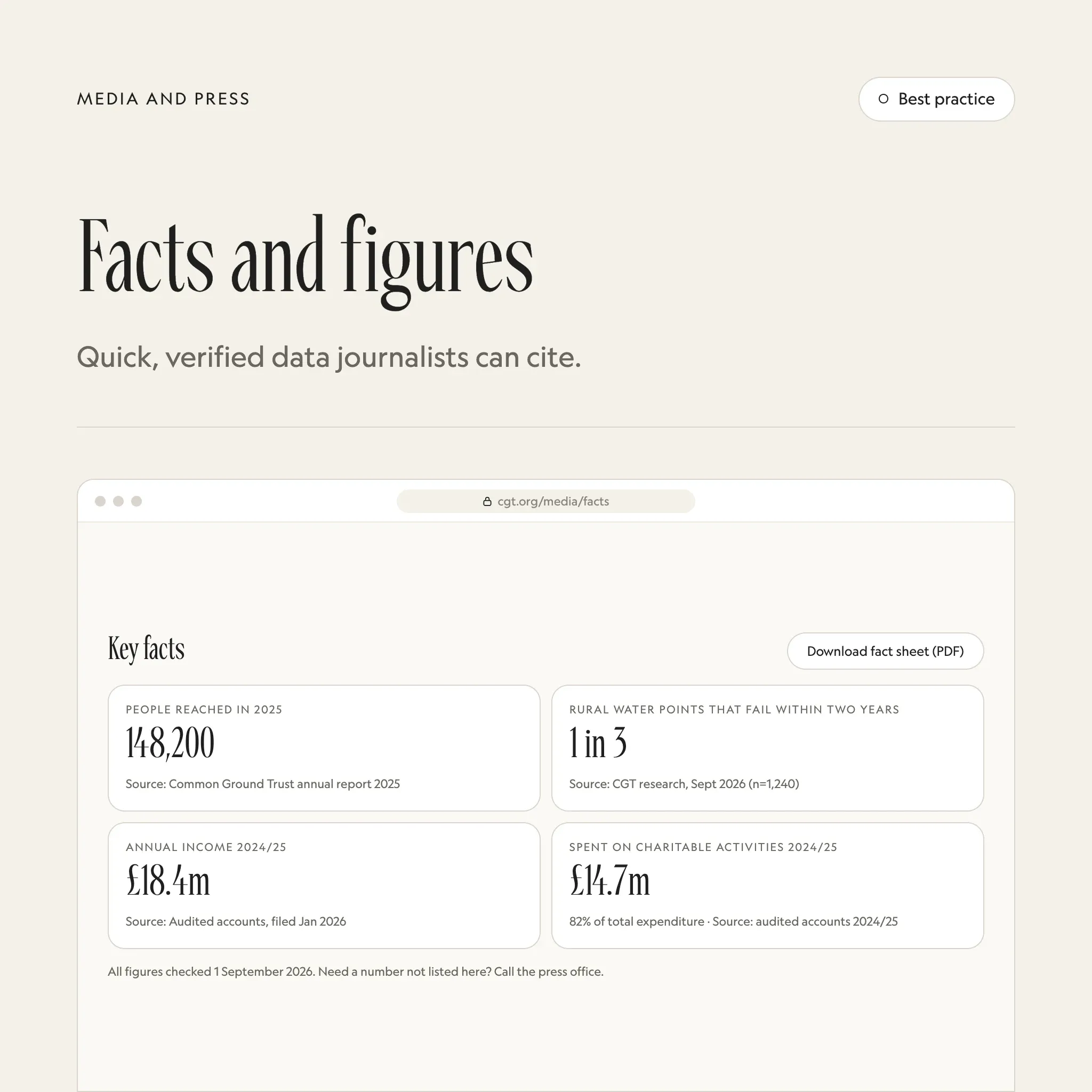
- What it is for
- Give verified numbers with their sources.
- What goes on it
- Key figures, each with its date and source, and a fact sheet to download.
- Best practice
- No duty. Cision's 2026 survey of nearly 2,000 journalists names original research and expert access among what they value from PR teams.
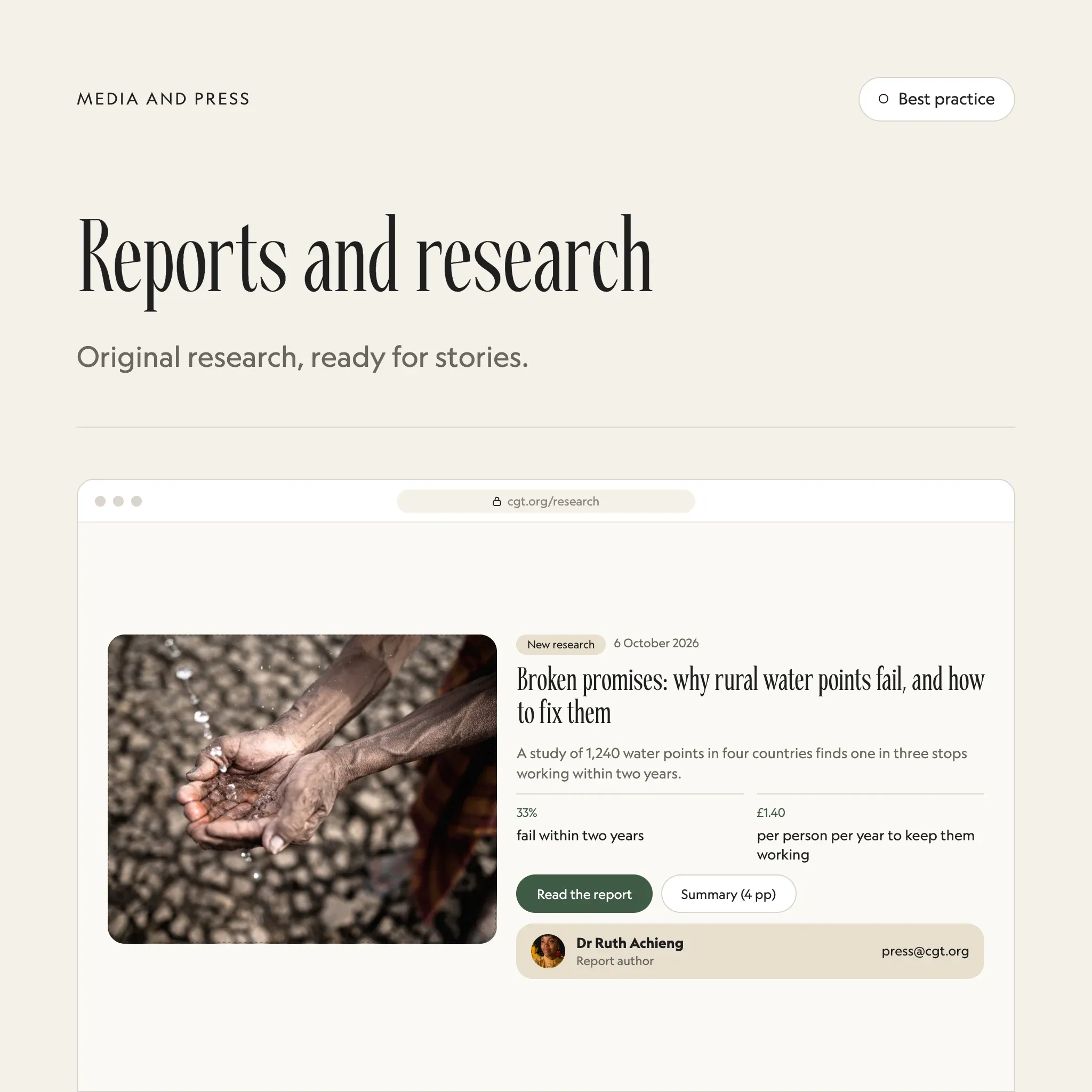
- What it is for
- Offer original evidence for a story.
- What goes on it
- Each report with a summary, its method, and a named media contact.
- Best practice
- No duty. In Cision's 2026 survey, 66% of journalists said they rely on content from PR teams for story ideas.
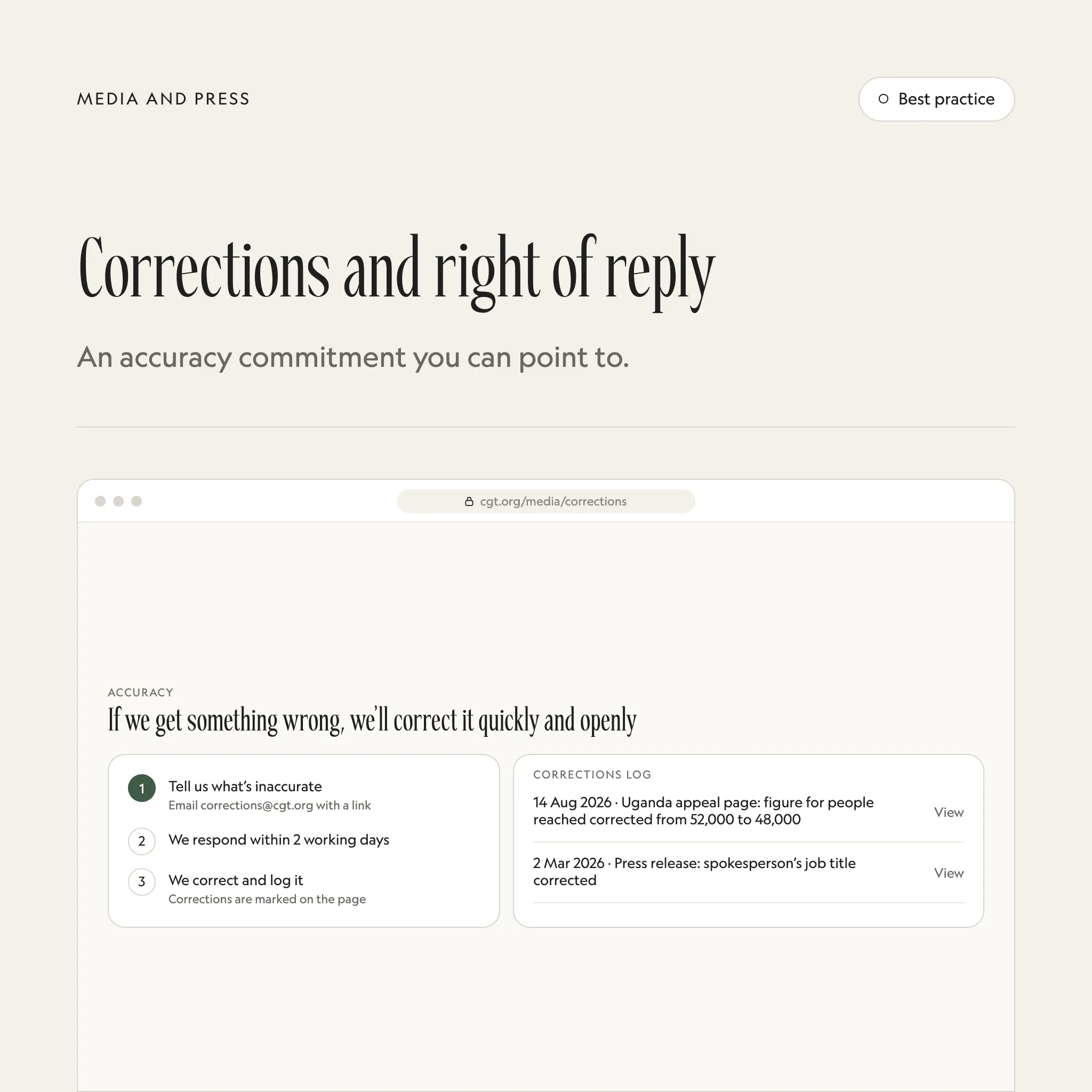
- What it is for
- Show you care about accuracy.
- What goes on it
- How to ask for a correction, how fast you respond, and a log of what you have corrected.
- Best practice
- No duty. The Editors' Code binds the publishers that sign up to IPSO, not charities, but a charity that corrects itself in public is harder to misquote.
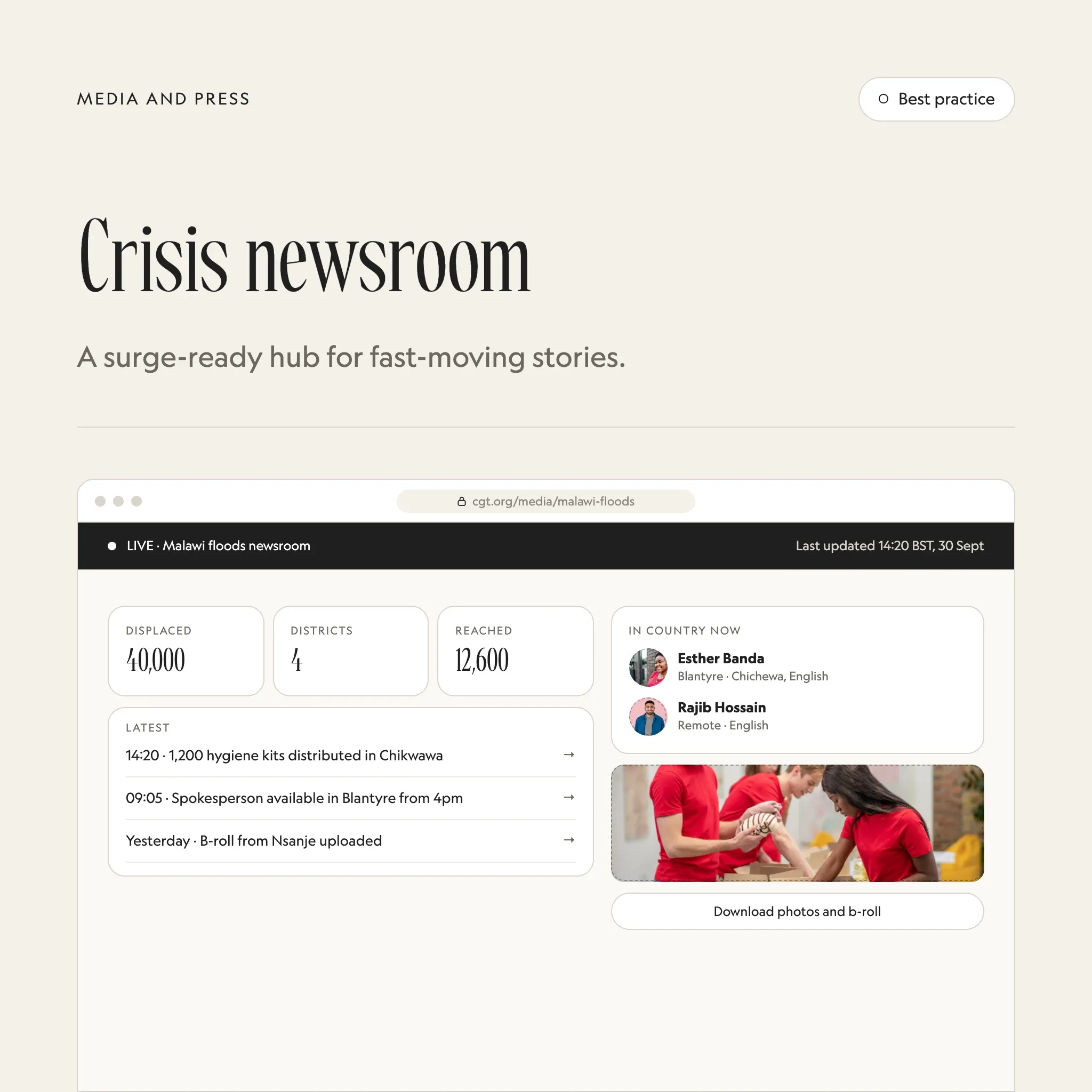
- What it is for
- Be the source when it matters most.
- What goes on it
- Live updates, the situation in facts, spokespeople in the country, assets, and the appeal link.
- Best practice
- No duty. It is built before the crisis or not at all.
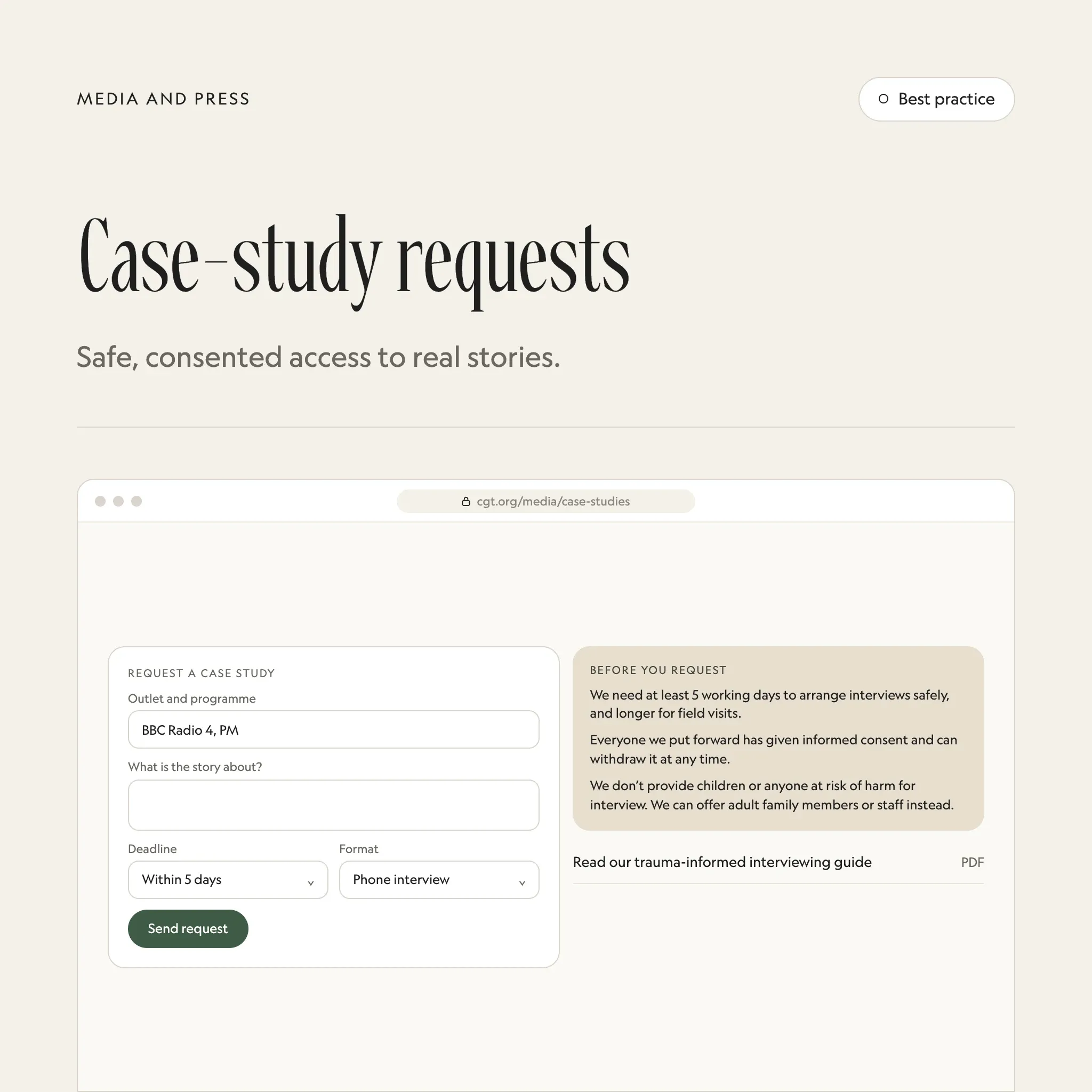
- What it is for
- Give journalists access to real stories, safely.
- What goes on it
- A request form, lead times, the consent and safeguarding conditions, and your rules for children and people at risk.
- Best practice
- No duty. Informed consent is one of the four commitments in the Dóchas Guide to Ethical Communications, and your trustees' safeguarding duty covers the people you put in front of a camera.
- What it is for
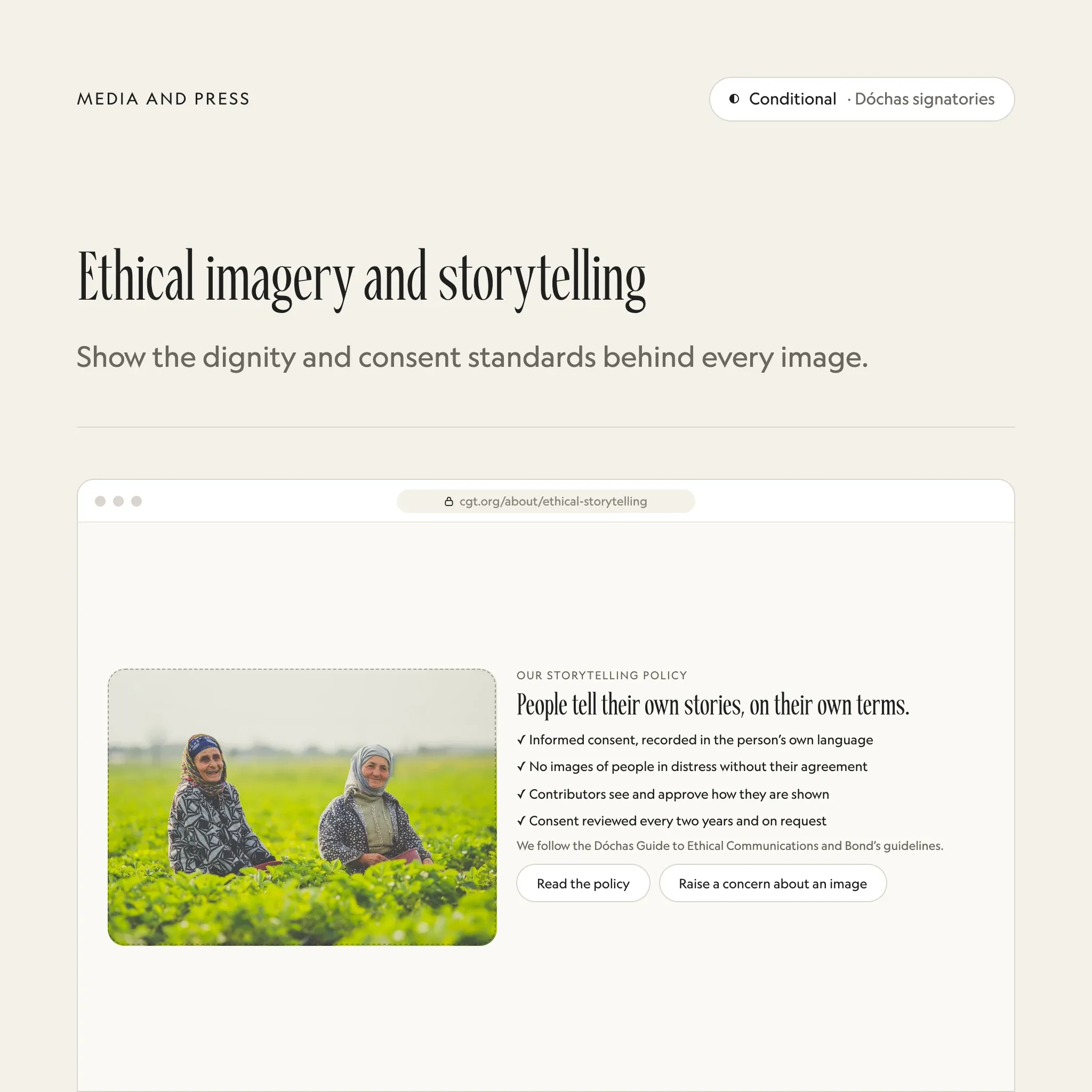
- Show your standards on dignity and consent.
- What goes on it
- A summary of the policy, how you get consent, and how to complain.
- Conditional: Signatories to the Dóchas Guide to Ethical Communications
- Signatories agree to show the Guide's commitments on their homepage or About page and to give prominent information on feedback and complaints. For everyone else it is best practice.
- Go further
- Ethical nonprofit photography
Trust and compliance
- What it is for
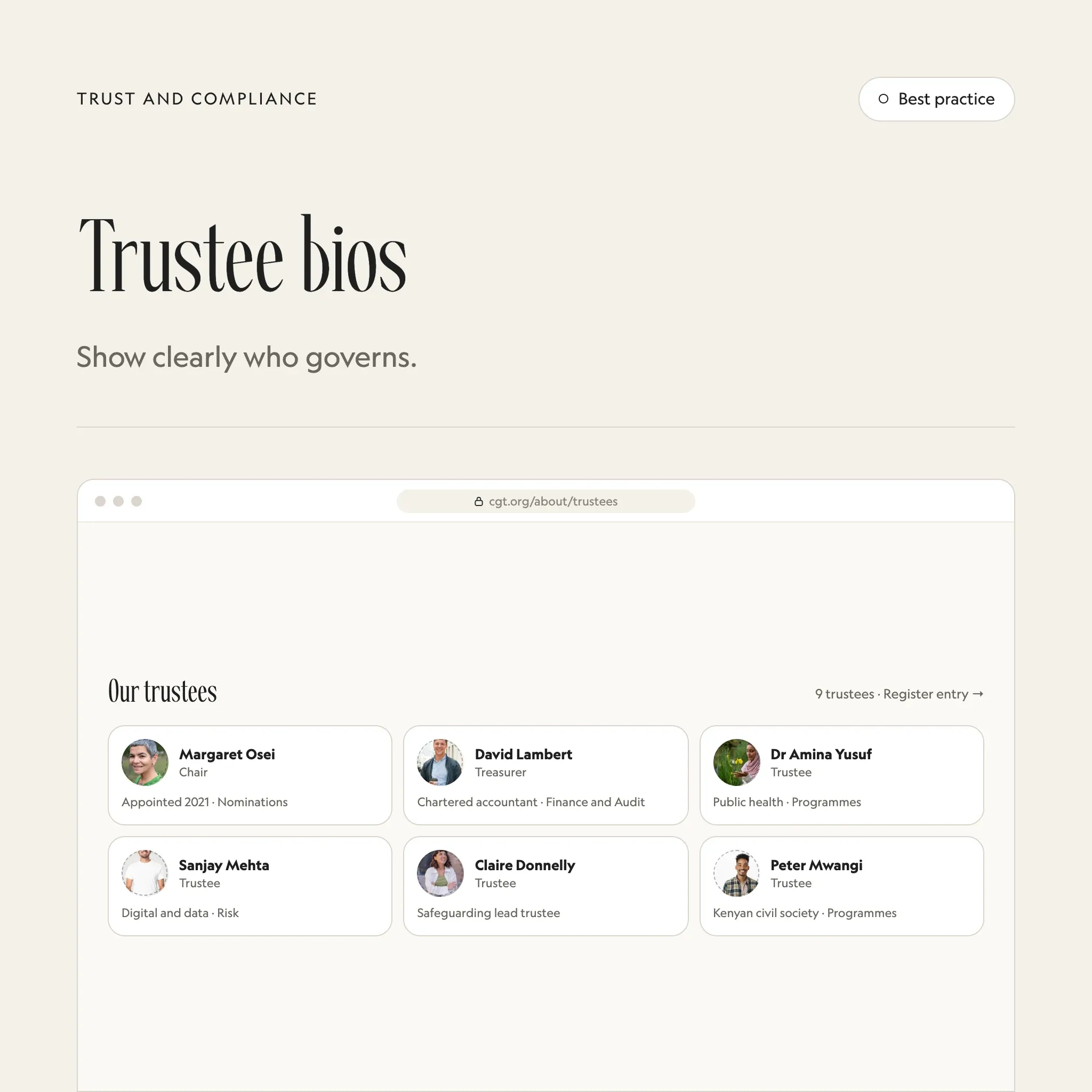
- Show who governs.
- What goes on it
- Names, roles, relevant experience, when each was appointed, and which committees they sit on.
- Best practice
- No duty to publish on your own site, and the names are public anyway: the Charity Commission register shows trustee names, and since 9 March 2026 so does OSCR's. The Charity Governance Code lists trustee profiles on the website as evidence of good governance.
- Sources
- Go further
- Board questions about the website
- What it is for
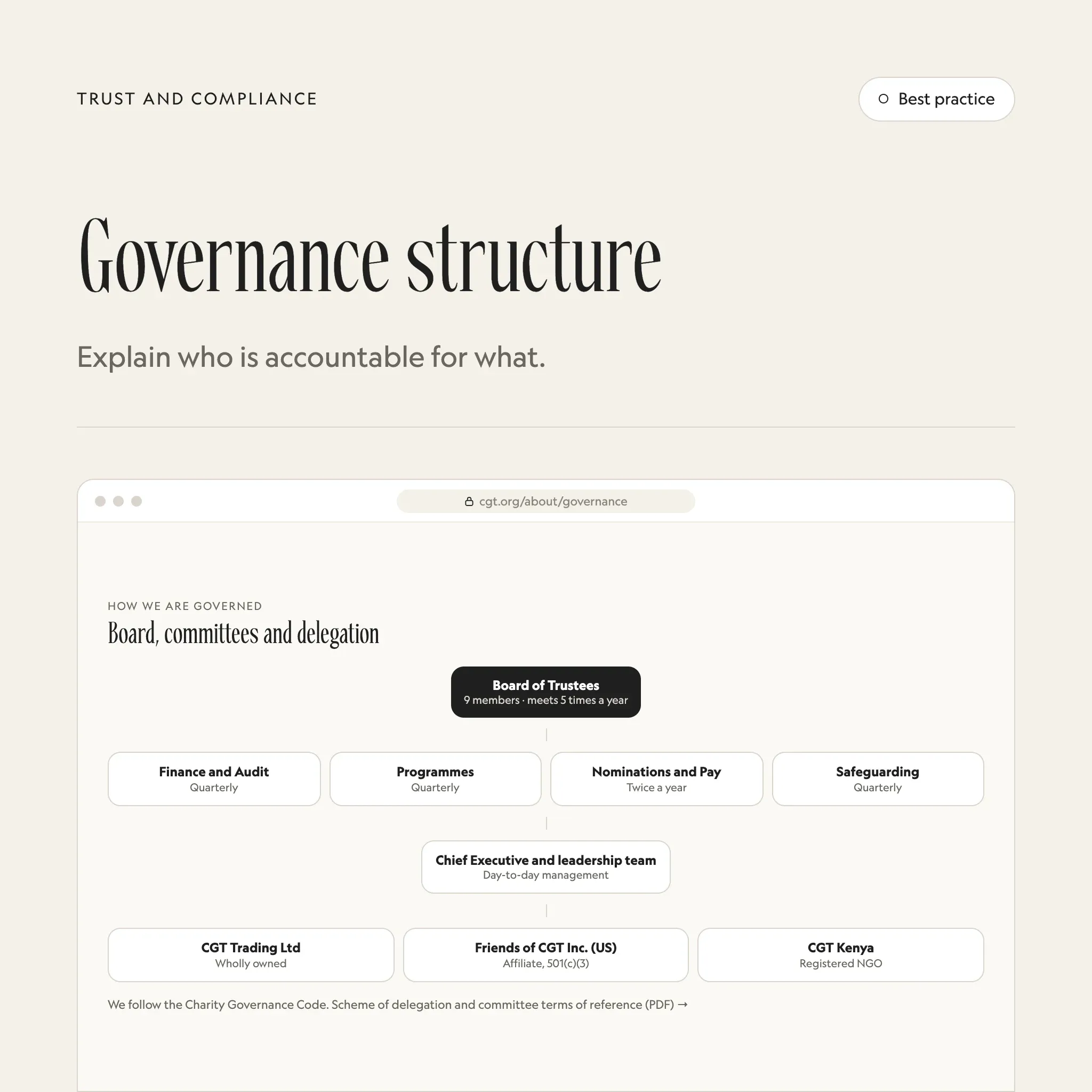
- Make accountability legible.
- What goes on it
- The board, its committees, what is delegated to whom, and how any subsidiaries or affiliates relate to the charity.
- Best practice
- No duty. The Charity Governance Code suggests a scheme of delegation and committee terms of reference as evidence of good governance; it does not say they must be public, and complying with the Code is not a regulatory requirement.
- Go further
- Federated nonprofit website governance
- What it is for
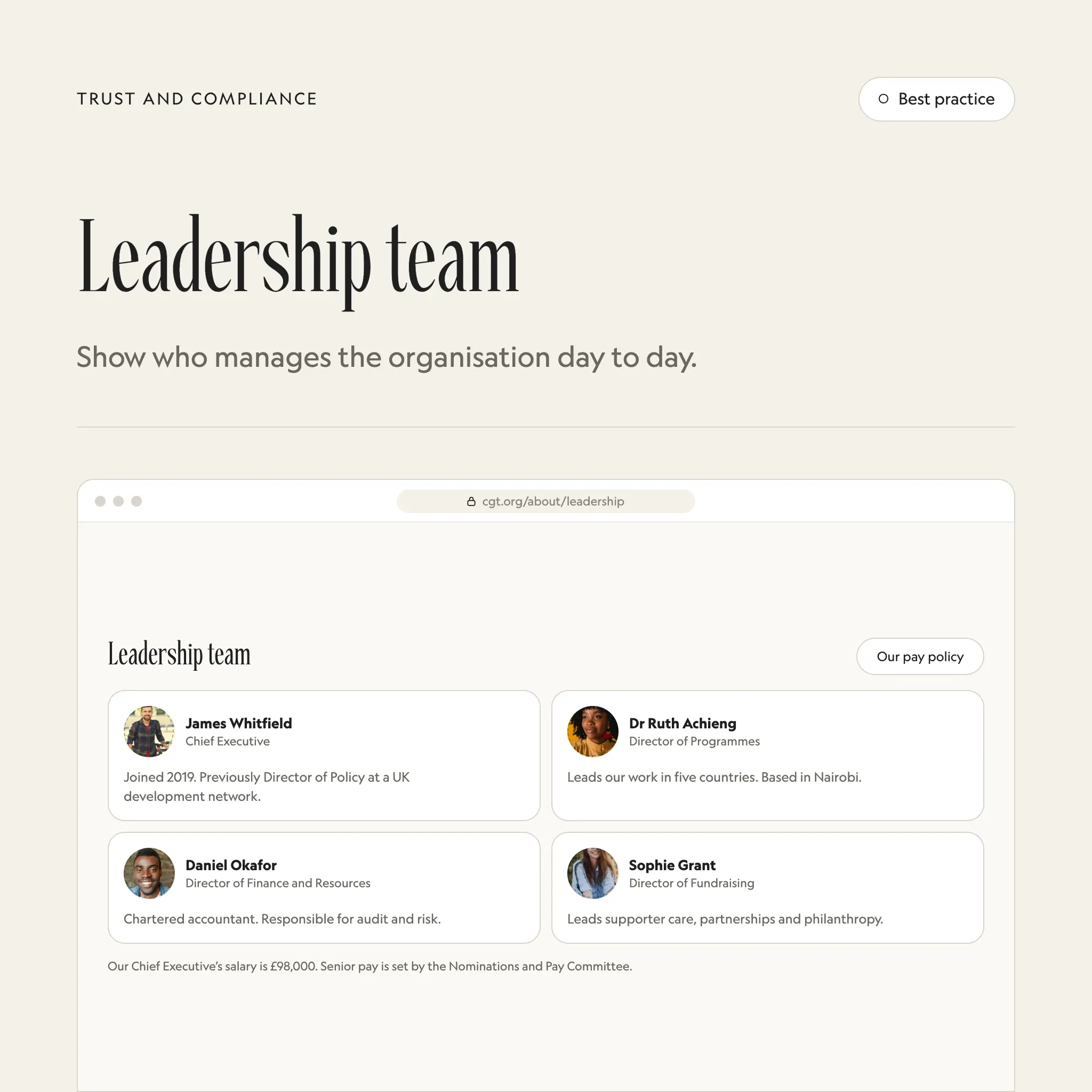
- Show who runs the organisation day to day.
- What goes on it
- The executive team, what each is responsible for, and a link to your pay policy.
- Best practice
- No duty. The Charity Governance Code lists profiles of senior staff on the website as evidence of good governance.
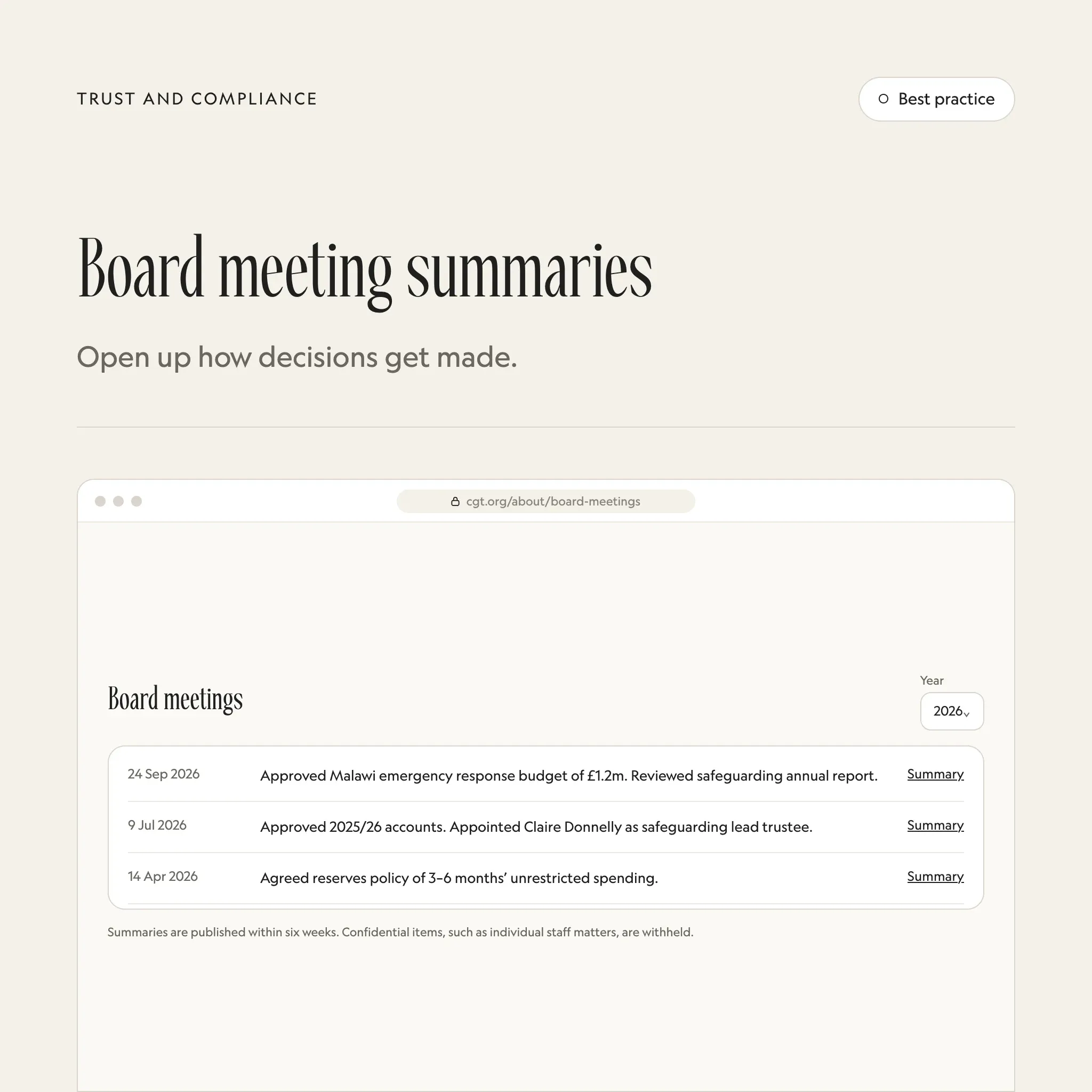
- What it is for
- Open up how decisions are made.
- What goes on it
- Meeting dates and the key decisions, as summaries or minutes.
- Best practice
- No duty. The Code asks for minutes that record the reasoning behind decisions, without saying they should be public. Publishing a summary is a choice, and a telling one.
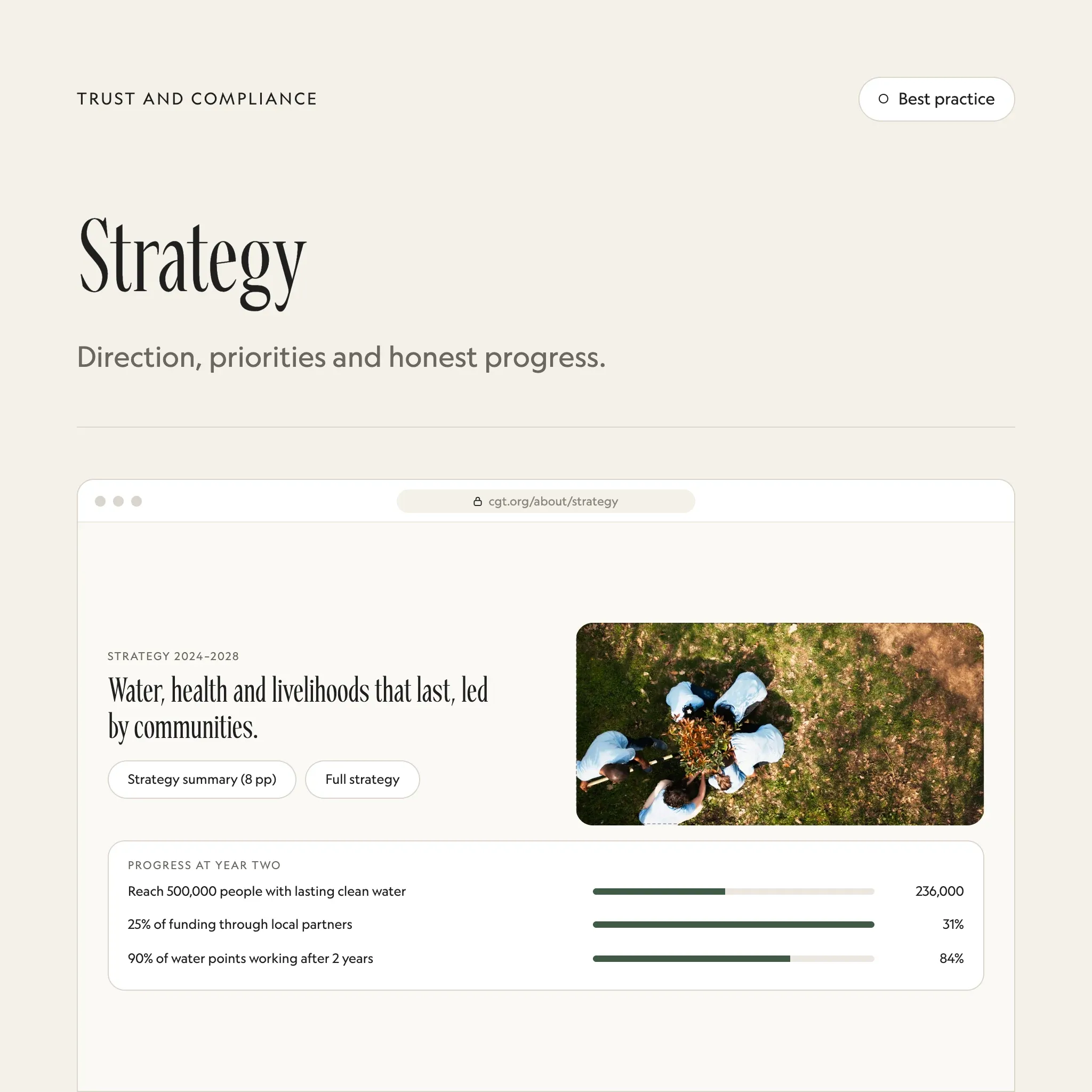
- What it is for
- Say where you are going and how you will know.
- What goes on it
- A summary of the strategy, its goals, and progress against them.
- Best practice
- No duty. The Code lists published information on progress against plans as evidence of good governance.
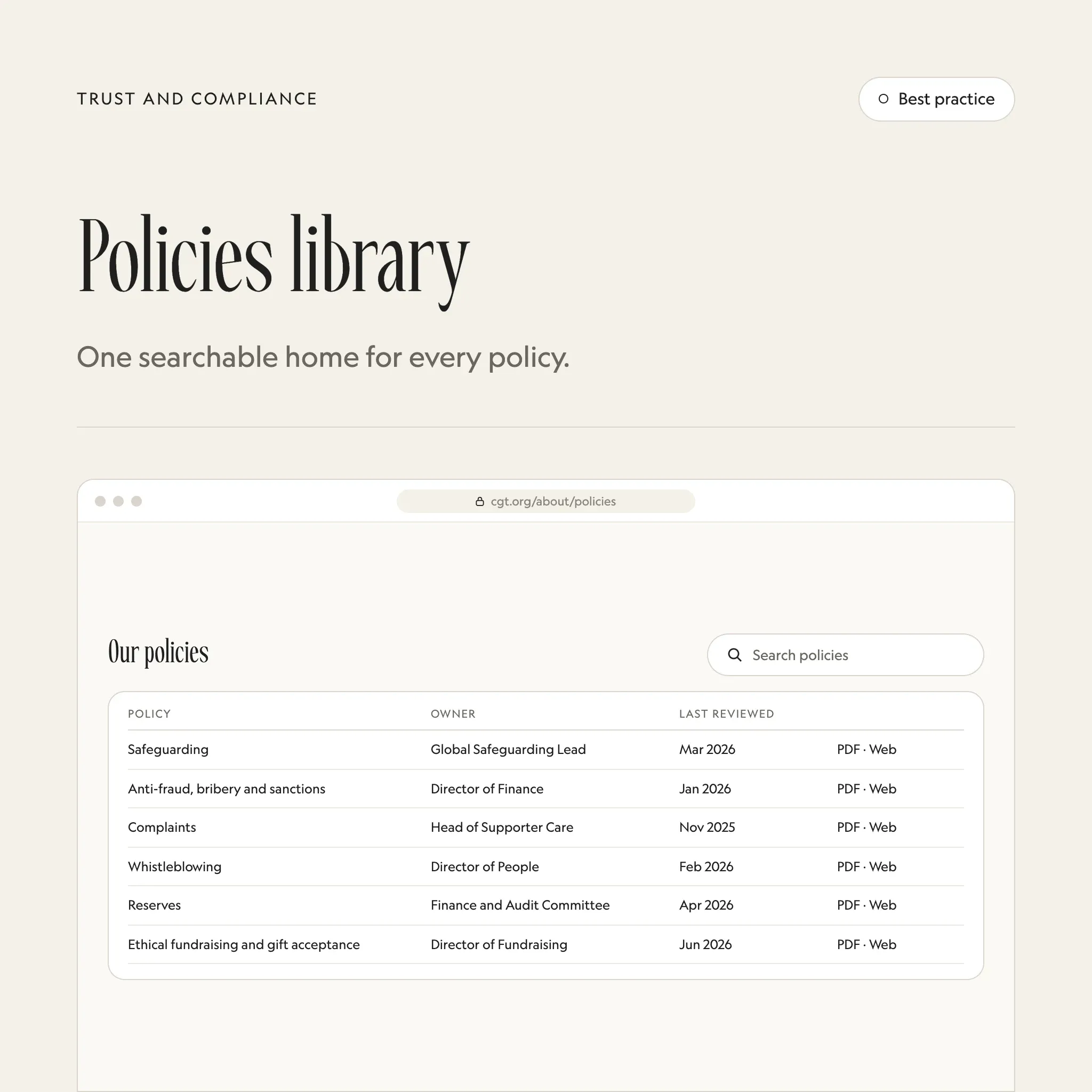
- What it is for
- Put every policy in one place.
- What goes on it
- A searchable list with each policy's owner and review date, as a web page as well as a PDF.
- Best practice
- No duty to publish a library as such, though some policies have rules of their own (sections 80 and 86). The Code expects a full set of policies and published guidance on how people can raise concerns.
- Go further
- Website governance policies for nonprofits
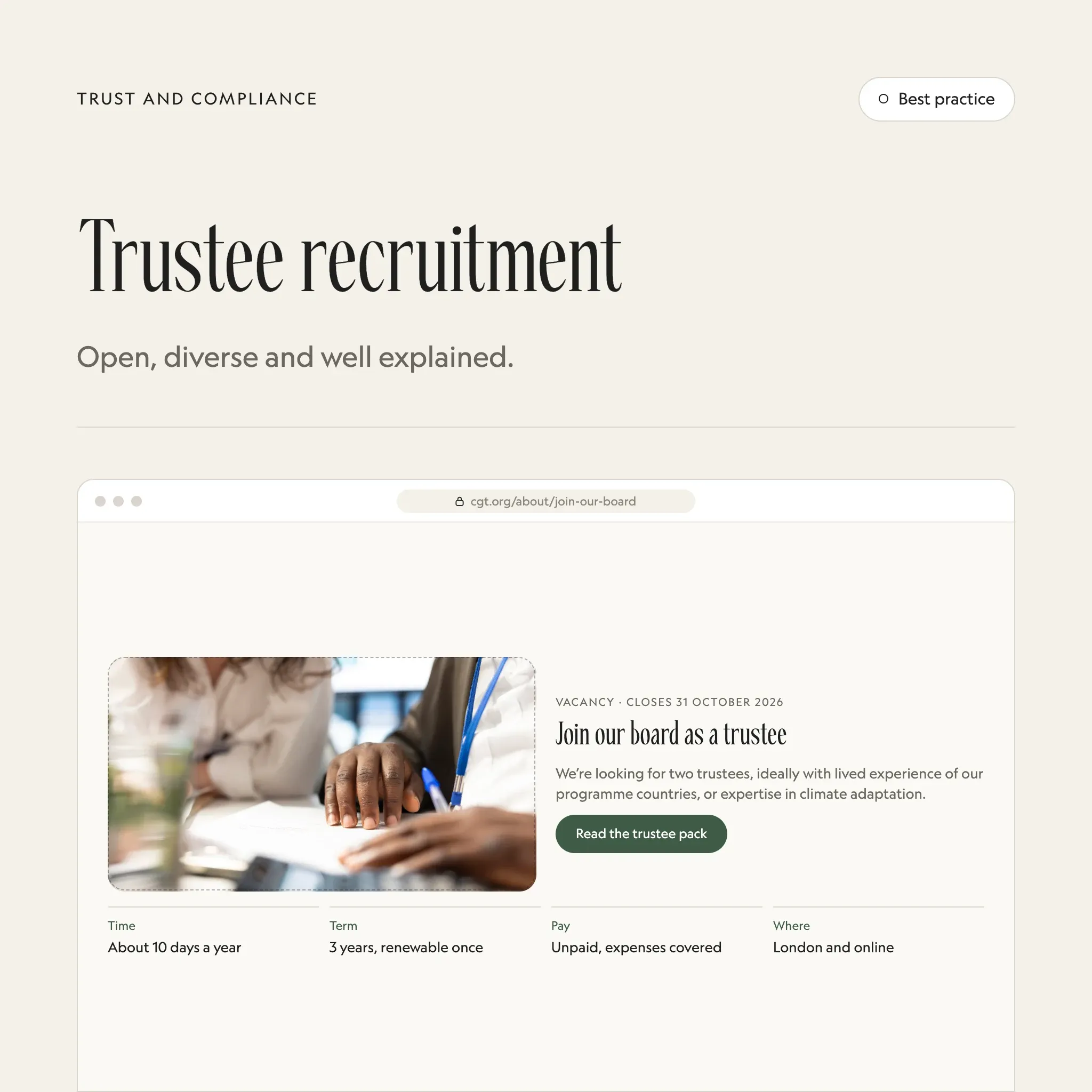
- What it is for
- Recruit trustees openly.
- What goes on it
- Current vacancies, the role, the time it takes, the skills you are looking for, and how to apply.
- Best practice
- No duty. The Code recommends a formal, transparent approach to recruiting trustees, including advertising vacancies.
- What it is for
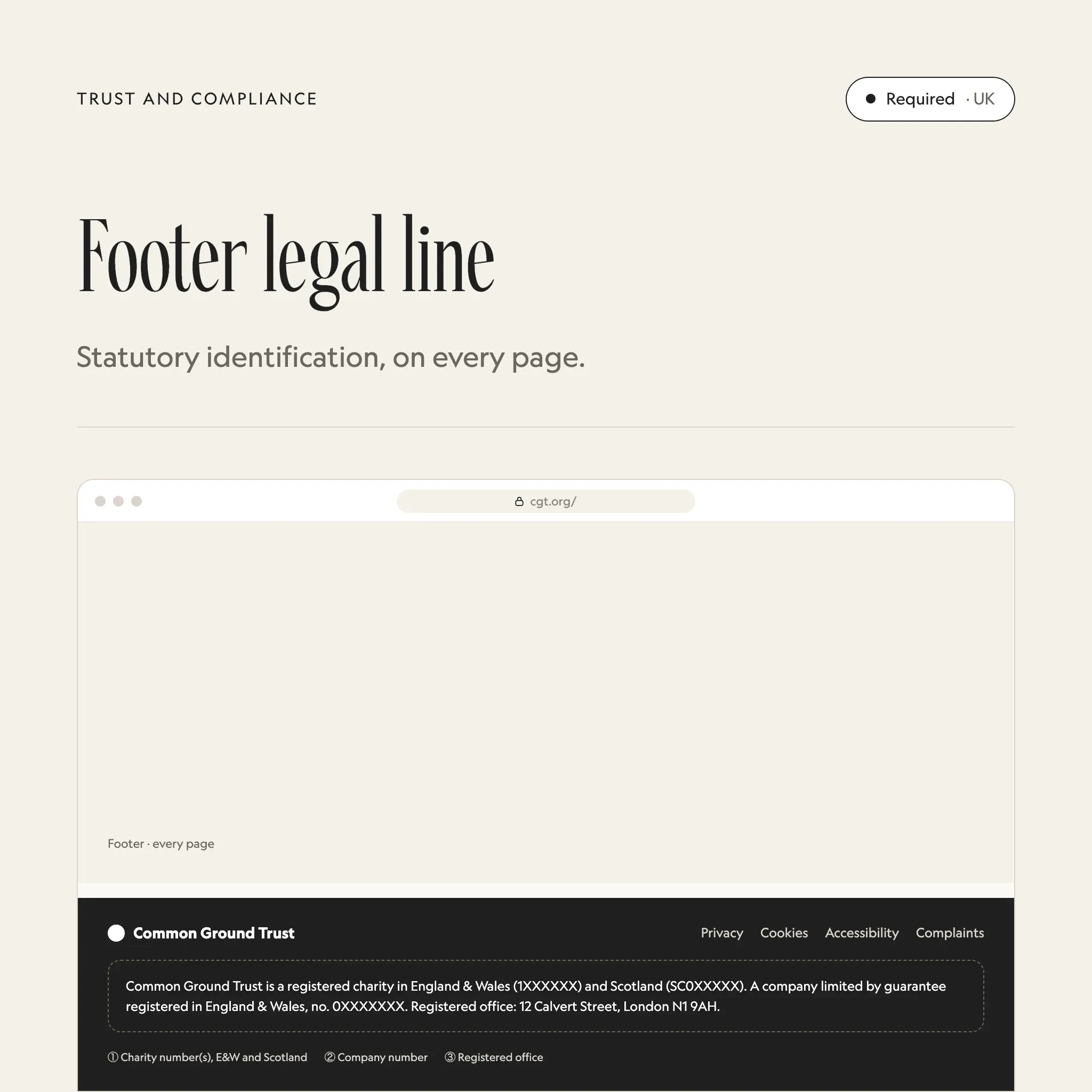
- Say who you are, legally.
- What goes on it
- Your registered name, charity number for each register you are on, company number, where the company is registered, and the registered office.
- Required: Charitable companies; charities on the Scottish register; registered charities in England and Wales with income over £10,000, on pages that ask for money
- Three separate rules. A charitable company must show its registered name, number, place of registration and registered office on its website. OSCR names the website home page as a place a Scottish charity must show its name, number and charity status. In England and Wales, section 39 requires the fact that you are a registered charity on anything soliciting money; it does not require the number or mention websites, but funders expect the number and there is no reason to leave it out.
- Sources
- Go further
- Charity Commission website requirements
- What it is for
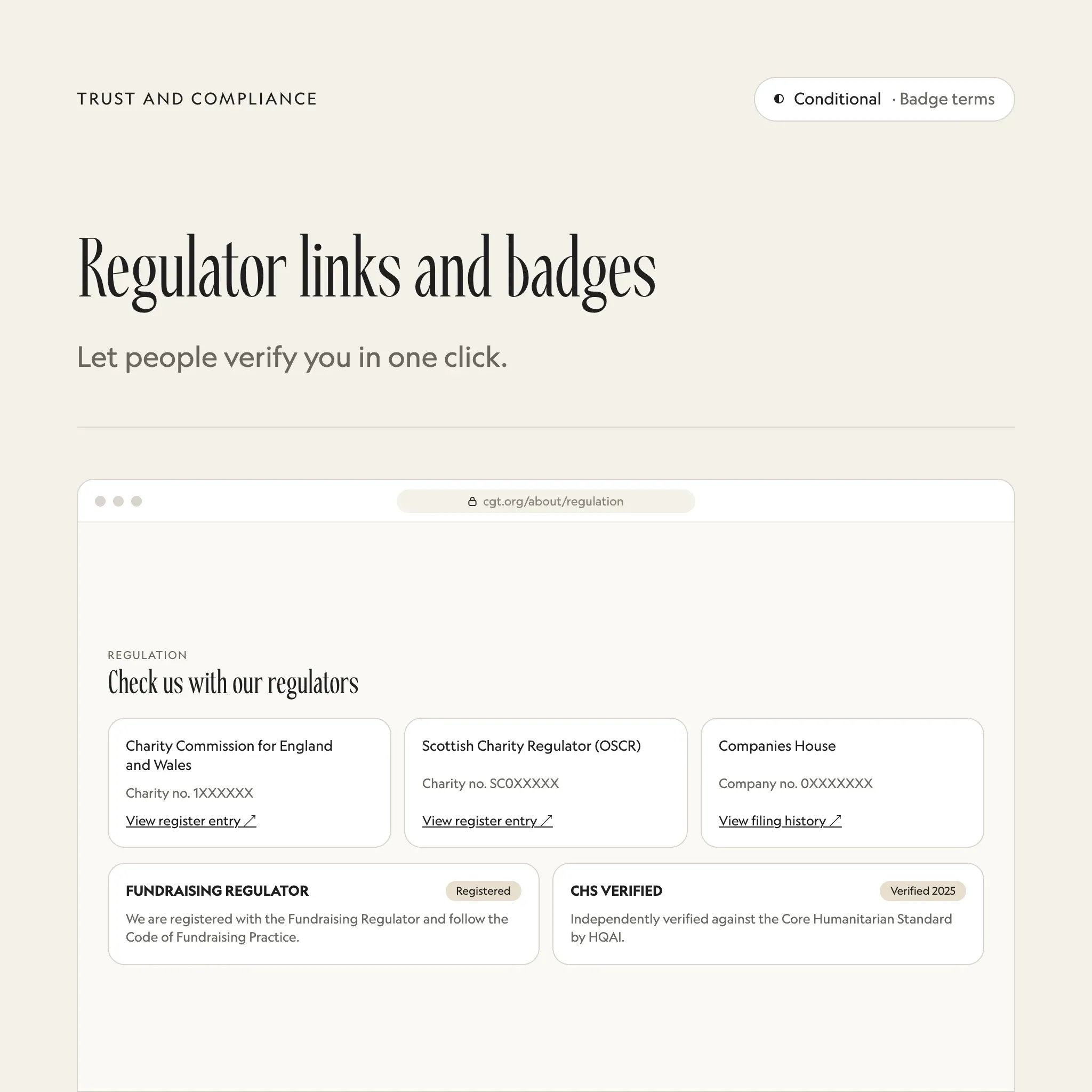
- Let people check you independently.
- What goes on it
- Links to your entry on each charity register, the Fundraising Badge if you are registered, and any certification you hold.
- Conditional: Organisations registered with the Fundraising Regulator (the badge); CHS-certified organisations (the claim)
- The Fundraising Regulator's badge guidelines require registered organisations to show the badge on fundraising materials, website donation pages included, as a condition of voluntary registration. A claim to meet the Core Humanitarian Standard needs independent verification. Linking to your register entry is best practice.
- What it is for
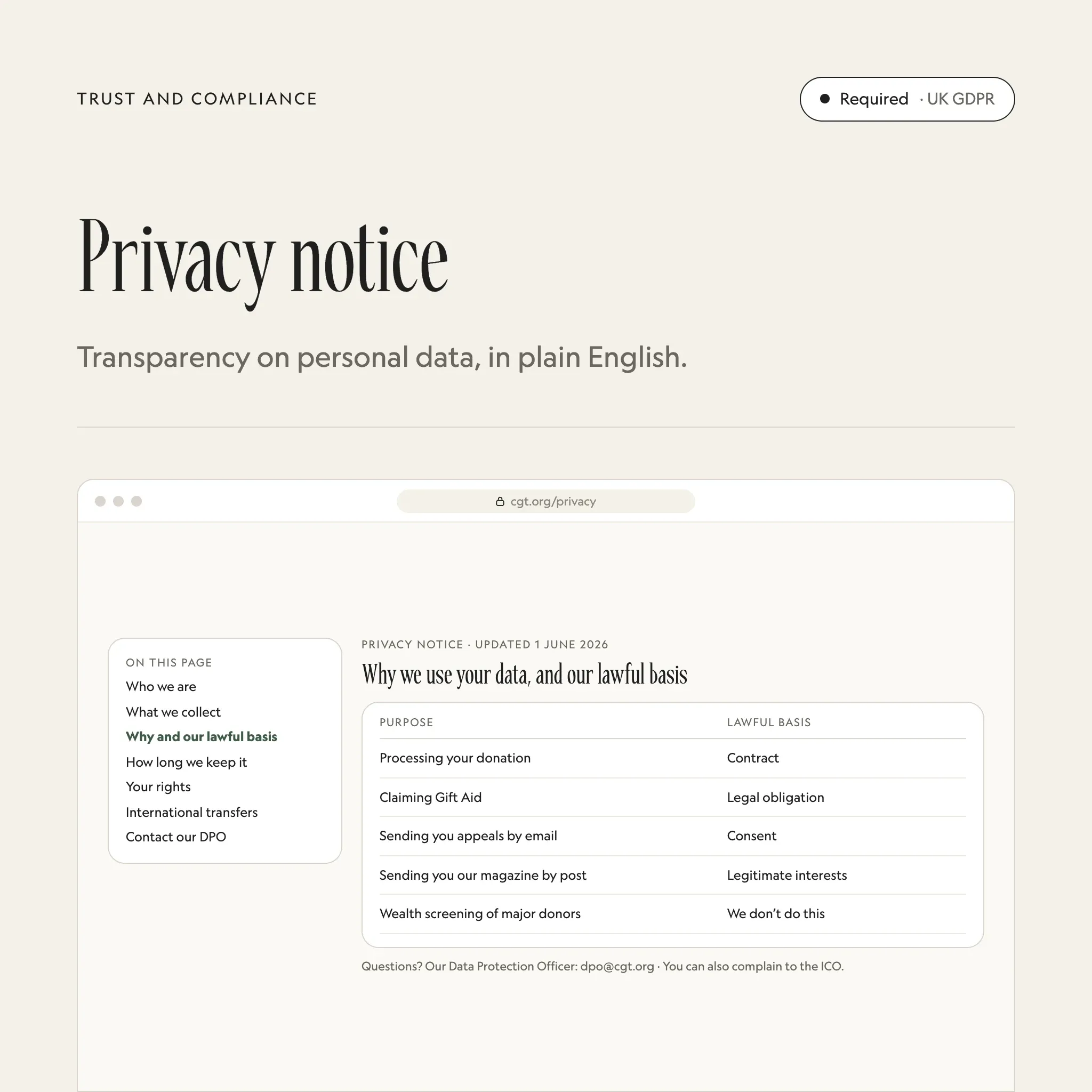
- Explain how you use personal data.
- What goes on it
- Who you are, why you use data and on what lawful basis, who receives it, transfers abroad, how long you keep it, and people's rights.
- Required: Any organisation collecting personal data (UK GDPR; EU GDPR where it applies)
- Article 13 of the UK GDPR requires this information when data is collected, and Article 14 when it comes from someone else. The law requires the information, not a page, but for a website the notice is how you provide it.
- Source
- Go further
- The GDPR checklist for a charity website
- What it is for
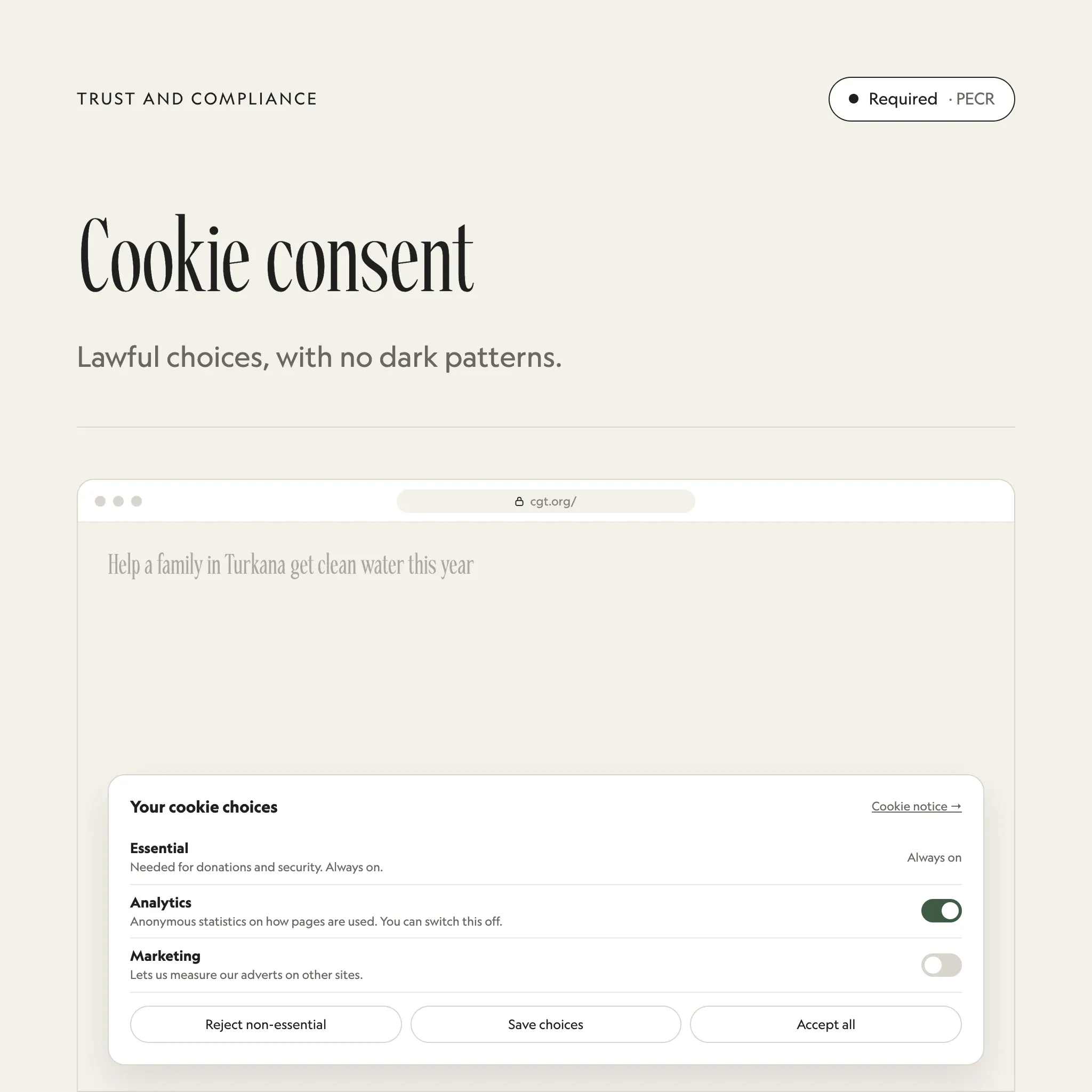
- Store and read cookies lawfully.
- What goes on it
- Consent for anything outside the exceptions, and clear information with a simple way to object for the analytics and preference cookies that no longer need consent.
- Required: Any UK website that stores or reads information on a visitor's device
- Since 5 February 2026 PECR has exceptions for analytics used to improve the site, remembering preferences, and emergency location. The analytics and preference exceptions still need clear information and a free way to object, and advertising still needs consent. Schedule A1 does not apply in the EU, where Article 5(3) of the ePrivacy Directive is applied country by country; some national authorities, such as France's CNIL, publish their own audience-measurement exemptions.
- Sources
- Go further
- Cookie consent on nonprofit websites
- What it is for
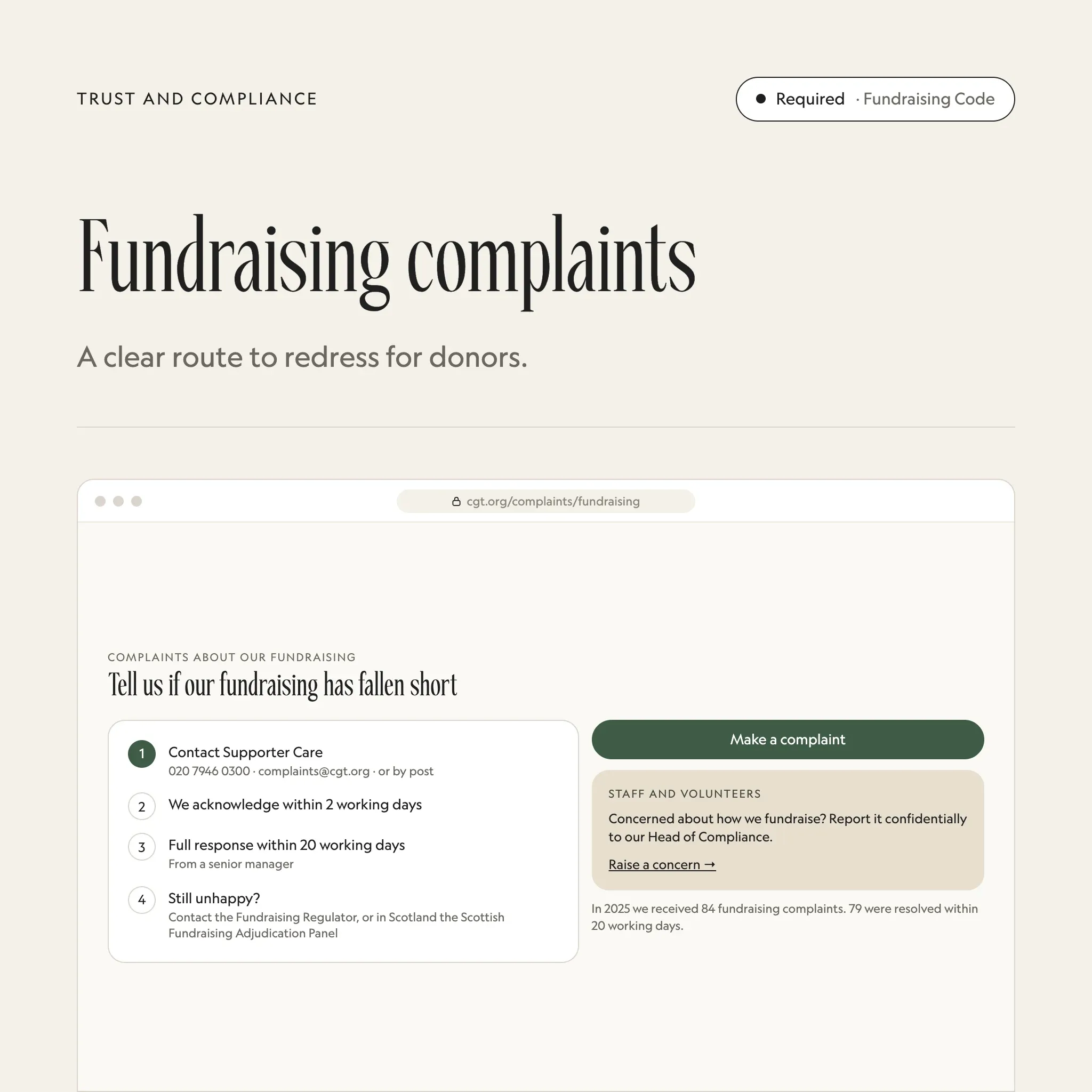
- Give donors a way to complain about your fundraising.
- What goes on it
- The steps and timescales, how to escalate to the Fundraising Regulator or, for Scottish charities, the Scottish Fundraising Adjudication Panel, and the route for staff and volunteers to raise concerns.
- Required: UK charities that fundraise (a binding regulatory code, not statute)
- The Code of Fundraising Practice, in force since 1 November 2025, requires a clear and publicly available fundraising complaints procedure (rule 2.3.1). The Regulator's FAQ allows it to be available on request or set out on your website; the website is the safe default.
- Go further
- Complaints and speak-up routes
- What it is for
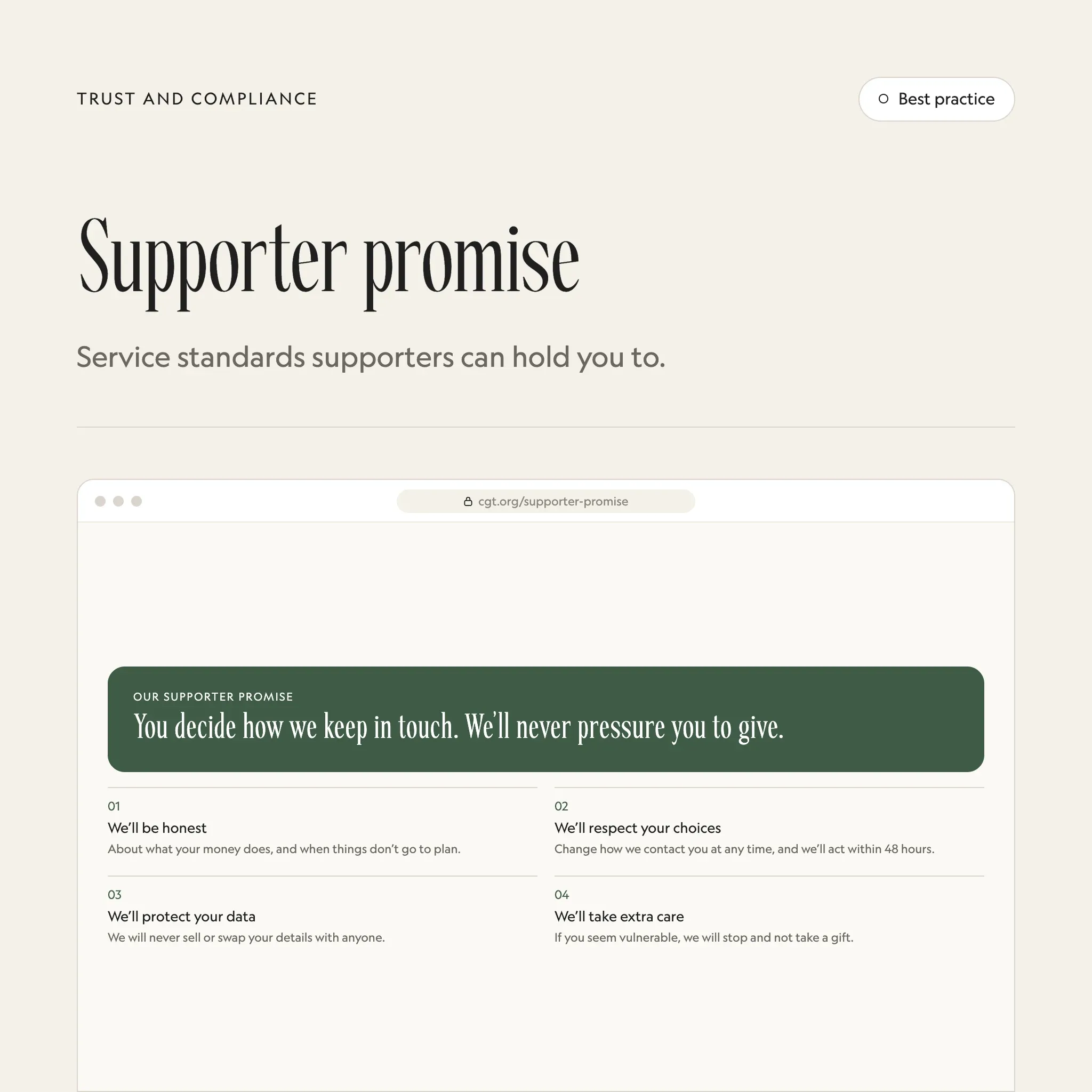
- Say how you will treat supporters.
- What goes on it
- Your commitments on contact, data, pressure and vulnerable people, and a link to contact preferences.
- Best practice
- No duty. A promise is only worth publishing if the fundraising team can keep it, so write it with them.
- What it is for
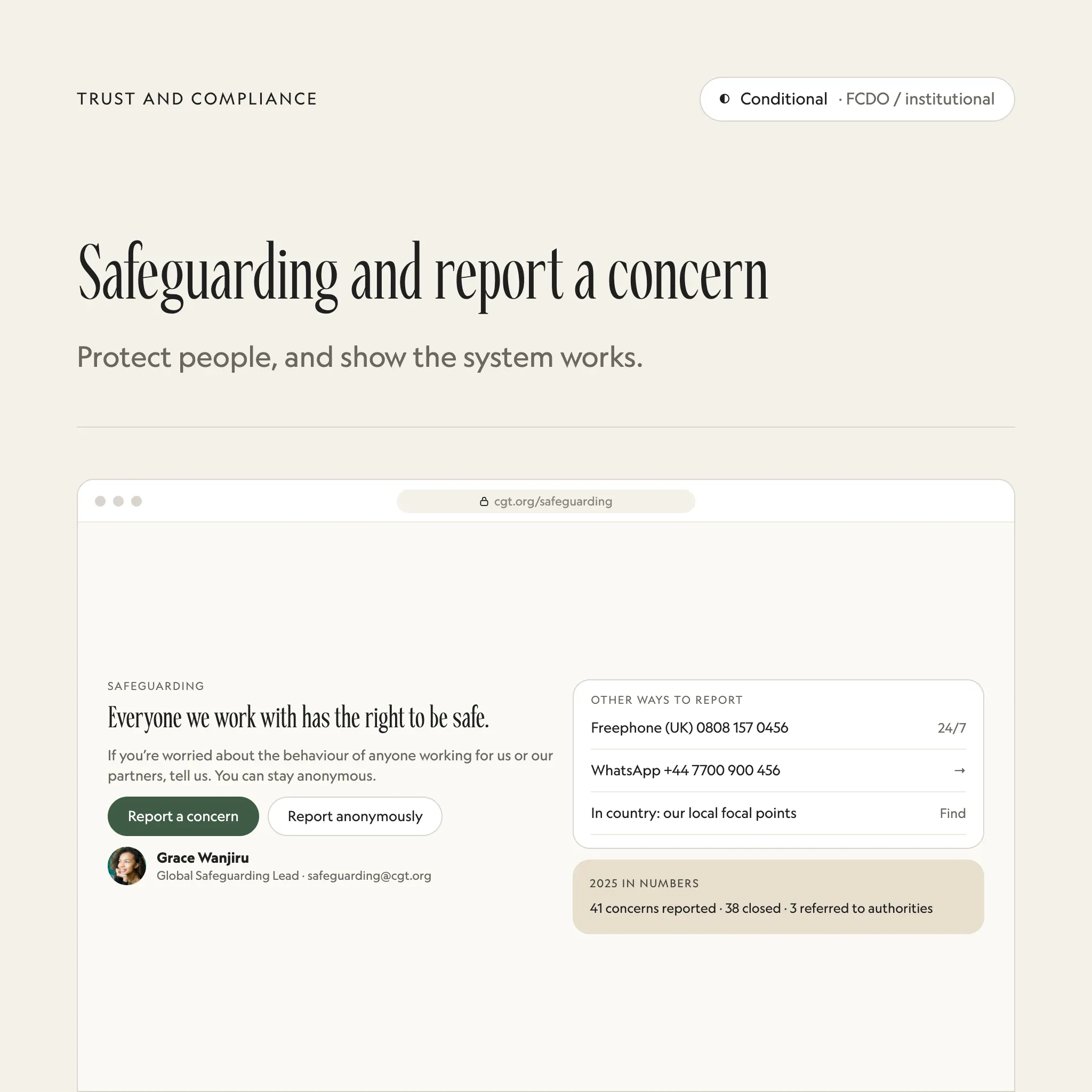
- Protect people, and show how you do it.
- What goes on it
- The policy, the safeguarding lead, a way to report a concern (anonymously if you can), external routes, and your standards for partners (section 49).
- Conditional: FCDO-funded partners. For everyone else, a firm regulator expectation
- FCDO's guidance expects funded partners to make their safeguarding policies known and to offer outsiders a confidential way to report. For every charity, the Charity Commission says trustees must take reasonable steps to protect people from harm and that safeguarding policies should be available to the public.
- Sources
- Go further
- Safeguarding pages and reporting a concern
- What it is for
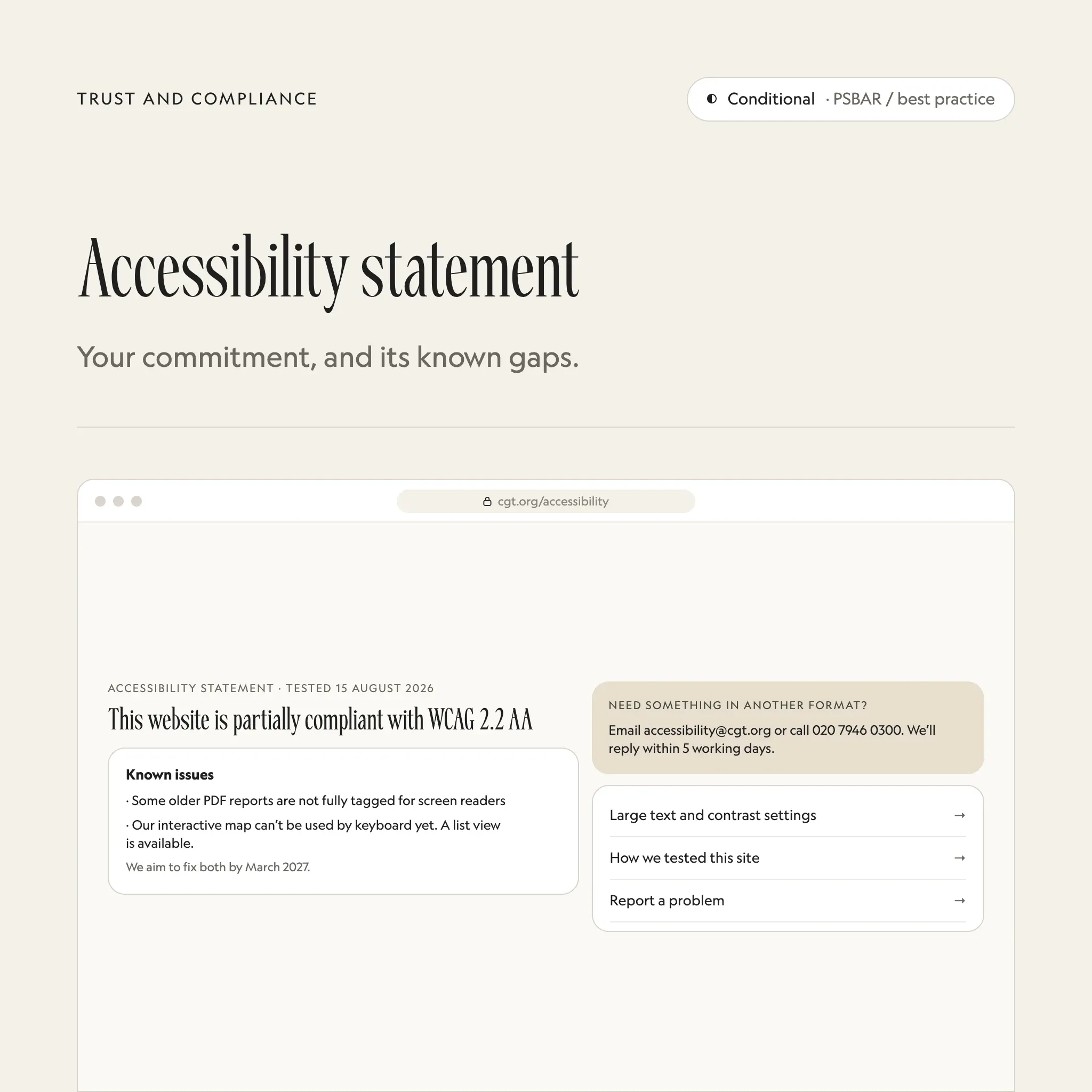
- State how accessible the site is, and what is not.
- What goes on it
- The standard you test against and your status, known issues, how to report a problem, and when you last reviewed it.
- Conditional: Charities mostly financed by public funding, or providing services essential to the public or aimed at disabled people
- The Public Sector Bodies Accessibility Regulations exclude most charities; GOV.UK lists those three triggers as the exceptions. Every service provider in Great Britain still owes disabled people reasonable adjustments, which a statement does not satisfy but does help you show.
- Sources
- Go further
- Accessibility statement template
- What it is for
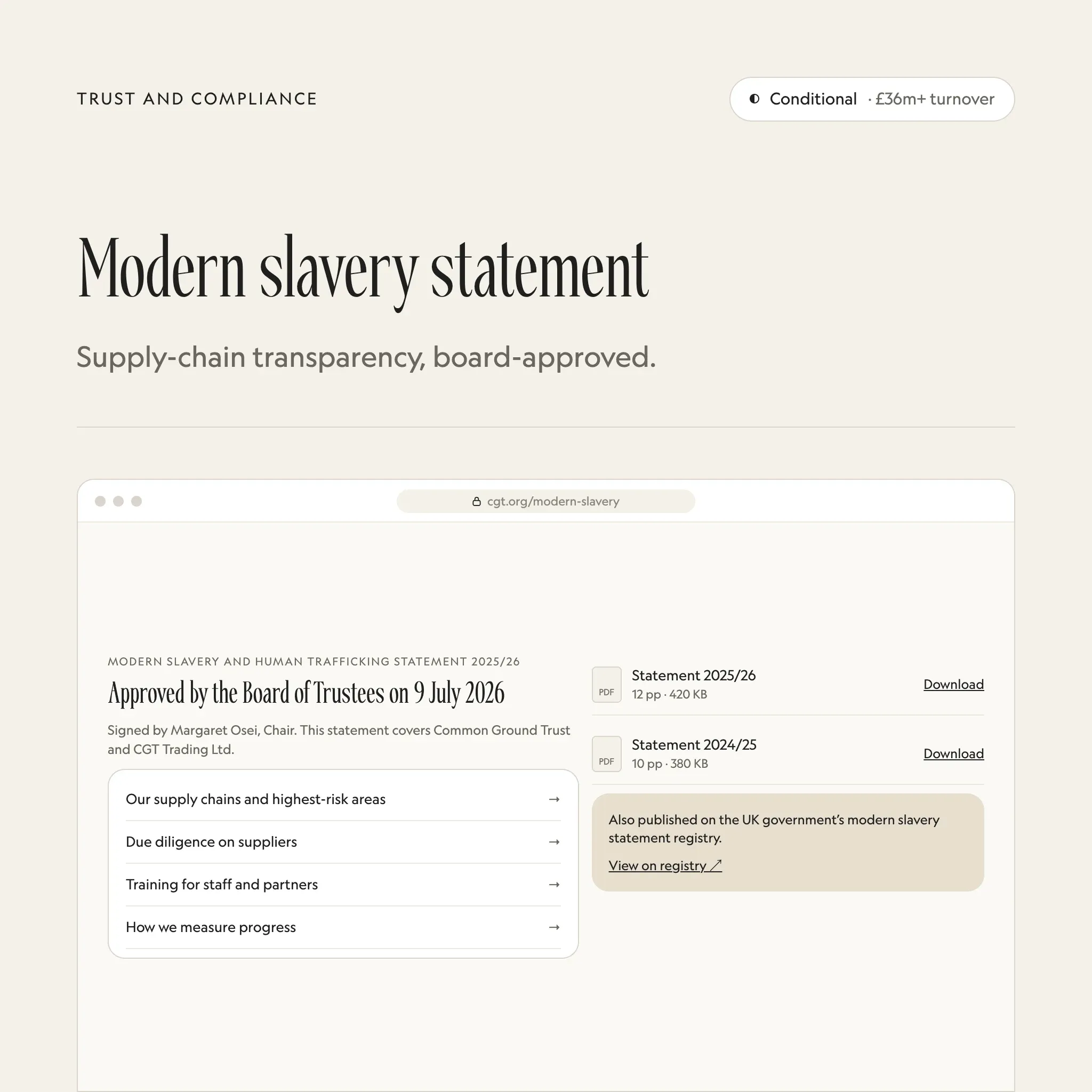
- Report on slavery risk in your supply chains.
- What goes on it
- The annual statement, approved by the board, with a link to it in a prominent place on the homepage.
- Conditional: Incorporated charities with £36m or more of turnover from business activities
- Section 54 of the Modern Slavery Act applies to a body corporate or partnership supplying goods or services with turnover of at least £36m, and a statement published on a website needs a link in a prominent place on the homepage. Home Office guidance says donations, legacies and grants where the donor gets nothing back generally do not count towards the threshold.
- Sources
- Go further
- Modern slavery and gender pay gap pages
- What it is for
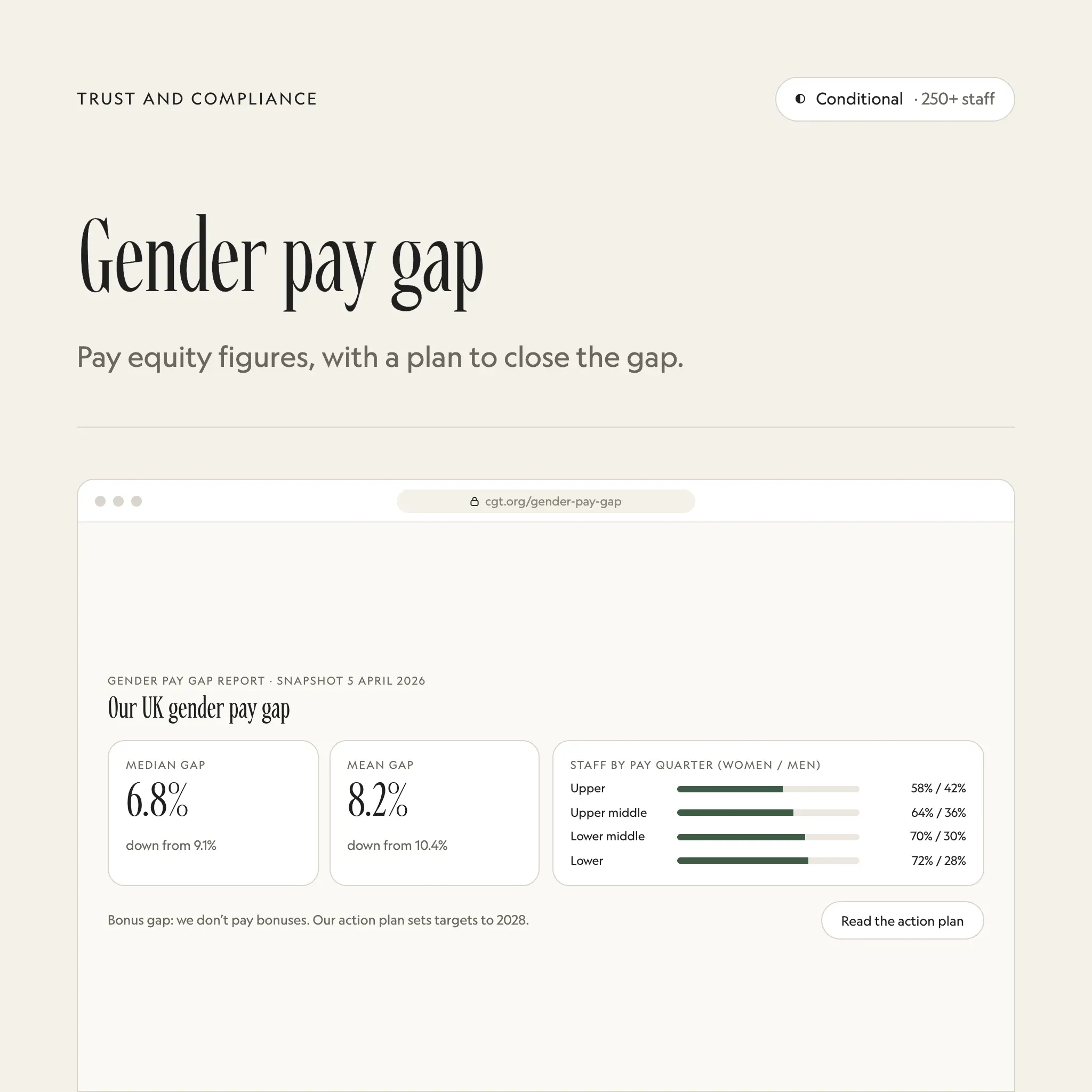
- Publish your pay gap figures.
- What goes on it
- The figures, a written statement, and any action plan.
- Conditional: Employers in Great Britain with 250 or more employees
- The 2017 regulations require the figures and statement on your own website for at least three years, as well as on the government service. Action plans are voluntary now; GOV.UK says that, subject to legislation, they become mandatory from spring 2027, and they are published on the government service.
- Sources
- Go further
- Modern slavery and gender pay gap pages
- What it is for
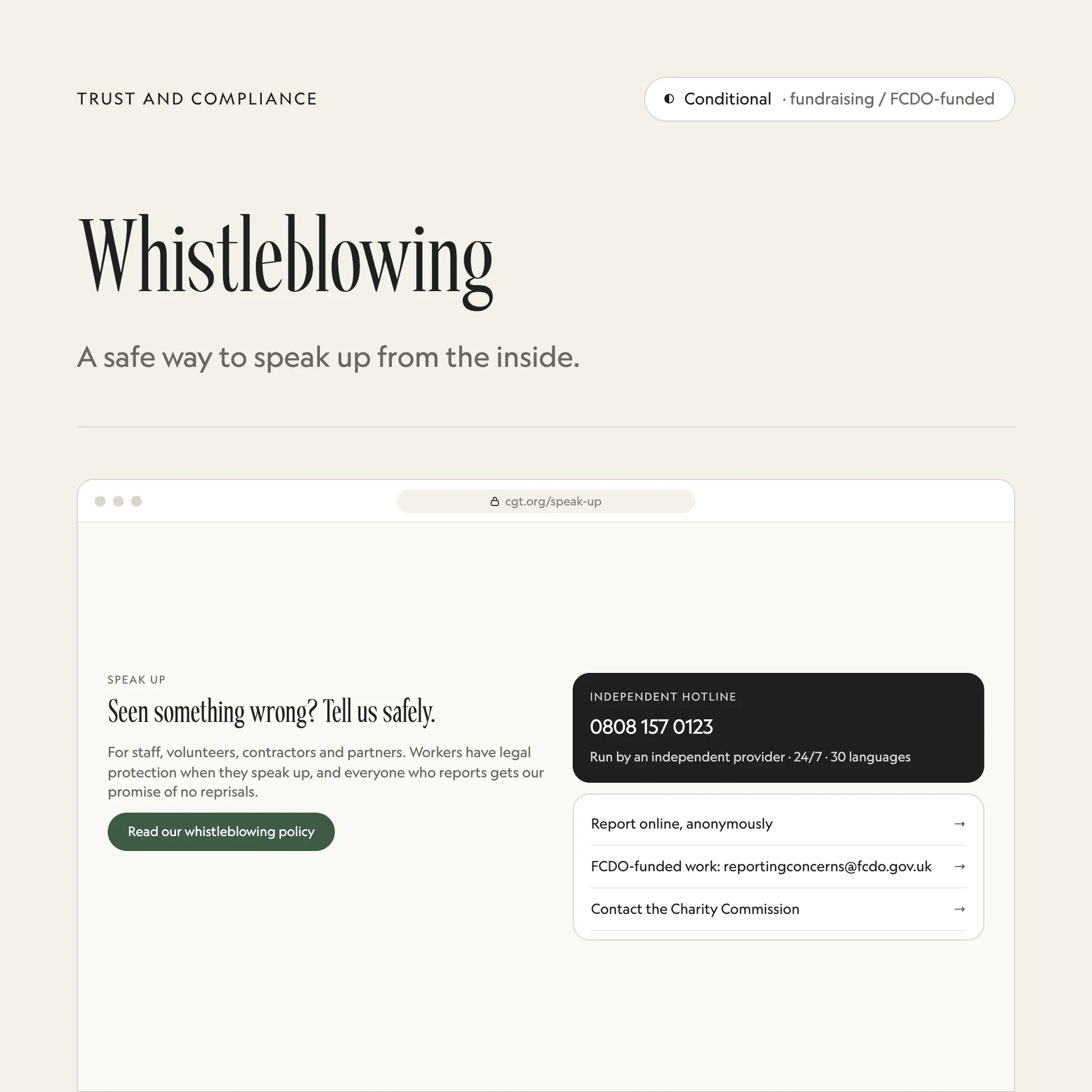
- Let people raise concerns without fear.
- What goes on it
- The whistleblowing policy, an independent route, the protections, and a separate route for staff, volunteers and partners.
- Conditional: Charities that fundraise (concerns about fundraising); FCDO-funded partners
- The Code of Fundraising Practice requires a published procedure for staff and volunteers to report concerns about fundraising practice (rule 2.3.3), not whistleblowing in general. FCDO expects funded partners to have a whistleblowing policy with no reprisals. Beyond those, it is best practice, and the Charity Governance Code expects published guidance on raising concerns.
- Sources
- Go further
- Complaints and speak-up routes
- What it is for
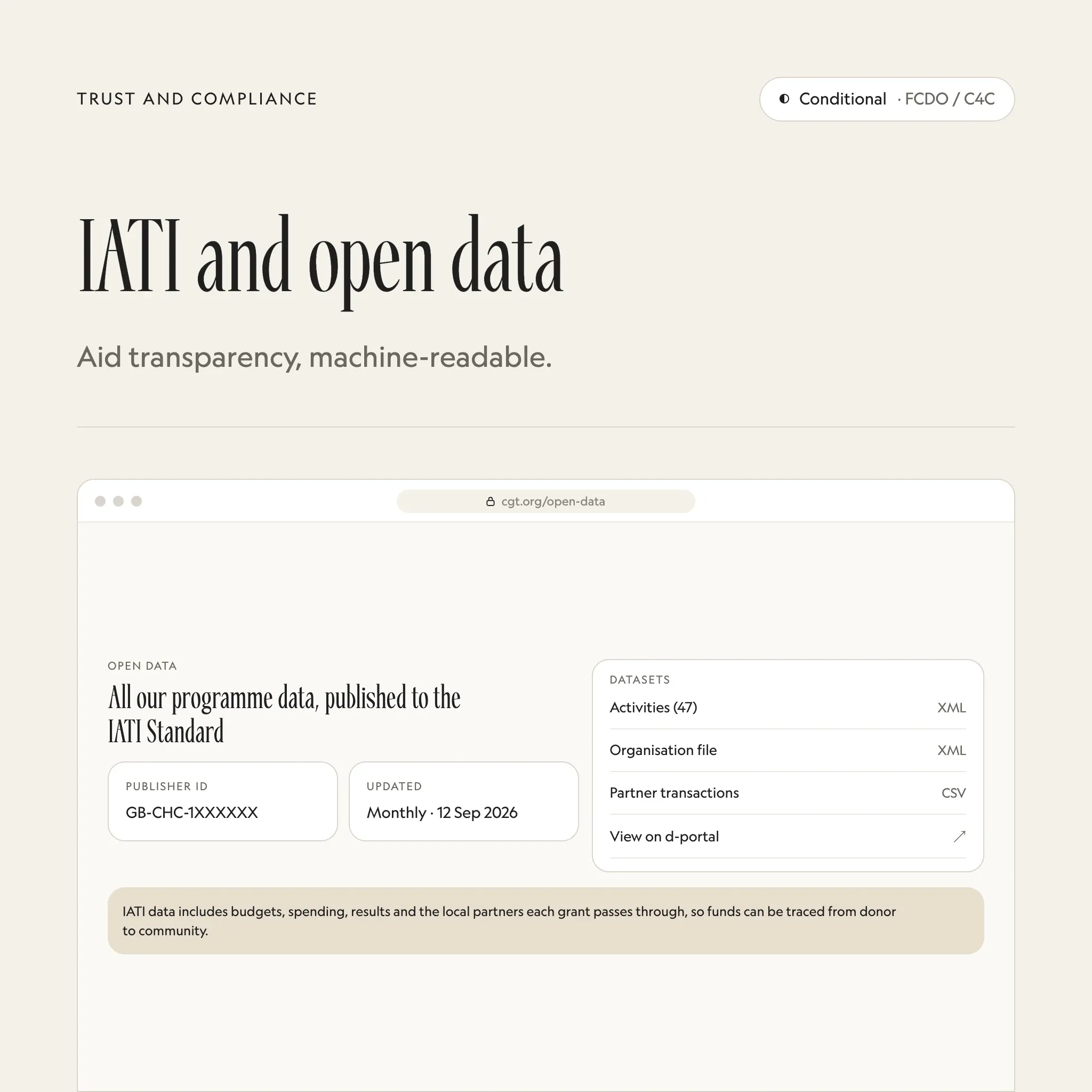
- Publish your aid data openly.
- What goes on it
- Your IATI organisation identifier, links to the data and a portal where people can read it, and how often it is updated.
- Conditional: Where your FCDO agreement requires IATI publishing
- FCDO mandates IATI publishing in most of its agreements and expects activity data to be updated at least quarterly. The data is published through IATI's own systems (the IATI Registry was replaced by IATI Account in December 2025); the page on your site is what makes it findable.
- Source
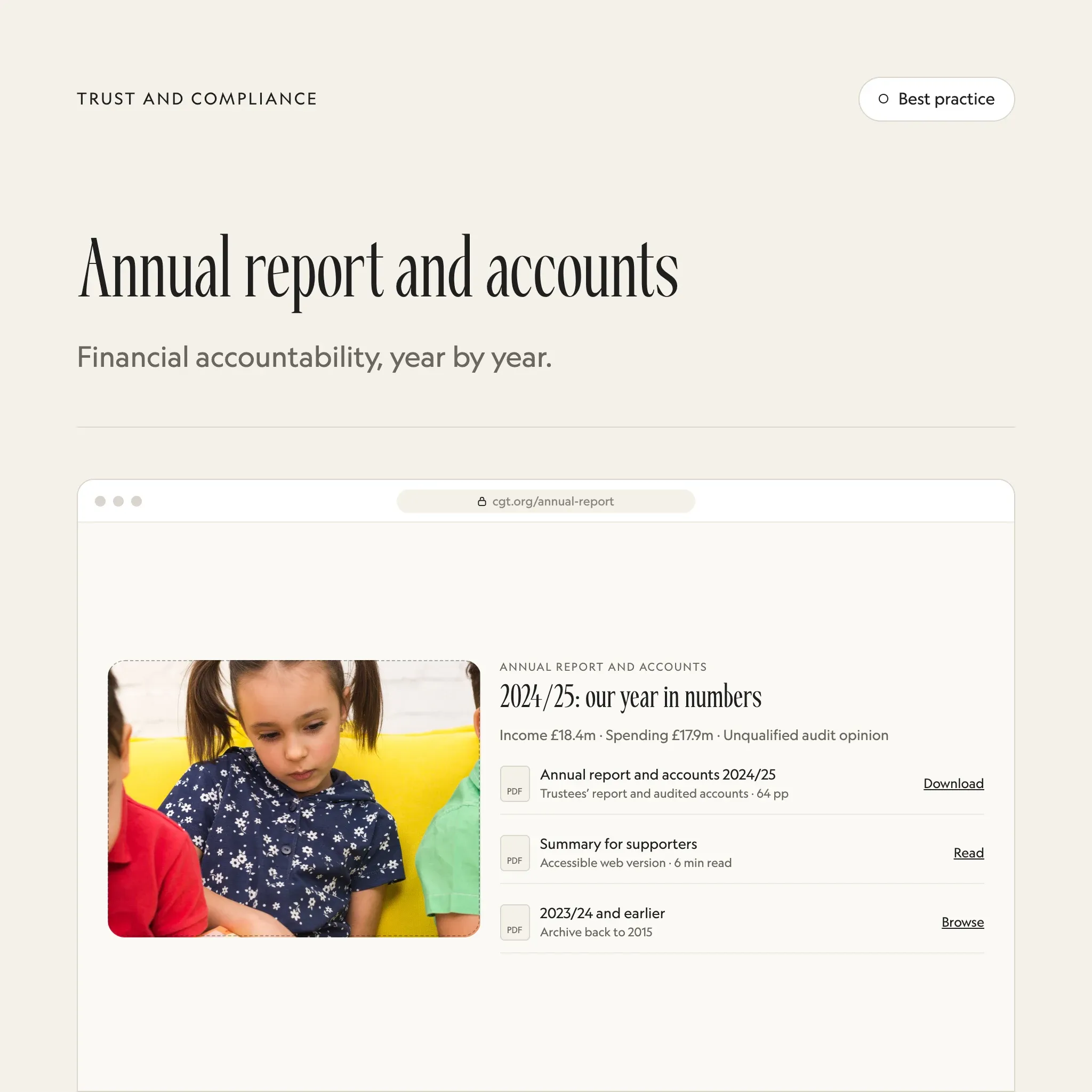
- What it is for
- Account for the money, year by year.
- What goes on it
- The latest and previous years' reports and accounts, and an accessible summary.
- Best practice
- No duty to publish them on your own site. Filing is required: in England and Wales with income over £25,000, and in Scotland, where OSCR has published every accounts document in full since 9 March 2026. Anyone can ask for your accounts in writing, and publishing them saves you the request.
- Sources
- Go further
- Publishing your annual report online
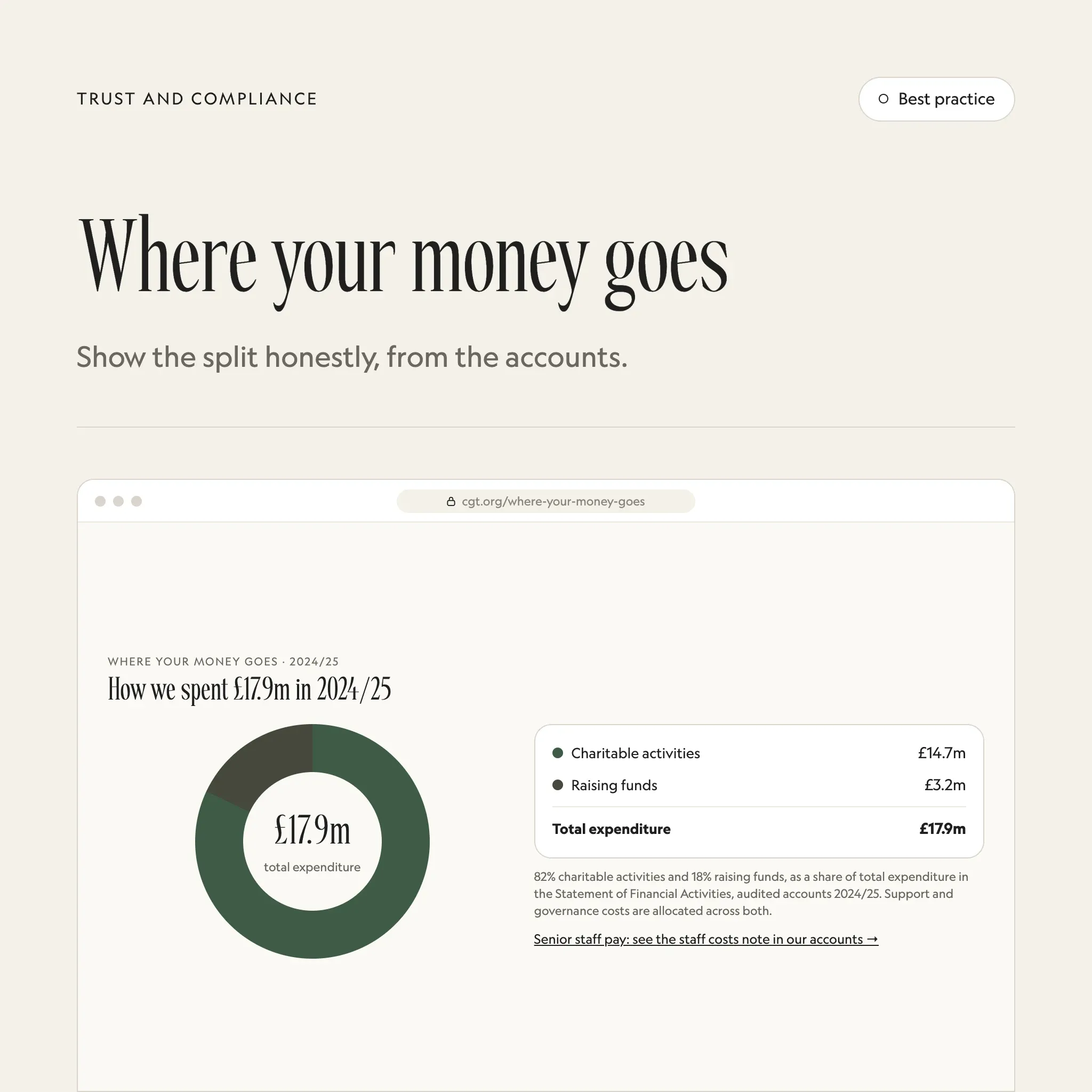
- What it is for
- Show what is spent on the cause.
- What goes on it
- What was spent on charitable activities and on raising funds, taken from the accounts the trustees signed, with the year, a link to the full accounts, and where senior pay is disclosed.
- Best practice
- No duty. It answers the public's first test: in the Charity Commission's 2026 research, most money going directly to the cause was the top driver of trust (55%), and focus groups asked for a simple breakdown and read high chief executive pay as a reason for suspicion.
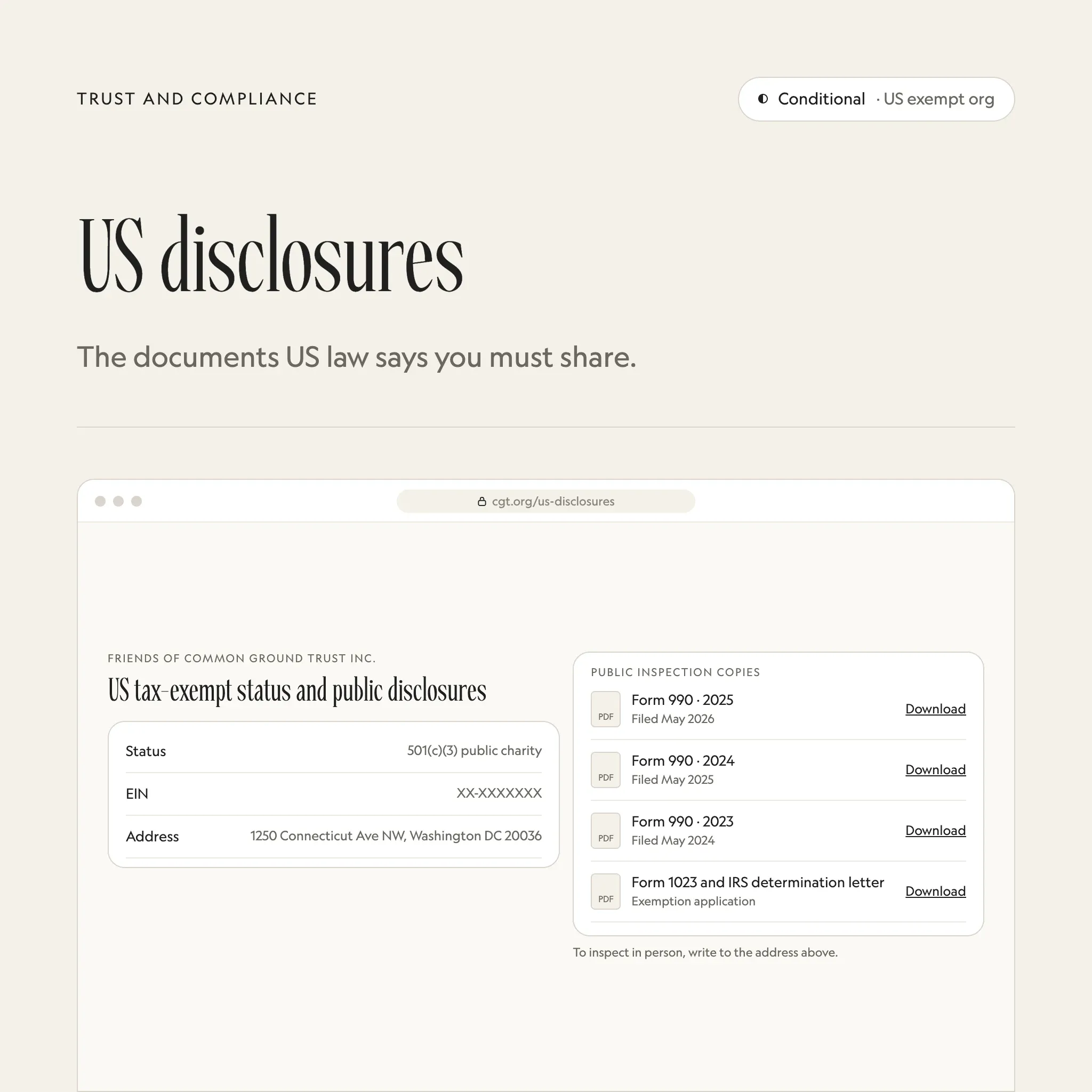
- What it is for
- Publish your US tax-exempt information.
- What goes on it
- The US entity's status and EIN, its last three Form 990 returns, its exemption application, and how to inspect them.
- Conditional: US tax-exempt organisations, such as a US 501(c)(3) affiliate
- The IRS requires a tax-exempt organisation to make its Form 990 available for three years from the due date, and its exemption application too. Posting them online removes the duty to send copies, though not in-person inspection.
- Go further
- What a US 501(c)(3) should show online
No section matches. Clear the search, or choose another status.
Two clicks. Three things.
Send the address of your website. Within two working days you get a short email naming the three things a funder would hold against it, including what AI assistants like ChatGPT and Google’s AI Overviews currently say about you. No report, no call, no follow-up unless you ask.
Received. Your three things arrive within two working days.
That did not send. Email hello@socialectric.com with your website address and I will reply from there.
Frequently asked questions
- Does the law require a charity to have all of these sections?
No. Seven are required by law or by a binding regulatory code, and they apply to almost every UK charity that fundraises and collects personal data. Twenty more become required only if a threshold or trigger applies to you, and the row says which. The other 63 are best practice. They are what each audience looks for, and the tag says only that nobody will fine you for leaving one out.
- Why is the charity number in the footer not tagged Required on its own?
Because the law is narrower than most trustees think. Section 39 of the Charities Act 2011 requires a registered charity in England and Wales with income over £10,000 to state that it is a registered charity on anything that solicits money. It does not require the number and does not mention websites. The footer line is tagged Required because a charitable company must show its registered details on its website and a Scottish charity must show its name, number and status on its home page. The detail is in what UK charities must publish.
- Does this checklist apply outside England and Wales?
It is written UK-first. Scottish rules are included where they differ, and EU and US rules are flagged where they apply to an NGO with staff, donors or an entity there. Northern Ireland's charity rules were not checked for this page, so a charity registered there should confirm its own position with the Charity Commission for Northern Ireland.
- Is this legal advice?
No. Each tag summarises the law, code or guidance linked beside it as it stood on 30 September 2026. An organisation with entities in several countries, or one near a threshold, should confirm its obligations with its own advisers. What the page does is tell you which questions to take to them.
- Where should we start?
With the seven Required rows, because a gap there is visible to a regulator, a funder and a journalist at the same time. Then read the triggers on the Conditional rows and mark the ones that apply to you. Then choose the audience that funds most of your work and check its sections against your own site. If you want someone to read your site the way a funder reads it, that is what the Blueprint Audit does.